
Under Fire and in the Process of Reconstruction: A Conversation Among Four on Why Ukraine's Recovery is a Strategic Opportunity for America

February 2026
During Ukraine Week in Washington (February 1–7, 2026), something changed in how the American capital talks about Ukraine's recovery. The conversation moved beyond solidarity to specifics: project portfolios, energy equipment, tax statistics, the economy of electoral districts.
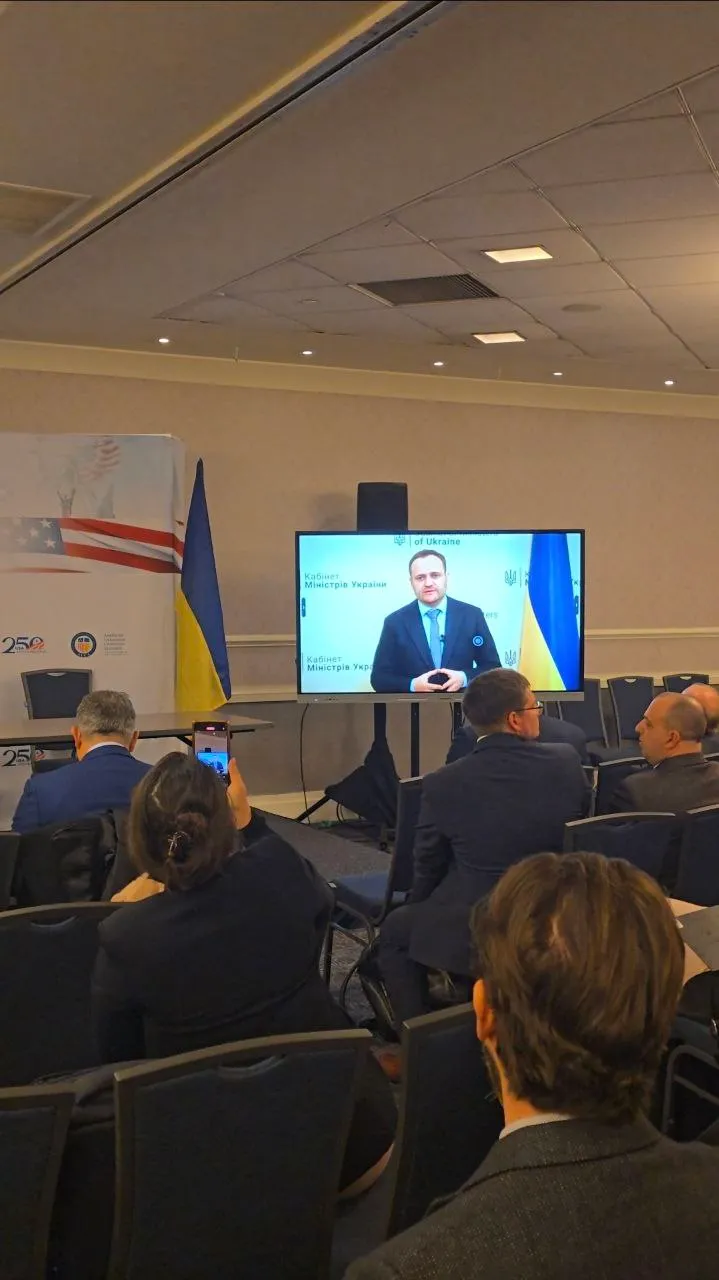
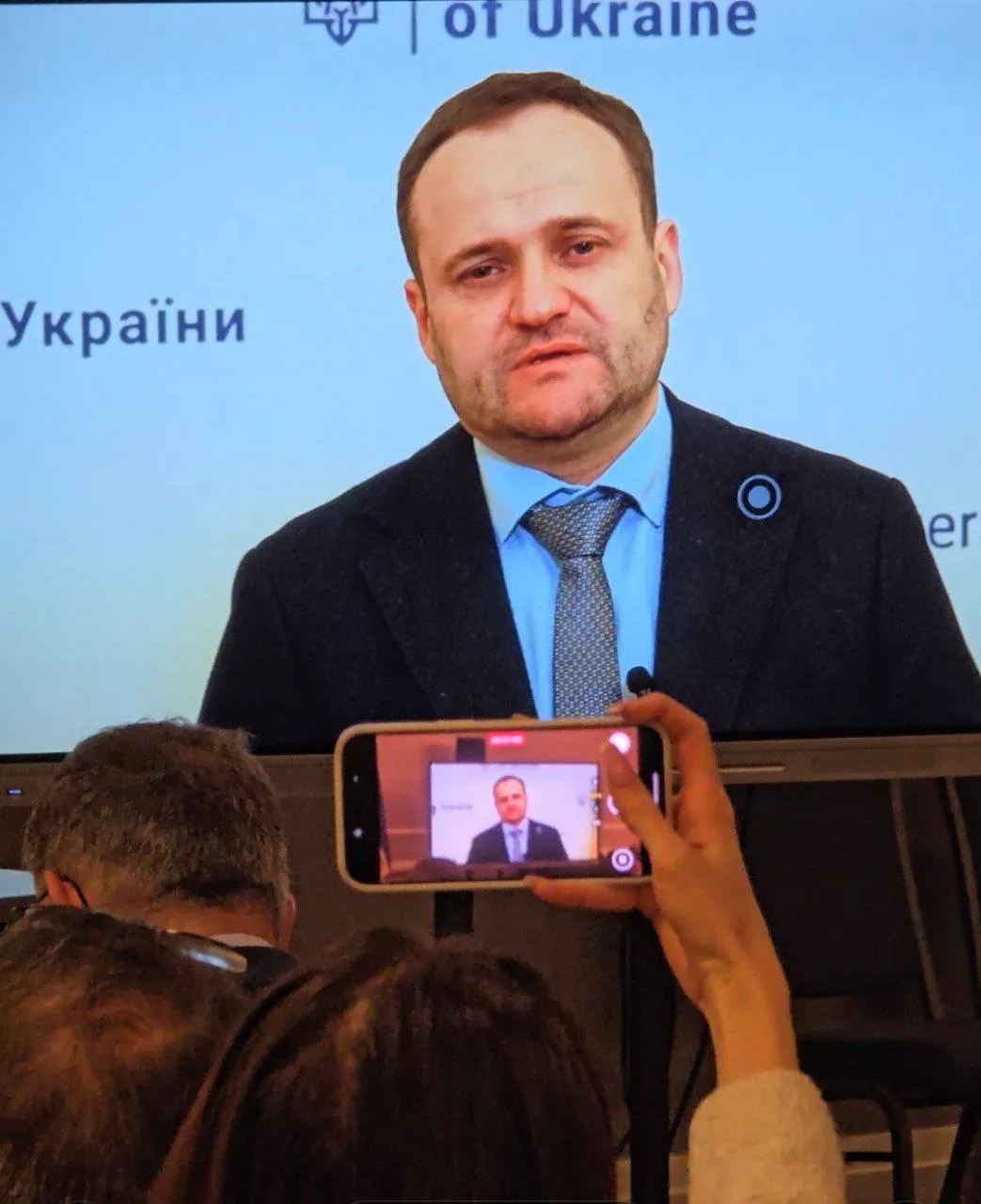
One of the central participants of the week could not attend in person. Oleksiy Kuleba, Vice Prime Minister of Ukraine for Reconstruction and Minister of Community and Territorial Development, joined remotely from Kyiv. Not for symbolism, but because he was managing emergency operations in the energy sector following another massive Russian strike on the Ukrainian power grid. His physical presence in the country was critically necessary.
Meanwhile, in Washington, Oleksandr Romanyshyn, an advisor on international affairs at the State Agency for Reconstruction and Infrastructure Development of Ukraine, coordinated interactions with Congress and federal structures and presented the national recovery framework UR³.
Olena Malitska, director of ISE Group — an international analytical center and corporate accelerator, presented a new study that for the first time quantitatively assesses the economic footprint of Ukrainian-American business in all 50 U.S. states. The second edition of this study is currently being developed in partnership with Nova Ukraine, expanding the public reach of this project and strengthening its role as a bridge between diaspora businesses and long-term economic cooperation between the U.S. and Ukraine.
Eva Sigaev, president of the Ukrainian-American Chamber of Commerce and Industry (UACCI) — mobilized diaspora business networks and established partnerships at the state level.
All four agreed to a joint interview to answer a question increasingly heard in Washington — in congressional offices, governor's offices, investment companies, and among defense contractors:
What does the reconstruction of Ukraine really mean for America?
I. War and Reconstruction — Simultaneously
Journalist: Mr. Kuleba, you joined Ukraine Week remotely rather than coming to Washington. Why was it important for you to stay in Ukraine — and at the same time participate in this discussion?
Oleksiy Kuleba: Because both duties are equally critical — and neither can be postponed.
My main priority now is managing emergency operations in the energy sector. We are in a state of constant crisis coordination: restoring heat, maintaining water supply systems, stabilizing municipal infrastructure under direct strikes. This work requires physical presence and daily team communication with regional and municipal authorities across the country.
Let me convey the scale. On the night of February 3, Russia launched a combined strike — 61 missiles and 450 strike drones, most of which were Shahed-type UAVs. This happened in extreme cold conditions: minus twenty degrees. The consequences were devastating — over 2,000 multi-story residential buildings in Kyiv and Kharkiv were left without heating.
This is not a line in a briefing. This is a city waking up in winter without heat. These are elderly people in high-rises, families with children, hospitals — all suddenly switched to emergency mode.
Our energy workers are operating at the absolute limit of their capabilities, restoring systems under fire. And they manage — but each new strike sets us back again.
And yet, even after ten or more hours of daily emergency coordination, we find the time and determination to advance the recovery agenda. Because if we pause reconstruction until the end of the war, we will lose not just buildings. We will lose communities. We will lose economic activity. We will lose institutional momentum. And the cost of reconstruction will multiply.
That's why I chose to participate remotely in Ukraine Week — because this platform is not ceremonial. It's one of the few opportunities to align the positions of American representatives, city and state-level partners, funds, and businesses around a practical recovery agenda that can be implemented now. And I couldn't afford to lose this alignment just because I had to be in Kyiv.
First of all, I want to sincerely thank all the organizers and American partners who made Ukraine Week possible: ISE Group, the Ukrainian-American Chamber of Commerce and Industry, members of Congress, federal agencies — and especially religious and philanthropic organizations that demonstrated exceptional leadership.
American philanthropy has had a real, measurable impact. Organizations like Samaritan’s Purse, the Slayton Foundation, the JEM Foundation, and many others do not just issue press releases — they deliver equipment that warms families and supports infrastructure operations. I know that Ken Isaacs, Vice President of Programs and Government Relations at Samaritan’s Purse, was present at Ukraine Week, and I want to express special gratitude for his personal involvement and the organization's ongoing support. Such leadership inspires us.
Journalist: What is the current state of Ukraine's energy resilience — and what specifically are you asking of American partners?
Kuleba: The main lesson of the last two winters is this: centralized infrastructure becomes a target. When Russia can disable one power plant and leave an entire district without heat, the system's architecture itself becomes a vulnerability.
Therefore, decentralized energy is no longer just a modernization aspiration. It is a survival doctrine.
Today, decentralized energy systems literally save lives. Thanks to significant support from the United States and American organizations, communities have received over 700 units of cogeneration equipment, backup generators, boilers, and mobile power stations in recent weeks. This is specific equipment that supports hospitals, water pumps, heating nodes, and emergency shelters.
But one-time deliveries are not a system. We need structural resilience.
That's why we are creating the National Reserve of Mobile Energy Equipment — a strategic operational reserve that can be quickly deployed to any community after an infrastructure strike. Its specific task is to prevent the collapse of water and heating systems during repairs and to keep them from freezing in winter.
For American partners — equipment manufacturers, logistics companies, energy firms — the practical takeaway is this: Ukraine needs standardized, rapidly deployable energy packages tied to municipal capacities. This is not a request for aid — this is a formed procurement direction.
Journalist: Many American politicians ask: why rebuild now? Why not wait for stability?
Kuleba: Because waiting creates a second crisis on top of the first.
If buildings remain destroyed, if heating is unreliable, if schools cannot function properly — communities cannot stabilize. People leave. Economic activity collapses. Municipal budgets are depleted. And recovery becomes not only more expensive but also politically fragile.
That's why our priorities are continuous, not postponed.
We are restoring the housing sector through compensation mechanisms and affordable programs for repairing damaged buildings. We maintain transport corridors — roads, railways, ports, as they are the backbone of internal connectivity, military logistics, export routes, and evacuation capabilities. Together with donors and partners, we ensure the stability of critical transport infrastructure. Ukrainian ports are at the heart of President Zelensky's "Grain from Ukraine" initiative, which supports global food security through our infrastructure. We are implementing a large portfolio of municipal infrastructure projects — in water supply, utilities, civil protection facilities, and energy-efficient modernization. We urgently need resources to restore bridges, utility networks, and shelters — especially in the ten regions that have suffered the most destruction.
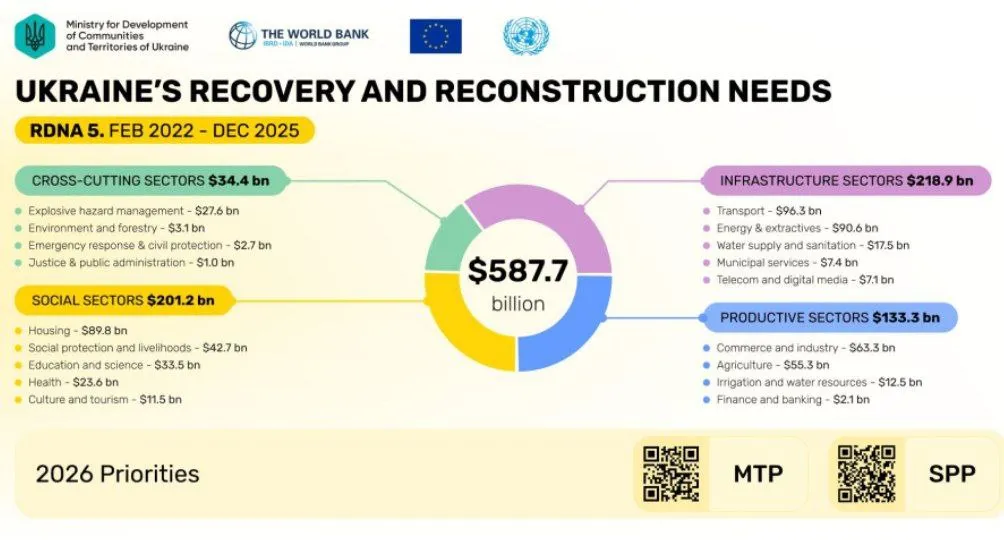
In February, we presented the RDNA5 damage assessment, prepared jointly with the World Bank, the European Union, and the UN. It is already clear: the scale of destruction is unprecedented. That's why it's so important not to abandon long-term priorities and continue reconstruction in all sectors.
Reconstruction is not planning for the future. It's stabilization today. And stabilization benefits not only Ukraine but also global economic systems, including the United States.
II. Partnership Architecture: UR³, Regions, and Capitol Hill
Journalist: Mr. Romanyshyn, during Ukraine Week, you presented the UR³ framework as the operational backbone of reconstruction. What problem does it solve — specifically for an American governor, city mayor, or private investor who wants to participate?
Oleksandr Romanyshyn: The problem is fragmentation. When it comes to reconstruction on such a scale — hundreds of billions of dollars in damages, dozens of sectors, 25 regions, thousands of municipalities — there is a risk that each partner encounters different doors, different sets of rules, and different engagement logic. This deters participation, especially private capital, which needs predictability.
UR³ — Recovery, Reconstruction, Rebuilding — is designed to address this problem.
It is an operational coordination framework that integrates the central government, regional authorities, municipalities, international donors, and the private sector into a single system. The goal is to create a clear, structured entry point for partners: predictable engagement rules, understandable project portfolios, and participation mechanisms that are business-friendly and feasible at the community level.
If you are a U.S. governor, you should be able to see which region of Ukraine matches your state's industrial profile. If you are a construction company, you should know which infrastructure projects are underway, at what stage they are, and under what procurement rules they are implemented. If you are a private equity fund, you should understand what tools are available: grants, PPPs, blended finance, co-investment — and where exactly they are applied.
This is what UR³ is designed to provide.
Journalist: The sister city agreement between Tulsa and Sumy became a landmark event of Ukraine Week. Why does municipal partnership matter in a reconstruction measured in hundreds of billions?
Romanyshyn: Because implementation happens at the local level, and trust is built between people, not abstractions.
The sister city agreement between Sumy and Tulsa, signed during Ukraine Week, creates an institutional foundation for long-term cooperation — focusing on municipal development, infrastructure recovery, economic interaction, and exchange of management practices. Ukrainian regional representatives, including Serhiy Dmytrenko, Director of the Department of Municipal Property of Sumy City Council, and representatives of the Sumy Regional Administration, are directly involved in this process.
This is not a symbolic gesture. This is a scalable model. State — with region. City — with community. This is how modern recovery works. This is how trust is built. This is how investments are attracted. As Vice Prime Minister Kuleba noted during Ukraine Week, we urge replicating this model across the United States and Ukraine.
And it benefits the American side too, as U.S. cities and states can justify their participation with specific results: experience exchange, supplier networks, procurement opportunities, management modernization projects. This turns "supporting recovery" into something a mayor or governor can present to their constituents.
Ukrainian regional leaders reinforced this message in Washington. Mykola Lukashuk, head of the Dnipropetrovsk Regional Council, emphasized that Ukrainian regions operate in a partnership logic — with a clear focus on joint projects, shared responsibility, and long-term results. It is at the regional level that recovery turns into specific decisions and their implementation.

Journalist: During Ukraine Week, you spent significant time on Capitol Hill. What has changed in conversations with members of Congress?
Romanyshyn: The most important shift is the transition from a narrative focused solely on security to one of economic partnership.
For too long, Ukraine has been discussed on Capitol Hill primarily in geopolitical and defense terms. This is an important frame — but it's incomplete. It doesn't answer the question every member of Congress hears from their constituents: what does this mean for my district?
We brought data to answer this question.
Through the "Economic Impact Study of Ukrainian-American Business," conducted by ISE Group in partnership with UACCI, we demonstrated: companies founded by Ukrainians in the U.S. generate about $55–58 billion in annual revenue, support approximately 300,000 American jobs, pay about $24 billion in wages annually, and contribute approximately $8–9 billion in federal, state, and local taxes each year.
These companies operate in all 50 states. They cover technology, manufacturing, retail, construction, logistics, professional services. They are not concentrated on the coasts — this is truly a nationwide economic network.
When you walk into a congressman's office and show that companies founded by Ukrainians in his district create local jobs and pay local taxes, the conversation fundamentally changes. Ukraine stops being a matter of foreign policy. It becomes a domestic economic reality.
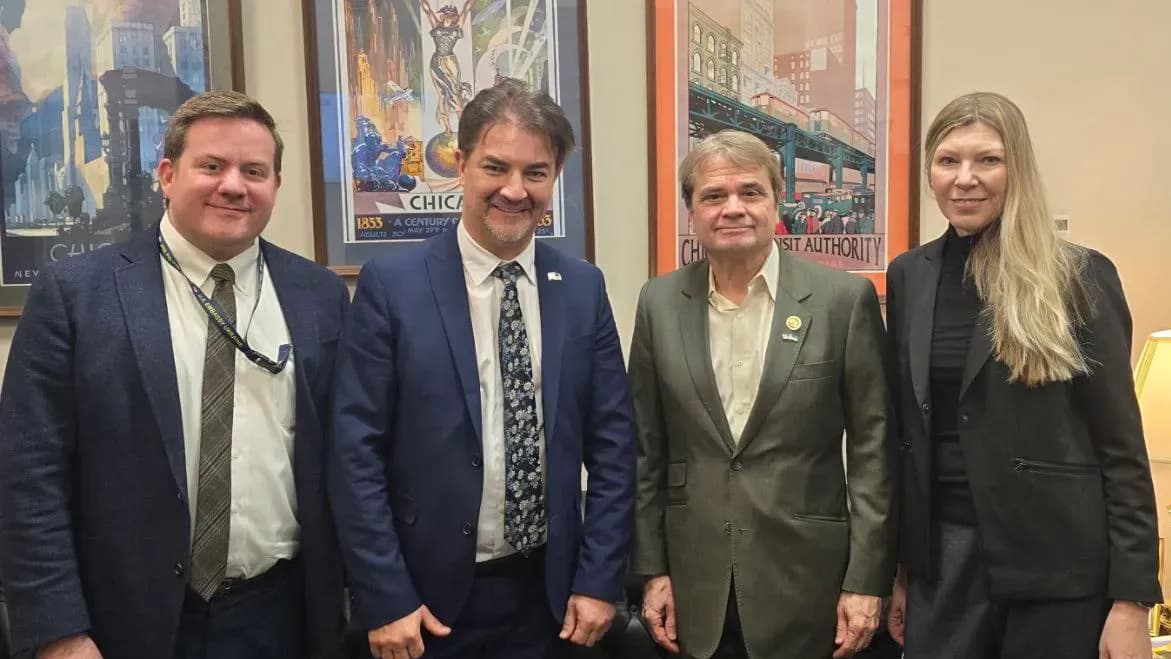
A telling example: after our meeting with Congressman Mike Quigley, he publicly acknowledged the contribution of Ukrainian-American business to Chicago's economy, noting that the city is home to over 3,000 Ukrainian businesses that create jobs, drive innovation, and generate economic growth.
He encouraged us to introduce more Ukrainian-American entrepreneurs to his colleagues in Congress — and pointed out specific members of both parties whom we should approach.
This kind of bipartisan, district-focused engagement makes support sustainable.
A direct result of Ukraine Week was the agreement to organize a closed business event on Capitol Hill in April — timed to coincide with the IMF and World Bank Spring Meetings, when leading global economic players will gather in Washington.
The event will take place directly on Capitol Hill. Its format is not speeches, but a structured dialogue between Ukrainian-American business leaders, members of Congress, senators, their staff, and federal stakeholders. The goal is to demonstrate with real cases and real data: diaspora businesses are already creating American jobs today — and are ready to drive Ukraine's recovery tomorrow.
And in May, during the SelectUSA Investment Summit (May 3–6, 2026) — the flagship event of the U.S. Department of Commerce for attracting international investment — we will integrate the Ukraine recovery agenda into federal commercial programs, presenting reconstruction opportunities directly to U.S. states and companies.
This sequence is intentional: political alignment in April, commercial engagement in May. This is how recovery becomes embedded in the American economic architecture — not as a one-time initiative, but as a continuous partnership track.
III. The Impact of Ukrainian Diaspora Businesses on State Economies
Journalist: Ms. Malytska, your research with ISE Group seems to be changing how Washington perceives the Ukrainian diaspora. What did your research reveal — and what surprised American politicians?
Olena Malytska: The strongest reaction was to the scale.
Most people in Washington — even those well-acquainted with Ukraine — did not realize that companies founded by Ukrainians in the U.S. are a structurally significant segment of the American economy.
Let me put these numbers in context: about 45,000 businesses founded by Ukrainians across all 50 states. Approximately $55–58 billion in annual turnover — comparable to the GDP of a state like North Dakota. About 300,000 supported American jobs. Approximately $24 billion in wages paid annually. About $8–9 billion in tax revenues — comparable to the annual budgets of several U.S. states.

These companies are not concentrated in a few enclaves. They span all major industries — technology, manufacturing, retail, construction, logistics, professional services — and create jobs from California and New York to Florida, Illinois, Texas, and Pennsylvania.
One of the most impressive results is the dominance of the tech sector. Nearly half of the employment in Ukrainian-American companies is concentrated in tech fields: software development, artificial intelligence, cloud services, cybersecurity, IT services. Many of these companies operate in a dual-market mode: they have teams both in the U.S. and Ukraine, effectively creating a transatlantic innovation corridor.
For American investors, this means access to highly skilled engineering talent at competitive costs. For Ukrainian ecosystems, it means integration into American markets and capital networks.
Some startups founded by diaspora members have become true American tech success stories. Think of Grammarly or GitLab — companies with Ukrainian roots, now valued at over a billion dollars and employing hundreds of Americans. Ukrainian founders have collectively raised over $25 billion in venture capital, a significant portion of which fuels innovation in the U.S.
And over 90% of the companies we surveyed plan further expansion in the United States. This signals long-term integration, not temporary relocation.
Partnership with Nova Ukraine gives the second edition of the research more than just visibility: it opens access to community networks, expands public engagement opportunities, and enhances the ability to turn research results into long-term partnerships across the United States. This is especially important for a project aimed not only at measuring economic impact but also at building long-term connections between companies founded by Ukrainians, American communities, and Ukraine's recovery agenda.
The conclusion is this: Ukrainian-American entrepreneurs are builders, not aid recipients. They strengthen the American economy through jobs, innovation, and tax revenues — while maintaining connections that can help rebuild Ukraine.
Journalist: Ms. Sigaev, given this economic footprint, how is the Ukrainian-American business community actually mobilizing? What does "diaspora business diplomacy" look like in practice?
Eva Sigaev: It looks like this: you walk into congressmen's offices with data on local jobs — not with an appeal for sympathy.
We call it business diplomacy because it uses the existing economic footprint — companies, employment, tax revenues, local trust — as a tool for structured partnership between American communities and Ukraine's recovery needs.
During Ukraine Week, we held a specialized forum with representatives of the Ukrainian business diaspora in the U.S., focused on the practical question: how ready are these entrepreneurs to engage in Ukraine's recovery — and under what conditions?
The answer was unequivocal: diaspora business leaders are ready to return to Ukraine with capital, experience, and teams. They are ready to enter Ukrainian projects as investors or operational partners. They seek to work directly with communities and regions in joint project formats.
But they also clearly articulated a request: they need clear rules, predictable tools, and a structured mechanism for entering the recovery economy. And this is where UR³ becomes relevant — it provides the interface between business readiness and community needs.
Regarding our work across states: we go district by district, showing American officials hard data on how companies founded by Ukrainians boost local employment, wages, and economic activity in their districts. When a member of Congress sees that Ukrainian-American companies in their district generate significant tax revenues and create jobs, supporting Ukraine becomes a domestic issue — not an abstraction of foreign policy.
We have integrated our diaspora-led platform, UA2USA, into the official national framework for Ukraine's recovery — so that this collaboration is embedded in the process from the start, not added as a late addition.
And the April event on Capitol Hill, mentioned by Mr. Romanyshyn, is a direct result of this work. We aim for senators, members of Congress, their staff, and American business leaders to hear firsthand: diaspora businesses are already creating American jobs today — and are ready to drive Ukraine's recovery tomorrow. If we can demonstrate that supporting Ukraine's recovery means new contracts for American construction companies, new R&D partnerships for tech businesses, more jobs in states like Oklahoma, Illinois, or Pennsylvania — this is a message that transcends party lines.
To deepen this work, Ukrainian-American entrepreneurs and organizations are invited to share their cases through UA2USA. Business cases from across the United States will help show how companies founded by diaspora members create jobs, mobilize investment, expand exports, and strengthen local communities — while building lasting bridges between the American economy and Ukraine's recovery. Share your story: ise-group.org/yourstory
Journalist: Deputy Prime Minister Kuleba, a final question. For the American reader — a business owner, investor, state legislator — who still asks: "What's in it for us?" What is your response?
Kuleba: My response is straightforward: Ukraine's recovery is not an act of charity from America. It is a strategic investment that yields results.
We are defending the same democratic and economic architecture that underpins American prosperity. But beyond shared values, there are also specific, tangible economic dimensions.
Infrastructure contracts. Ukraine needs to rebuild roads, bridges, ports, power grids, housing, and municipal systems. This is a market for American engineering, construction, and manufacturing companies.
Energy modernization. The transition to decentralized energy creates demand for American generators, cogeneration plants, solar systems, and grid management technologies.
Defense co-production. Ukraine's frontline has become a testing ground for modern technologies — drones, cyber defense, AI-based systems. American defense companies can co-develop and access innovations proven in real combat conditions.
Critical raw materials. Ukraine has significant reserves of titanium, lithium, and other minerals critical for the American aerospace industry, electric vehicles, and advanced manufacturing. Investments in Ukrainian supply chains reduce America's reliance on sources controlled by adversaries.
Supply chain resilience. A restored, stable Ukraine integrated into European and transatlantic markets strengthens the economic network from which the United States also benefits.
When Ukraine restores ports — American exporters benefit. When Ukraine modernizes power grids — American equipment manufacturers benefit. When Ukraine develops defense R&D — American companies gain innovations proven in real combat conditions.
We are not asking for symbolic solidarity. We offer a structured partnership. And we are ready to implement it. This Ukraine Week in Washington was not about asking for more aid. It was about building a shared architecture — where American cities become partners with Ukrainian communities, where American companies enter clear projects, and where the $55 billion economic footprint of the Ukrainian diaspora becomes a bridge between the two economies.
Recovery has already begun. And in Washington, there is growing understanding: this is not just a Ukrainian necessity — it is an American opportunity.
About the Participants
ISE Group — an international think tank and corporate accelerator operating in Washington, Kyiv, and Warsaw. The organization works at the intersection of public policy, innovation, entrepreneurship, and cross-sector partnerships, connecting government, business, universities, R&D centers, and tech players for economic modernization and sustainable growth. Recognized by the Financial Times as the best innovation hub in Europe, ISE has supported over 3,000 startups since 2018, helped 200+ companies enter global markets, built 70+ corporate-startup partnerships, and prepared 50+ research and market analyses. Through initiatives like UA2USA, ISE turns evidence into practical engagement with investors, policymakers, and communities — both in Ukraine and the United States. (ise-group.org)
Ukrainian-American Chamber of Commerce and Industry (UACCI) was established to unite and strengthen Ukrainian-American entrepreneurship. Headquartered in Chicago, the organization brings together business leaders, experts, and professionals to expand opportunities for Ukrainian-origin companies in the U.S. and beyond, providing advisory, legal, educational, financial, and market support to the Ukrainian-American business community. In the context of this initiative, UACCI serves as a practical bridge between companies founded by diaspora members, local business networks, and American institutional and trade opportunities. (ukrainianamericanchamber.org)
UA2USA — a platform designed to make the economic contribution of companies founded by Ukrainians in the U.S. visible, measurable, and actionable. Based on the "Economic Impact Study of Ukrainian-American Business" — the first verified nationwide map of its kind — the platform documents a diaspora network of 45,000+ enterprises across all 50 U.S. states, generating about $60 billion in annual revenue, supporting around 300,000 American jobs, and paying approximately $8–9 billion in taxes. UA2USA operates at the intersection of data, policy, and cross-sector partnership: it connects diaspora entrepreneurs with American investors, federal and state economic programs, and institutional networks, while bringing verified data into bilateral policy discussions on trade, labor market development, and Ukraine's recovery. Translating rigorous research into practical engagement — between government, business, and civil society — UA2USA presents the Ukrainian-American business community not as a story of forced relocation but as a driving force of transatlantic economic growth. (ise-group.org/media_research/ua2usa)
Ukrainian-American entrepreneurs and organizations are invited to share their business cases and corporate stories directly through the platform: ise-group.org/yourstory