
Voices Do Not Die
Genocide can never be fully realized. There are always those who survive. Survive, not just live through it. One can survive bodily, even by betraying oneself. To truly survive, one must remain oneself.
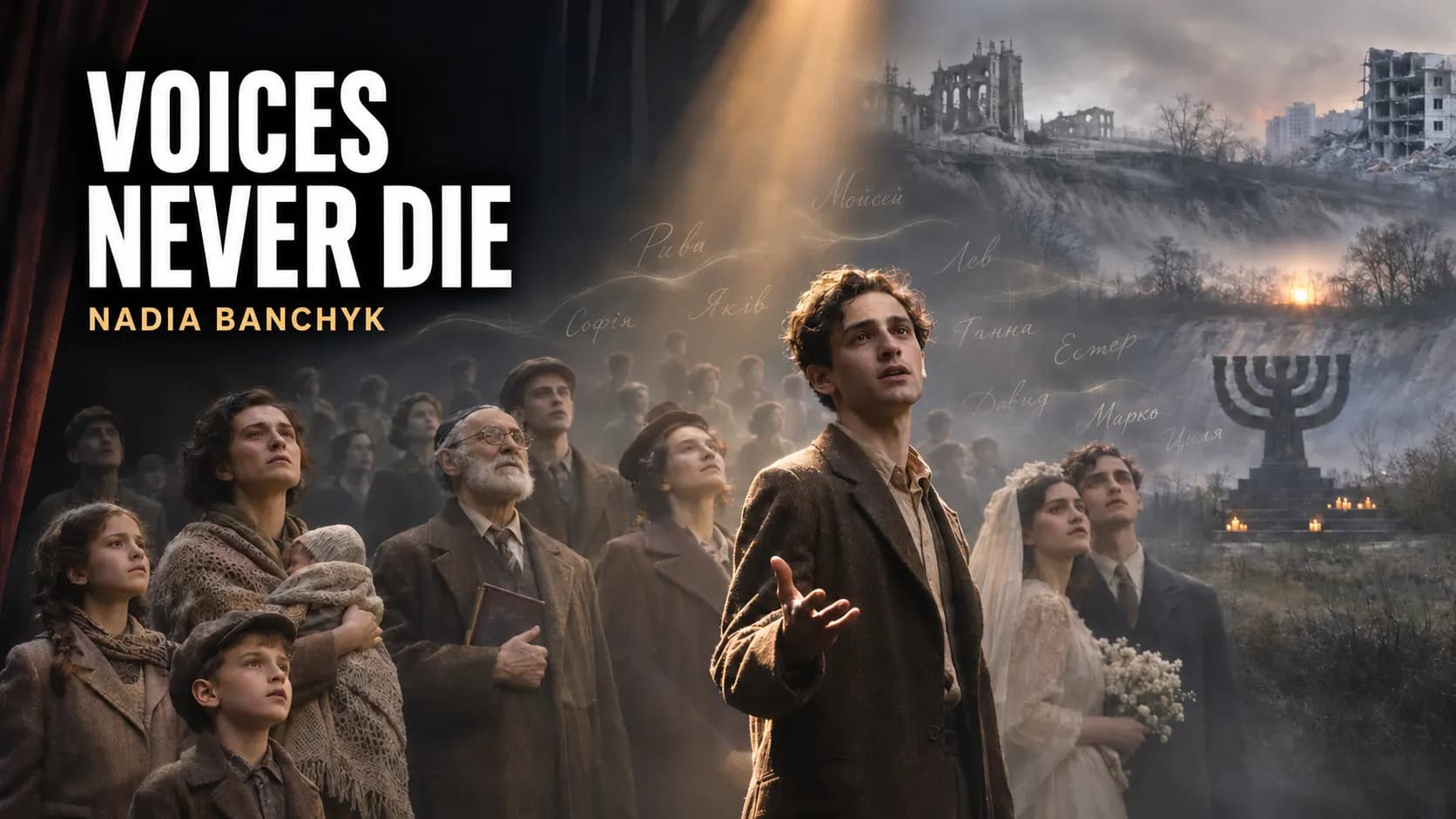
This is the conclusion, the idea, the leitmotif that runs through the performance of the Ukrainian amateur theater "Wandering Stars," dedicated to the 85th anniversary of the mass shootings of Kyiv's Jews in Babyn Yar. The title of the performance – "Voices" – strikes with its unusualness and even grammatical meaninglessness: the instrumental case "floats" in the air like a light cloud and cannot "land" anywhere. However, behind the grammatical meaninglessness lies intentional semantic vagueness, as in impressionism: memory responds with the voices of those who were attempted to be erased from the Earth. Not only to kill bodies, but also names, fates, identities.
"We tried to maintain a connection with the source of the performance – the poem 'Babyn Yar. Voices' by Marianna Kiyanovska – and at the same time show the connection between the Nazi genocide and the current one that the Rashists are committing in Ukraine," explains director Olena Bilyak. "The goal of the murderers is to turn individuals into a faceless mass, and we return names, fates, characters, their voices echoing living memory."
"Only now can I speak about it!" – a young man seems to return from a distant extraterrestrial life to testify about the horrific events. He survived amid death and now brings back the dead. (During Soviet times, it was forbidden to mention the Nazi Holocaust as the murder of Jews solely because they were Jews. I remember the monument in Babyn Yar with the inscription: "Here perished at the hands of fascist invaders one hundred thousand peaceful Soviet people." Even that monument has a tragic history: it was erected only in 1965 after numerous protests, spontaneous rallies despite bans, and Yevgeny Yevtushenko's poem "Babi Yar," which tore apart, like a bomb, the official silence. Only in independent Ukraine was it possible to properly honor the memory of the shot Jews, as well as members of the OUN, and Roma – all separately, preserving their identity).
But the young man who survived brings back each of the dead – names, characters, fates. They emerge from the darkness and walk their last path, recalling their lives. Here, a school teacher passes by the ruins of the school where he taught children "never to kill." One of his students is Mykola, whose brother, a sapper, died in the Finnish war.
A girl recalls: "I could have been happiness!" – but her fiancé, David, was burned alive in Irpin. The mournful crowd stretches across time and space – killings occurred not only in Babyn Yar but everywhere and long before September 29, 1941, on the Jewish New Year Rosh Hashanah, when Kyiv fell into the hands of the murderous occupiers.
Here is another bride, Tsilya. Her David was killed "on Hanukkah," they were separated, but love is stronger – and David comes to her, and they dance and marry right in the mournful march, as her dream – to die together with her beloved – comes true...
"I was at war," – David recalls. But this death is different: "they shoot everyone: pigeons and dogs with cats."
These are not heroes – ordinary people who went to "Yevbaz" ("Jewish Bazaar"), fished, visited Aunt Mira, who treated them with delicacies... Aunt Mira was shot in her apartment.
Not everyone can endure it. "Everyone suffers equally, some become animalistic instantly." Like David's (another David?) mother reproaches his non-Jewish bride: "You live, and he's gone, take this, Virka, as punishment!" Virka, not Jewish, is herself "dying little by little" – from hunger and from grief, longing for her beloved. "I would rather die for those who at least rejoice a little."
Some neighbors inform, while others hide. "Yasha needs to be hidden."
A young mother clutches the diapers left from newborn Elichka... "Taken from the bed... I understood, to be shot..."
A slice of everyday life, of which mass murders became an integral, mundane part, is unexpectedly illuminated. First, with a folk song about a rabbi teaching children the alphabet, and almost immediately it seems to transition into a Jewish prayer for Yom Kippur – the Day of Atonement. And all who are driven to the Yar become part of the ancient biblical people, united by a common tragic fate.
"Marianna Kiyanovska told me that it was as if someone dictated this poem to her," – says Olena Bilyak. "From her large book, we chose the most scenic episodes. All the characters, of course, are literary images; however, they are taken from life at that time. Marianna tried to imagine what they were like, how they reacted."
"Only now can I speak about it!" – the young man repeats each time with a different intonation. Genocide can never be fully realized.
Voices do not die.