Across the Ocean for Firewood: Ruslan Gorovyi and the Stories That Don’t End with the Credits
He writes books, makes documentaries, composes songs, helps find missing children, and seems to have a special knack for stumbling into extraordinary stories where most people would see nothing out of the ordinary. This fall, Ukrainian writer, filmmaker, and volunteer Ruslan Gorovyi set off for America once again, this time with a rather unexpected mission: to earn enough money to buy firewood for Ukrainian families. What sounds like a simple, practical undertaking turns out to be a much deeper story. One about creativity, war, human dignity, and a sense of responsibility that doesn’t end once a promise has been fulfilled.
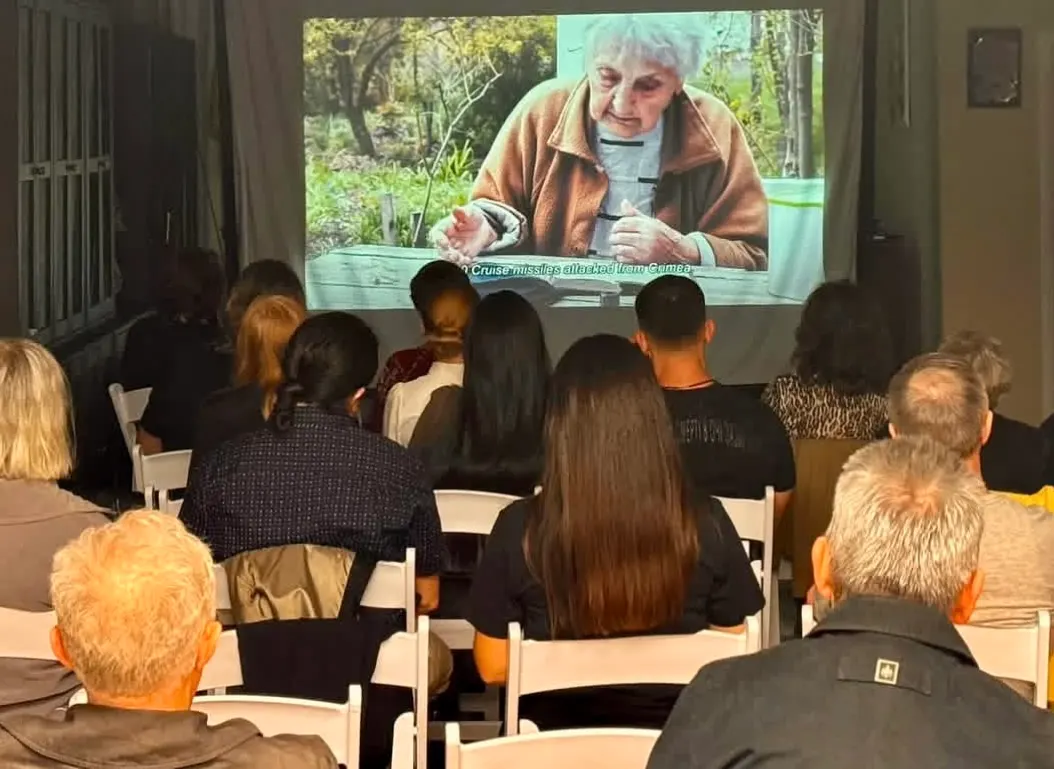
The documentary about Liudmyla Oleksandrivna has already been screened in Ukraine and abroad. Audiences have watched it, discussed it, and this fall its director took it across the Atlantic once again.
There is just one small catch.
As of September 2026, Liudmyla Oleksandrivna herself hadn’t seen the film.
She made sure to remind Ruslan Gorovyi of this little oversight during one of his visits to Moshchun.
“And you still haven’t shown me the film.”
“That’s true. Guilty as charged.”
Well, there wasn’t much he could say to that.
They agreed that once he returned from his American tour, Ruslan would finally arrange a screening right there in Moshchun.
In the meantime, however, the film has another job to do: help raise enough money to buy firewood for Ukrainians who otherwise may have no way to heat their homes this winter.
That little exchange offers a glimpse into Ruslan Gorovyi’s rather unusual creative world. A world where documentary filmmaking, literature, sharp humor, volunteer trips, and the thoroughly unglamorous business of everyday survival somehow fit together.
He calls his fundraising tour simply Po Drova — For Firewood.
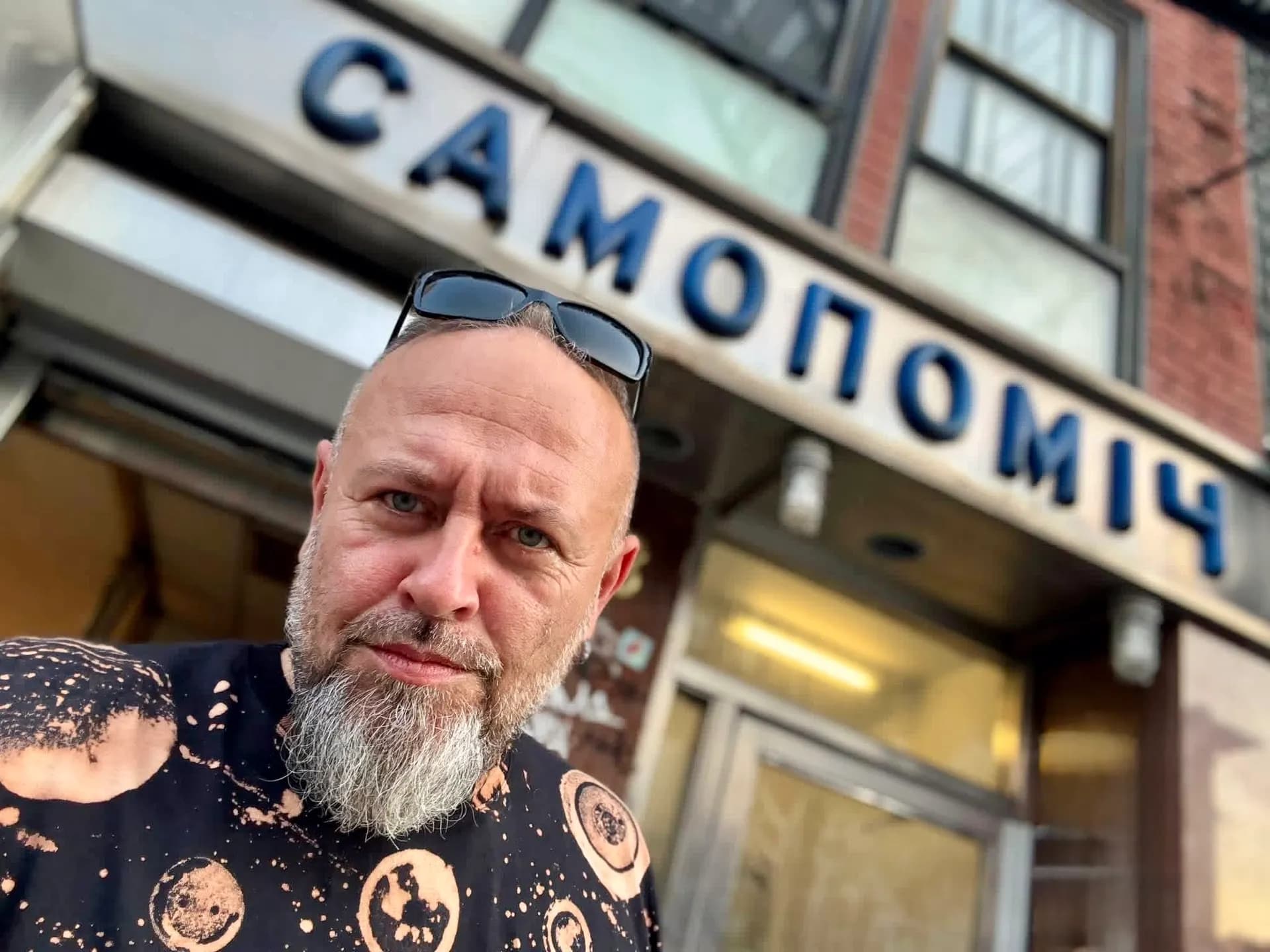
This October, we had the pleasure of welcoming Ruslan to Self Reliance in New York. And I must admit, among the many talented writers, artists, and community leaders whose visits have each enriched our cultural life in their own unique way, personalities like his spark a particular kind of curiosity.
Gorovyi is not someone who fits neatly into a professional category. Journalist. Documentary filmmaker. Writer. Poet. Musician. Publisher. Volunteer.
Quite a list, you might think. Yet even all those titles hardly capture the distinctiveness of his creative world.
His public appearances and writing are often marked by sharp, sometimes biting humor. He can take an ordinary situation, turn it slightly on its head, and suddenly make it sound completely absurd. Then, almost before you’ve finished laughing, the very same seemingly lighthearted story reveals a human tragedy that makes you feel a little uncomfortable about the safety of your own everyday life.
What makes it compelling is that these shifts never feel forced.
After all, isn’t that how our lives have come to work?
We can laugh at something ridiculous and, a minute later, read that someone we know has been killed. Enjoy an ordinary sunny morning while feeling guilty that, somewhere back home, people woke up to explosions.
War has taught us to live with things that once seemed impossible to reconcile.
And to me, Gorovyi’s work captures that uncomfortable reality remarkably well.
In one interview, Ruslan described writing, music, and playwriting as interests that take center stage at different points in his life. First and foremost, he considers himself a filmmaker.
An interesting choice of words for someone whose books have found their own readership, whose songs have their listeners, and whose literary events help fund very real humanitarian needs.
Still, look closely at his work and that filmmaker’s eye is there, even in his prose.
Gorovyi has a gift for noticing the details most of us overlook. A conversation overheard on public transportation, a passing remark on the street, a stranger’s funny story — any of these can become the beginning of a piece of writing.
His book Kyieve Mii (My Kyiv) grew out of conversations he recorded on Kyiv’s streets over nine years. What could possibly be so fascinating about the chatter of a busy city? Yet those fragments of other people’s lives gradually form a portrait of the Ukrainian capital, with all its humor, contradictions, language, habits, and wonderfully recognizable characters.
The same attention to people runs through Skabky, Poimennyk, and his other works. People who aren’t always easy to deal with, aren’t necessarily likable, and can be funny, complicated, or contradictory.
Perhaps that’s why it’s so easy to recognize someone you know in his stories.
And sometimes, rather less comfortably, yourself.
There is another, considerably more serious dimension to Gorovyi’s creative work.
His documentaries The Kyiv Flood, Ukrops of Donbas, A Little Below Heaven, and Moshchun: Liudmyla Oleksandrivna’s Diary explore events and human lives that have not always received the attention they deserve in the public record.
In The Kyiv Flood, he revisits the 1961 Kurenivka disaster, a catastrophe whose true scale the Soviet authorities tried to conceal.
Ukrops of Donbas tells the stories of people whose lives were changed by Russian aggression. A Little Below Heaven focuses on Ukrainian soldiers who defended Donetsk Airport and those among them who lost their lives.
And the artistic project This Is How Memory Works, dedicated to fifteen-year-old Danylo Didyk, who was killed in a terrorist attack in Kharkiv in 2015, brought Ukrainian musicians together around the story of a boy whose life ended far too soon.
This side of Gorovyi’s work becomes even more interesting when you consider an unusual detail from his own life.
He was born in Konotop, grew up in a largely Russified environment, and connects his conscious embrace of Ukrainian identity with Donbas.
It was there, in Kramatorsk, where he arrived in the 1990s, that he met people who introduced him to the Executed Renaissance, the Holodomor, and Ukraine’s struggle for independence — chapters of history largely absent from Soviet education.
In 1995, by his own account, he made a deliberate decision to switch to speaking Ukrainian.
Donbas, a region Russian propaganda spent decades portraying as somehow alien to Ukrainian culture, became the place where he developed a conscious sense of his Ukrainian identity.
I found myself thinking about that story long after reading it.
How many more truths like this — so inconvenient for the imperial narrative — are buried in our past?
And how many have we still not managed to tell?
Ukraine’s history is not simply a collection of dates, borders, and political decisions. It is also made up of people who, under very different circumstances, discovered their own language, culture, and past. And who sometimes had to fight for the right to remain themselves.
For almost a quarter of a century, another part of Gorovyi’s professional life has been devoted to work in which every single person’s name matters.
In 2001, while working at Magnolia-TV, Ruslan launched the Missing Children Search Service.
At the time, hundreds of children could be missing across Ukraine at any given moment, while the means of spreading information quickly were far more limited than they are today. The idea of a dedicated television program proved effective. Eventually, other television channels, journalists, law enforcement agencies, and civic organizations joined the effort.
Over the years, the project has helped search for and locate missing children, bringing families information and, in many cases, the chance to be reunited.
After Russia’s full-scale invasion, that work took on a new and particularly painful dimension. According to Ruslan, the number of requests increased hundreds of times over.
Children became separated from their families during evacuations, lost contact with loved ones, ended up in occupied territories, or were forcibly taken out of Ukraine.
Behind every missing-child report is a family for whom time seems to have stopped.
We often talk about journalism as a profession that demands impartiality, accuracy, and the ability to maintain a certain distance. And rightly so.
But is there really such a thing as a safe emotional distance when you’re sitting across from a mother who doesn’t know where her child is?
In an interview with The Ukrainians, Gorovyi acknowledged that it’s practically impossible to work with stories like these without taking them to heart. At the same time, becoming overwhelmed by the pain can threaten your ability to keep doing the work.
Writing became one way for him to cope with what he had experienced.
And here, another connection between his professions begins to emerge. Journalism provides material to reflect on. Documentary filmmaking preserves testimony. Literature helps make sense of what has been lived through.
Though perhaps some experiences simply refuse to make sense.
After the liberation of the Kyiv region, Ruslan described entering villages with Ukrainian soldiers while ruined houses were still smoldering. He saw dead civilians, destroyed homes and farms, and animals killed in the fighting. He called out near abandoned houses, hoping someone might answer.
That was how he first got to know some of the people he began helping.
One person would tell him about another. New addresses followed. New villages. New needs.
And what began as occasional volunteer trips gradually grew into years of work.
There is Mariia Yukhymivna from Horenka. During the shelling, she used to wrap her little dog Bonia in a scarf to protect him. These days, although she needs help herself, she brings vegetables from her garden to a home for the elderly and looks after a bedridden neighbor.
And, of course, there is Liudmyla Oleksandrivna.
Her story could easily have become another documentary account of Russia’s assault on the Kyiv region.
In 2022, she remained in her home through almost the entire battle for Moshchun, even though the house stood close to the front line. Despite the constant danger, she kept a diary, recording what she saw and lived through.
Those entries later became the foundation of Gorovyi’s documentary.
But there is one detail here that, to my mind, deserves particular attention.
When Ruslan first met Liudmyla Oleksandrivna, her home had been damaged. He promised to help repair it.
According to his own account, he and his friends first managed to secure the building, cover the damaged sections with plastic sheeting, and gradually replace the windows and repair the roof. Eventually, supporters came forward who helped restore not only her house but nine others as well.
Only after helping to address her immediate needs did he return to Liudmyla Oleksandrivna with a camera.
A perfectly natural sequence of events, you might think.
But is it always?
In modern journalism, someone else’s tragedy often becomes the subject of a news report. The camera records the destruction. The journalist gathers testimony. The newsroom publishes the story.
That work is essential, particularly during a war, when documenting each crime can carry both historical and legal significance.
But what happens to the person when the filming is over?
Do we continue to see a living human being, or do they gradually become the subject of a documentary we’ve watched, discussed, and filed away?
In his own accounts, Gorovyi describes a different experience.
His relationship with Liudmyla Oleksandrivna didn’t end when the documentary was finished. He continues to visit her, bring supplies, and check on how she’s doing.
And judging by his stories, these visits have very little in common with the ceremonial appearances we sometimes associate with charity work.
In September, for instance, Ruslan found her sorting through her old embroidery. She was going through pieces she had made years earlier, stitching up the edges and getting them ready to hang on the walls.
She couldn’t afford frames, but why let perfectly good embroidery sit around gathering dust?
Among other things, Ruslan had brought her laundry detergent. In his account of the visit, he noted with gentle amusement just how happy she was to receive such an ordinary gift.
Her explanation was simple: in the village, it takes next to nothing to get something dirty, but washing it ends up costing a whole lot more.
That’s the economics of village life for you.
And alongside this wonderfully ordinary conversation sit the memories of Russian shelling, destroyed houses, a diary written during the fighting, and a documentary now being screened across the ocean.
What moves me most about this story is that Liudmyla Oleksandrivna is never reduced to being merely a witness to war.
She is still a woman who wants to put her things in order, joke with a visitor, and take care of her home.
And isn’t that one of the most fundamental human rights — to remain yourself, even when circumstances have tried to take almost everything from you?
The Ukrainian premiere of Moshchun: Liudmyla Oleksandrivna’s Diary took place in Kherson in November 2024.
A city still living under Russian shelling was introduced to the story of a woman who had survived the Russian assault on the Kyiv region.
I think there is something particularly meaningful about that choice of location.
People for whom war doesn’t end when the evening news is over were watching a film about someone who had lived through a similar ordeal.
Only now, the screenings aren’t just about applause.
They’re about firewood.
The idea began several years ago, when members of the Ukrainian community in Singapore offered financial support for Ukrainians. The donors wanted the money to go toward civilian needs.
Ruslan suggested buying firewood for people who couldn’t afford enough fuel to get through the winter.
Eventually, Ukrainian communities in other countries joined the effort. Gorovyi began organizing international literary and cultural tours, earning money through book sales, public appearances, and documentary screenings.
In 2024, he traveled around the world, visiting Australia, New Zealand, Singapore, the United States, Iceland, and Germany.
According to Gorovyi, his 2024 world tour initially raised enough money for 100 truckloads of firewood. By October 2025, he reported that the campaign had ultimately resulted in 116 truckloads. His American tour in 2025 raised enough for another 50.
And in the fall of 2026, he returned to the United States with the same purpose: to turn books, films, and conversations into something that could help Ukrainian families survive another winter.
But perhaps the most interesting part of this story isn’t even how much money he managed to raise.
In an interview with Ukrinform, Gorovyi recalled that some people found his fundraising tour rather odd. Raising money for firewood instead of directly for the military was, apparently, not exactly fashionable.
Not fashionable.
I read that phrase several times.
Have we really reached the point where human needs are judged by how popular they happen to be?
Of course, supporting Ukraine’s military is our shared responsibility. The future of our country, and the safety of its people, depend on how well our defenders are equipped.
Gorovyi himself has been supporting the military since 2014. He has raised money for vehicles, helped cover repairs, and delivered essential equipment. According to Ruslan, one of his earlier American tours helped pay for repairs to twelve military vehicles.
But does that mean a person who survived occupation and now cannot afford to heat their home must wait until their needs become sufficiently newsworthy again?
War doesn’t end where the front lines end.
It remains in devastated villages and ruined homes. In the lives of people who have lost loved ones, jobs, health, and any reliable means of supporting themselves.
Sometimes, one of its cruelest consequences isn’t just what happened yesterday, but the struggle to make it through tomorrow.
Especially when winter is coming.
Ruslan has spoken about elderly people who can afford to light their stoves only once every day or two, trying to make their firewood last.
Just try to imagine living like that for a moment.
Not from thousands of miles away. Not through a phone screen or the statistics in a humanitarian report.
A person who has survived Russian shelling, stayed in their village, and is trying to keep their household going — yet has no idea whether the firewood will last until spring.
We love talking about Ukrainian resilience. And we have countless reasons to admire it.
But hasn’t that word sometimes become a little too convenient?
Does it allow us to forget that even the strongest people can be exhausted, lonely, and in need of help?
Resilience should not mean having to live in a freezing house, go hungry, or face every consequence of war entirely on your own.
And perhaps this is where a kind of responsibility begins that receives far less attention in public conversation.
Not merely helping someone through the worst moment of their life, but continuing to be there when a great tragedy turns into hundreds of small, exhausting everyday struggles.
Gorovyi does not appear to see military assistance and civilian support as competing priorities. At least, his years of work show that he has remained active in both.
There is another interesting aspect to this initiative.
Ruslan has spoken openly about how financially exhausted Ukrainians have become. Fundraising is getting harder. International attention to the war is fading. And Ukrainians living abroad are not always in a position to make substantial donations.
That is why, as he explains it, he tries not just to ask people for money, but to earn it through his own work.
The small publishing house TaTySho, which he co-founded, also contributes to military support.
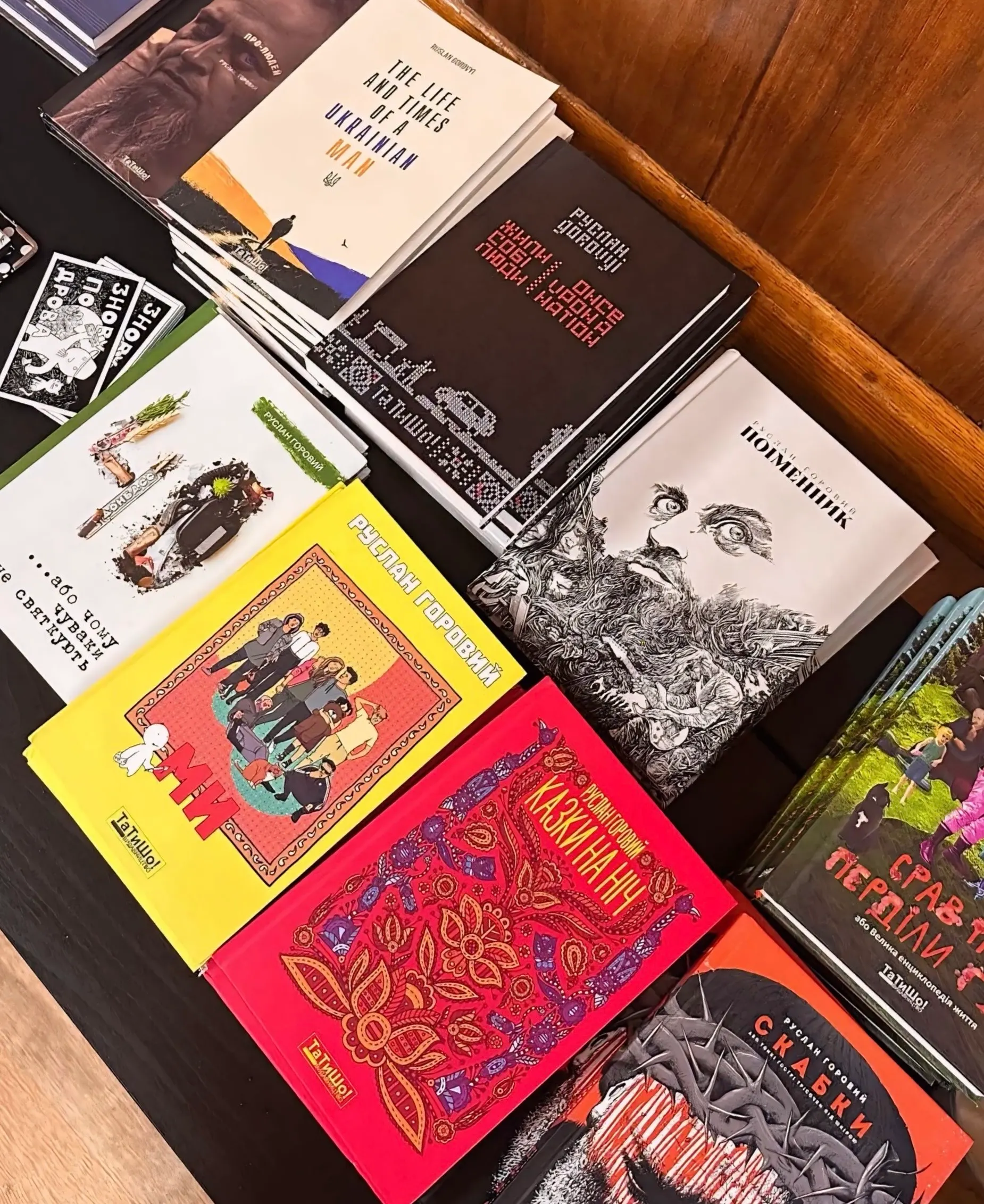
For example, proceeds from a book Ruslan wrote together with his wife, poet Liudmyla Gorova, and Vitalii Chepynoha helped purchase an SUV for Ukrainian defenders.
The book’s title is Srav Pes, Perdily Husy — roughly, The Dog Took a Dump, the Geese Were Farting, a deliberately earthy Ukrainian expression used to dismiss a situation as hopeless or absurd.
Well, let’s just say that probably wouldn’t be an advertising agency’s first suggestion for the title of a charity project.
But according to Ruslan, the outrage it sparked among some readers actually helped sales.
There is a certain irony in that: a book whose title some people found downright outrageous ended up helping buy a vehicle for the Ukrainian military.
It makes you wonder whether one sign of creative resourcefulness is the ability to spot an opportunity where others see nothing but trouble.
Literature is much more interesting when it has a voice of its own.
More interesting still when that voice leads to something tangible.
But there is one story that stayed with me in particular.
In early October, shortly before leaving for his American tour, Ruslan once again visited Nadiia and Viktor in Moshchun.
In 2022, Russian soldiers killed their son, who had been helping defend the village. Their home burned down. Since then, the couple had been living in temporary housing made possible with the help of volunteers.
At last, a foundation appeared on their cleared plot of land. Then the walls began to go up.
After years of waiting, the first signs of a return to ordinary life.
Although what can ordinary life possibly look like now?
Their son will never come home. The old house can never be restored to exactly what it was. Even in the new one, the memories of everything they have endured will remain. And yet people still have to live. They need furniture, appliances, groceries. They need money, which after so much hardship seems to be in short supply for just about everything.
When Nadiia and Viktor spoke about what they would need for the new home, Ruslan suggested they hold off on buying things. Perhaps something could be found.
And he added that they would have firewood.
“You’ll definitely have firewood. I promise.”
I lingered over those words longer than I did over many of his other volunteer updates.
Because there is something deeply telling about them.
For Nadiia and Viktor, a new house is not simply another item on a charity’s list of needs. It is an attempt to rebuild a life where the war has left an enormous emptiness.
And while no amount of help can bring their son back, it can give them a sense that they have not been left alone with their grief.
That their everyday worries matter to someone.
That even after everything they have endured, tomorrow is still worth making plans for.
In one of his September posts, Ruslan described how he almost missed Nadiia when he arrived with supplies. She was getting ready to attend the birthday celebration of her son’s godchild.
The boy’s godfather was gone.
So she would go in his place.
There is something devastating in the simplicity of that.
We often talk about war in the language of large numbers. The dead. The wounded. Destroyed homes. Displaced families.
All of this must be counted, analyzed, and documented.
But behind every number is a life that will never be quite the same again.
A child will celebrate a birthday. Family members will gather around the table. But someone who should have been there never will be again.
And life will go on anyway.
There is a birthday party to attend. A house to build. Firewood to find.
During our gathering at Self Reliance in New York, the importance of maintaining that living connection with Ukraine felt especially clear to me.
Because across the ocean, war inevitably takes on a different dimension. We follow the news, support the military, contribute to humanitarian initiatives, and worry about family and friends back home.
But distance changes our perception, whether we want it to or not.
The stories Gorovyi brings with him lead us back to people for whom war is not simply another headline.
It is their home. Their losses. Their loved ones. Their everyday concerns.
And suddenly, a literary evening in New York can have a very real outcome in a Ukrainian village.
Someone buys a book. Someone supports a documentary screening. Someone makes a donation.
And thanks to those people, firewood is purchased and delivered to families on the other side of the world.
Families who may never have been to New York. Who may never have read Gorovyi’s books or watched his films.
But do they really need to?
I don’t think so.
Because the true value of that help lies not in whether anyone remembers who provided it, but in whether someone who has survived the war can finally fall asleep in a warm home.
And here I want to return once more to Liudmyla Oleksandrivna.
During his September visit, Ruslan noticed that her garden had become terribly overgrown. Apples were lying on the ground. She no longer had the strength to gather them.
He picked up a few to take with him on the way back to Kyiv.
For some reason, that small detail has stayed with me.
There was a time when she tended her garden herself. She survived the fighting in her village, kept her diary, and lived to see her home repaired.
And now she simply doesn’t have the strength to pick up her own apples.
It is good when someone is there to notice such things.
Ruslan still has a promise to keep: to show Liudmyla Oleksandrivna the film about her own life.
Perhaps she’ll have plenty of questions for the director. Perhaps she’ll find something to criticize. Judging by their published conversations, though, I doubt anyone will be bored at that screening.
And once again, I find myself thinking about the brief promise he made to Nadiia and Viktor.
Because in the end, a book can be read and put back on the shelf. A film can be watched and discussed. Even the most powerful artistic experience eventually gives way to new events.
But winter will come to that Ukrainian village.
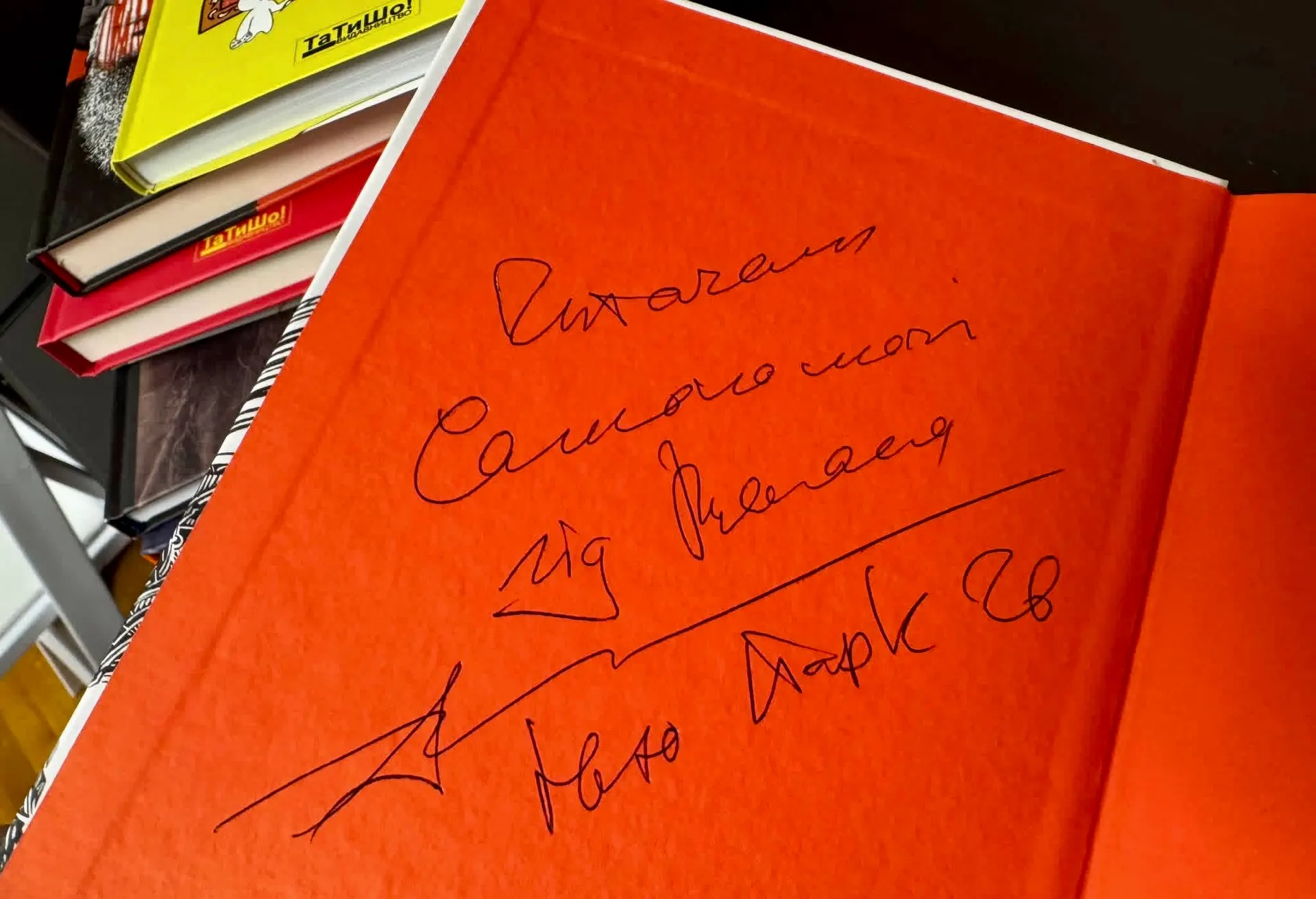
And someone Ruslan Gorovyi promised to help will be able to light a fire in the stove.
Not for a beautiful story. Not for a report. Simply because a person deserves to be warm.
And because a promise ought to mean something.