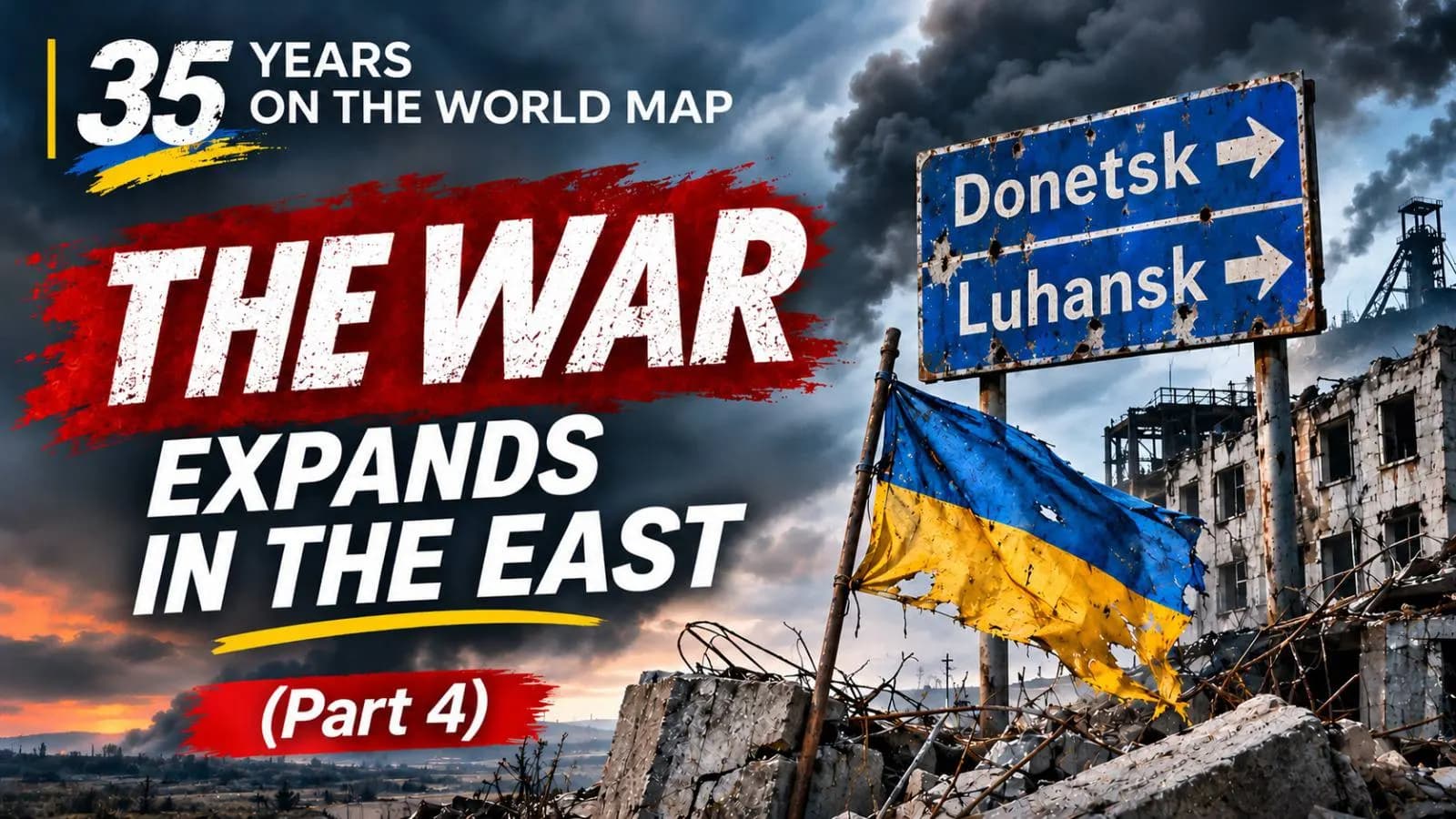
35 Years on the World Map — The War Expands in the East
Immediately after the "peaceful" annexation of Crimea, the Russian Federation launched a "hybrid war" in eastern Ukraine, primarily in the Donbas. Hostilities began there.
In March 2014, alongside the events in Crimea, pro-Russian forces destabilized the situation in Donetsk and Luhansk and attempted to stir unrest in Kharkiv and Odesa.
The events are detailed in an article in the Ukrainian segment of "Wikipedia" — the article "War in Eastern Ukraine."
Thus, I will refer to this article and provide a brief overview of events from April 2014 to the inauguration of Volodymyr Zelensky as President of Ukraine in May 2019. Most of this period falls under the tenure of Ukraine's fifth president, Petro Poroshenko.
"DPR", "LPR" and other "people's republics"
Events in Donetsk and other cities unfolded according to the Crimean scenario. In March 2014, rallies of both pro-Russian and pro-Ukrainian civilians took place in many cities in eastern and southern Ukraine. The pro-Russian demonstrators rallied under the slogan "Russian Spring."
To calm the situation, "on March 18, Prime Minister Arseniy Yatsenyuk issued an appeal to the residents of southern and eastern regions of Ukraine, assuring them of the unchanged status of the Russian language as regional and announcing plans to significantly decentralize power by transferring broad financial powers to the regional and district levels, as well as the right to decide on education, culture, history, and heroes. Regarding foreign policy, he announced intentions to restore good relations with the Russian Federation, emphasized the unilateral nature of economic preferences from the EU under the agreement, and stated there were no intentions for Ukraine to join NATO," as noted in "Wikipedia."
However, even such an action by the Ukrainian government did not calm the pro-Russian forces, agitated by "unknown activists" from the neighboring state.
On April 6, the SBU building in Luhansk was seized. The next day, April 7, "the declaration of state sovereignty" of the DPR in Donetsk and the KHR in Kharkiv took place. Participants of the self-proclaimed assemblies read texts of the "declaration of sovereignty," "act of state independence," and then appealed to Putin with a call: "Introduce peacekeeping forces, and scheduled a referendum on May 11 regarding accession to the Russian Federation," – notes "Wikipedia."
On April 27, the "Luhansk People's Republic" was proclaimed in a similar manner.
On April 8, the ODA building in Kharkiv was liberated by the forces of the Ministry of Internal Affairs. Pro-Russian actions did not resume in Zaporizhzhia after "Egg Sunday" on April 13, when participants of a pro-Russian rally were pelted with eggs by local activists," writes "Wikipedia." The "Russian Spring" also suffered defeat in other cities.
In Odesa, the confrontation between pro-Russian and pro-Ukrainian rallies and the attempt to stage a "Russian Spring" there ended in tragedy; on May 2, 49 people from both sides died as a result of clashes. The confrontation ended with a fire in the Trade Unions House, during which most of the pro-Russian supporters perished.
Anti-terrorist operation — the beginning of hostilities in the east
Despite the depleted treasury and the disorganized Armed Forces, a peaceful development of events similar to the Crimean scenario was no longer possible. It became evident that Russian aggression could spread further if not countered. The General Prosecutor's Office of Ukraine classified the militants who seized administrative buildings and committed violence as terrorists.
On April 13, Acting President of Ukraine Oleksandr Turchynov announced the start of an anti-terrorist operation (ATO). He stated that Ukraine tried to avoid human casualties but was ready to counter invasion, destabilization, and terrorist actions with weapons.
The National Security and Defense Council decided to launch a large-scale anti-terrorist operation involving the Armed Forces of Ukraine, "We will not allow Russia to repeat the Crimean scenario in the eastern region of Ukraine," – cites "Wikipedia" from Turchynov's speech.
The first combat clashes occurred with varying success. Ukrainian ATO forces engaged in heavy fighting. However, the "referendum" on the separation of the "DPR" and "LPR" from Ukraine took place as scheduled on May 11. By May, a significant part of Donetsk and Luhansk regions, including Sloviansk, was captured.
On June 7, Ukraine elected a president — Petro Poroshenko. An experienced businessman, politician, and statesman who previously held positions as Minister of Foreign Affairs and Minister of Economy, Poroshenko began his presidency with an attempt to resolve the situation in Donbas diplomatically. A trilateral contact group was organized for resolution: representatives of Ukraine, Russia, and the OSCE.
"On June 20, 2014, Petro Poroshenko ordered ATO forces to unilaterally cease hostilities in the territories occupied by terrorists from 22:00 on Friday, June 20, to 10:00 on Thursday, June 27, 2014, and called on militants to participate in negotiations for a peaceful resolution of the incident in Donbas [...] Simultaneously with the ceasefire, negotiations took place at the level of the Contact Group for the peaceful resolution of the situation in eastern Ukraine," – writes "Wikipedia".
The militants only intensified terrorist and combat actions.
"On June 24, Russian militants carried out an air attack near Mount Karachun.
On the night of June 26-27, near Sloviansk in the area of the village of Myrne, pro-Russian militants attacked a Ukrainian Armed Forces checkpoint using mortars and 8 tanks. One tank and one mortar were destroyed by Ukrainian military, another enemy tank was captured, 4 Ukrainian APCs were damaged. As a result of the attack, 5 paratroopers of the Ukrainian Airborne Forces and 1 fighter of the National Guard of Ukraine were killed, 5 people were injured," the article states.
From July 1, 2024, all Ukrainian security forces and units of the Armed Forces of Ukraine began a wide-scale anti-terrorist operation along the entire line of contact. "Since the beginning of the ATO, as of July 4, 17 settlements were liberated, and government forces controlled 23 out of 36 districts of Donetsk (13 out of 18) and Luhansk (10 out of 18) regions," notes "Wikipedia." Sloviansk and the entire Kramatorsk agglomeration were liberated.
A terrible mistake or a terrorist act? 298 random victims of war
On July 17, in the midst of battles, an aviation disaster occurred: a Malaysia Airlines Boeing 777, flight MH-17 from Amsterdam (Netherlands) to Kuala Lumpur (Malaysia), crashed while flying over Donbas. On the Donetsk land, 298 people, completely random and in no way involved in the Russian-Ukrainian war — citizens of the Netherlands, Malaysia, and 16 other countries — found their death.
The plane crashed in an area controlled by pro-Russian terrorists, near the city of Torez, between the villages of Hrabove and Rozsypne in the Shakhtarsk district of Donetsk region.
"According to the investigations conducted from July to September 2014 by representatives of the Dutch Safety Board and several international organizations, it was found that the cause of the plane's crash was its being hit by a 9N314M warhead from a 9M38 series surface-to-air missile, which are equipped on Buk missile systems. Russian media, contrary to the investigation results, tried to blame the downing of the plane on Ukrainian military," – notes "Wikipedia".
The Russian trace in this disaster was so evident that "the terrorist act became the immediate cause of the international economic isolation of the Russian Federation from the civilized world, declared by 41 countries and several international organizations, and led to the third wave of sanctions against specific sectors of the economy and increased restrictions on cooperation and technological support to the Russian Federation," – is noted in the article.
Russia tried to drown the truth about the disaster by introducing numerous "versions," some blatantly absurd, others half-truths.
The Russian Federation also resisted all attempts at international investigation. This only led to a complete loss of trust in the Russian Federation and its exclusion from the international investigation commission.
Despite all desperate attempts by the Russian Federation to prevent an international investigation (in particular, an international tribunal under the UN was never created), a Joint Investigation Team was formed by 5 countries: the Netherlands, Malaysia, Ukraine, Australia, and Belgium. The investigation was very thorough and lasted from 2014 to 2020.
"Wikipedia" dedicates a separate article to the MH-17 catastrophe: "Downing of Boeing 777 near Donetsk", where it is stated:
"In 2017, participants of the Joint Investigation Team agreed that the criminal prosecution of suspects would take place in the Netherlands under Dutch law.
The trial began on March 9, 2020, in the District Court of The Hague. The accused in the case were four individuals: three citizens of the Russian Federation (Igor Girkin, Sergey Dubinsky, Oleg Pulatov) and one citizen of Ukraine (Leonid Kharchenko). The case was considered by a panel of three professional judges.
On November 17, 2022, the court found three of the accused guilty of downing the plane and murdering 298 people and sentenced them to life imprisonment. One of the defendants, Oleg Pulatov, was acquitted due to insufficient evidence of his direct involvement.
In the text of the verdict, the court stated that the Buk missile system, from which the plane was shot down, was delivered from the territory of the Russian Federation and belonged to the 53rd Anti-Aircraft Missile Brigade of the Russian Armed Forces. Evidence was also provided of the coordination of the accused's actions with representatives of Russian military structures. Although the court did not have the authority to make decisions regarding the international legal responsibility of Russia as a state, the presented facts became the basis for interstate lawsuits against the Russian Federation in the European Court of Human Rights and the International Court of Justice," the article states.
What was the point of bringing the "Buk" to the Donetsk terrorist group? What was the point of them shooting down a passenger plane?
In July 2014, hostilities in the Donetsk region intensified significantly on both sides. Ukrainian forces were advancing, liberating occupied settlements, and they used military transport aviation to supply troops and occupied points; and the Russian Federation escalated the supply of weapons to militants, including anti-aircraft missile systems. Three days before this aviation disaster, militants shot down a Ukrainian transport plane AN-26.
Most likely, the militants mistook the passenger plane for a Ukrainian military transport. However, this does not absolve the Russian side of responsibility, as it was the one that began the occupation of Ukraine and illegally supplied militants with heavy weaponry.
"Advisor to the Minister of Internal Affairs of Ukraine Anton Gerashchenko stated on his Facebook that the plane was shot down by a Buk missile system. According to him, the plane was flying at an altitude of 10,600 meters. A Ukrainian military transport Il-76, heading to drop supplies to blocked Ukrainian troops, was flying near the Malaysian airliner. It is unknown which plane they intended to hit," – notes "Wikipedia" ("War in Eastern Ukraine").
Russian troops engage directly — the tragedy at Ilovaisk
By the end of July and in August, Ukrainian forces were advancing and nearly approaching the border with the Russian Federation. However, Russia sent significant reinforcements to Ilovaisk.
"Starting from mid-August 2014, the offensive actions of Ukrainian forces in the Ilovaisk area gradually ceased due to a lack of forces for the final capture of the city.
On the night of August 23-24, four battalion-tactical groups of the Russian Armed Forces entered Ukraine in the Amvrosiivka area, formed based on units of the 6th Tank Brigade, 8th Motorized Rifle Brigade, 31st Airborne Brigade, 331st Parachute Regiment, which encircled the Ukrainian forces in the Ilovaisk area.
From August 24-28, fierce battles took place while Russian troops entrenched themselves, strengthening the encirclement. During these days, Ukrainian units managed to capture 13 Russian servicemen, seize a modern Russian T-72B3 tank, and destroy a column of the 8th Motorized Rifle Brigade.
On August 27, an attempt was made to unblock the Ukrainian formations surrounded at Ilovaisk from the outside by a company-tactical group of the 92nd Mechanized Brigade and a company of the 42nd Territorial Defense Battalion, but their columns were subjected to artillery shelling on the night of August 27-28 and lost combat capability.
On the morning of August 29, the withdrawal of Ukrainian troops from Ilovaisk began along a previously agreed route with the Russian side, attempting a breakthrough. Russian troops opened heavy fire on Ukrainian columns. Around noon, to ensure the breakthrough of Ukrainian troops, two pairs of Su-25 attack aircraft were deployed. One of the planes was shot down during its return to the base airfield along the reverse route in the Starobesheve area. Ukrainian troops managed to destroy at least several tanks of the 21st Motorized Rifle Brigade, and fighters of the "Donbas" battalion managed to capture four more Russian servicemen and destroy several tanks of the 6th Tank Brigade of the Russian Federation. During the withdrawal, over 500 Ukrainian soldiers were killed, hundreds were wounded and captured," – notes "Wikipedia".
First and second Minsk agreements
Against the backdrop of the Ilovaisk tragedy, on the one hand, and heavy fighting, including the liberation of previously captured Mariupol — on September 5, under the auspices of the OSCE, the so-called "Minsk Protocol" or "Minsk Trilateral Agreement" was signed in Minsk by the OSCE representative Ambassador Heidi Tagliavini, Ukraine's second president Leonid Kuchma, Russian Ambassador to Ukraine Mikhail Zurabov, and leaders of the "DPR" (Alexander Zakharchenko) and "LPR" (Sergey Plotnitsky). "Wikipedia" dedicates a separate article to the Minsk agreements: "Minsk Protocol".
"The signatures of Zakharchenko and Plotnitsky under the protocol are as autographs of private individuals. The text of the agreement does not provide for any recognition of the Donetsk and Luhansk "people's republics," but only secures the territories controlled by pro-Russian militants in the two regions with "special status" within Ukraine," – notes the article. Since then, the occupied areas have been officially named: "Special Districts of Donetsk and Luhansk Regions" (ORDLO).
On September 19, a "Memorandum" was also signed, outlining the procedure for implementing the "Protocol."
These documents introduce a ceasefire from September 5, define a "buffer zone" created by withdrawing heavy weapons from the line of contact on both sides. It also provides for broad autonomy — to adopt a Law on Special Status; a monitoring group was appointed to monitor compliance with the ceasefire regime, amnesty for all.
However, these agreements were not implemented by the separatists for a single day; the Russian Federation did not stop supplying them with weapons.
From the very beginning of the ceasefire, the Ukrainian side reported so-called "uncontrolled terrorist groups" that continued the war, allegedly not subordinating to either Russia, LNR, or DNR.
At the beginning of October, it turned out that almost the entire territory of the LNR and DNR had turned into continuous "uncontrolled terrorist groups" that attacked the Ukrainian army and sometimes fought among themselves," – is noted in the Wikipedia article.
As of early November 2014, according to official data from the Ministry of Foreign Affairs of Ukraine, more than 100 Ukrainian servicemen had died, and about 600 were wounded.
On November 2, elections were held in the "DNR" and "LNR," although the Minsk agreements did not provide for this. Since then, Zakharchenko and Plotnitsky began to call themselves "heads of state." However, no one recognized these "elections" and "states," not even the Russian Federation.
Militants also attacked civilians.
On January 12, 2015, militants shelled a checkpoint near Volnovakha, hitting a passenger bus. Twelve civilians died. From September 3, 2014, to January 23, 2015, the Armed Forces of Ukraine and volunteer units heroically held the defense of Donetsk airport for 242 days.
On January 20, 2015, pro-Russian forces blew up the new terminal, causing concrete ceilings and roofs in many sections to collapse, burying Ukrainian defenders. On January 22, 2015, the surviving defenders left the terminal, but many wounded and concussed Ukrainian soldiers were captured," notes Wikipedia in a separate article "Battles for Donetsk Airport."
"During the battles, the Ukrainian army built a defense, creating a line of fortifications around the runway along the perimeter of the surrounding villages — in Pisky, Vodiane, Opytne, near the ventilation shaft of the Butivka mine.
The battles for Donetsk airport became a symbol of the indomitability and fighting spirit of the Ukrainian army, and the defenders of the terminals were nicknamed — "Cyborgs."
The final breakdown of the Minsk agreements occurred against the backdrop of a large-scale attack by militants on the Debaltseve bridgehead.
Amid fierce battles for Debaltseve, on February 12-13 in Minsk, the summit of the so-called "Normandy Four" (Germany, France, Ukraine, and the Russian Federation) opened – as noted in a separate Wikipedia article: "Package of Measures for the Implementation of the Minsk Protocol."
However, the same individuals who signed "Minsk-1" signed "Minsk-2."
This document, in particular, provides for the holding of "local elections in accordance with Ukrainian legislation and the Law of Ukraine: "On the Temporary Order of Local Self-Government in ORDLO" and about the regime of these areas. No later than 30 days from the date of signing the document, the Verkhovna Rada should adopt a resolution indicating the territory where the special regime applies in accordance with the Law "On the Temporary Order of Local Self-Government in ORDLO," based on the line established in the Minsk Memorandum of 19.09.2014 – this document is quoted in the mentioned article. From the very first day, hostilities from the militants did not cease.
During the first day of the "silence" (February 15, 2015), Russian terrorists delivered 112 strikes on Ukrainian troop positions, 88 of which were on Debaltseve. According to the ATO press center, since the start of the "silence" regime, the enemy used multiple launch rocket systems 31 times, tanks 4 times, artillery and mortars 56 times. The most affected by the shelling were: Debaltseve, which was hit 19 times by "Grads"; Chornukhyne, which was stormed three times by bandit formations and shelled four times by "Grads." Illegal armed formations also actively fired "Grads" and artillery on the villages of Popasna, Sanzharivka, Zolote, Kamyanka.
On February 16, 2015, Russian terrorists shelled the city hospital in Shchastia. On the same day, terrorists twice shelled ATO positions in Shyrokyne near Mariupol with tanks, resulting in the death of 5 fighters of the "Azov" regiment.
The coordinator of the "Information Resistance" group, Dmytro Tymchuk, reported that Russian terrorists began firing on Debaltseve more intensively than before the "ceasefire." ATO spokesman Andriy Lysenko emphasized at a briefing in Kyiv that, according to operational information, the bandits received orders from their Russian curators to take Debaltseve at any cost and provoke our military," – is noted in the article.
In Debaltseve, Russian terrorists destroyed the city police department building and are fighting in the city. This information was confirmed by the ATO general staff. One of the leaders of the so-called "DNR," Denis Pushilin, stated that despite the Minsk agreements, Russian militants are not going to stop fighting for Debaltseve.
On the same day in Soledar, negotiations of the contact group with representatives of the militants Denis Pushilin and Vladislav Deynego continued, who claim they have no influence over the terrorists storming Debaltseve. Later, ATO spokesman Andriy Lysenko reported that through the Izvaryne checkpoint on the Ukrainian-Russian border, 12 BMPs and 54 trucks with ammunition entered Ukraine. Later, the press service of the Ministry of Defense of Ukraine reported that a column of Ukrainian equipment, while delivering supplies for the military fighting on the Debaltseve bridgehead, was ambushed. Ukrainian soldiers engaged in an unequal battle and, after exhausting their ammunition and having their armored personnel carrier destroyed by superior enemy forces, were captured.
About a hundred activists and participants of the anti-terrorist operation blocked the Chernihiv highway at the exit from Kyiv, demanding help for the soldiers near Debaltseve," – Wikipedia writes.
The Minsk agreements were initially drafted to trap Ukraine: after all, the leaders of the "DNR" and "LNR" (or ORDLO) were criminal offenders specially selected by Russian special services. If elections are held there according to Ukrainian laws, a "cancerous tumor" of criminality and pro-Russian sentiment is embedded in Ukraine. This trap was recognized in Ukraine, and there was no rush to implement these agreements, especially since neither the militants nor their curators intended to cease fire.
Thus, the Minsk agreements turned into a vicious circle with no way out.