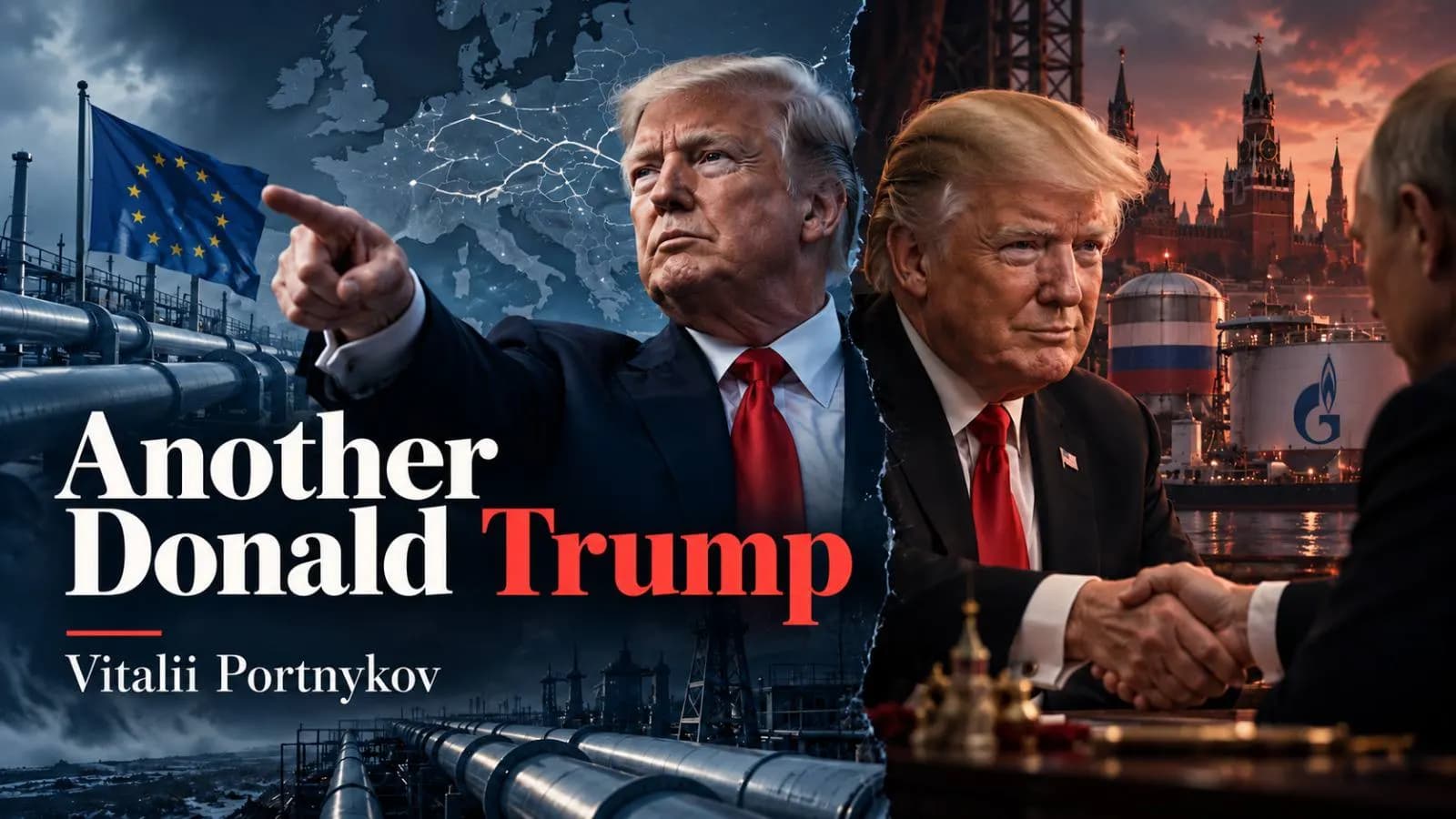
Another Donald Trump

During his first tenure in the Oval Office, Donald Trump criticized Europe for purchasing Russian gas and emphasized that this would create a dangerous dependency on the Kremlin. There are well-known clips showing German ministers laughing at these words of the American president. Now, this laughter appears as a perfect testament to shortsightedness and a lack of strategic thinking. After all, Berlin was warned that the completion of the "Nord Streams" could lead not to drawing Putin into big business with Europe, but to a major war in Europe.
However, the one who insisted on the dangers of energy dependency is now, under new circumstances, negotiating with Putin about supplying Russian diesel fuel to global markets. Moreover, the media claims that the resumption of Russian gas supplies to Europe and the use of the Ukrainian gas transportation system for such supplies should become an important condition for ending the war.
It seems that these decisions are now being made by a different Donald Trump — not the person who warned Europeans about the dangers of depending on Russia. But why has the American president's view on Russian energy resources changed so much? Perhaps because he saw the prospect of uniting efforts and American presence in Russian business? Maybe when you depend not only on Russian energy resources but also on American profits from their sale, it doesn't seem like such a dependency?
But whatever Donald Trump's motives are, they are unlikely to reflect on ending the war and affecting Russia's income.
Firstly, because Europeans seem to have agreed with Trump's opinion — the Trump who persuaded them to abandon energy dependency, not the Trump who might propose to restore it. The refusal of Russian gas — at least pipeline gas — happened at a pace that even Europeans themselves did not anticipate. And even if we imagine that the war ends and sanctions against Russia are eased, who said that Europe would abandon the diversification of gas supplies? After all, Trump was right: all these pipelines turned out to be a real trap, with which Putin intended — and possibly still intends — to dictate his terms to Europe.
Secondly: Russia itself has already had all this. It had a monopoly position in the European market, built over decades of efforts by Soviet and Russian leaders and energy specialists. And there was the Ukrainian gas transportation system, which had the capacity to pump a larger volume of Russian gas supplied to European countries.
What did Putin do when he first came to power? First of all, he replaced the leadership of "Gazprom" headed by the influential founder of the corporation, Rem Vyakhirev. Then he ordered the new head of "Gazprom," Alexey Miller, who has led the corporation for almost as many years as Putin has ruled Russia, to develop a plan for building so-called bypass pipelines — an underwater network that would allow abandoning the services of the Ukrainian gas transportation system. And around the same time, Russian propaganda began creating a mythological image of the Ukrainian who steals Russian gas and can be blackmailed by cutting off supplies. Thus, Putin and Miller began preparing to abandon Ukrainian services.
In other words, everything Trump is prepared to offer Putin — in exchange for an end to hostilities in Ukraine and joint energy projects — is something Putin already possessed. Yet, he sacrificed it all for the sake of controlling Ukraine. This is because Putin’s political priorities differ significantly from Trump’s. Trump continues to believe in the power of profit, whereas Putin is convinced that profit is generated through force — a point he has sought to demonstrate throughout his entire rule in Russia.
Therefore, nothing will come of the American proposals for the Russians, Europeans, and Ukrainians. Putin wants Ukraine — and he is confident that, in this way, he will gain control over Europe, even without the help of Gazprom or Trump; he will take it by force. Yet, the Ukrainians were prepared to keep the gas transmission system operational even during the war — and that did not save us from the war.
As for the Europeans — well, they simply bought into the logic of Donald Trump, who urged them to break their energy dependence on Russia nearly a decade ago. We all preferred the logic of that "earlier" Donald Trump.