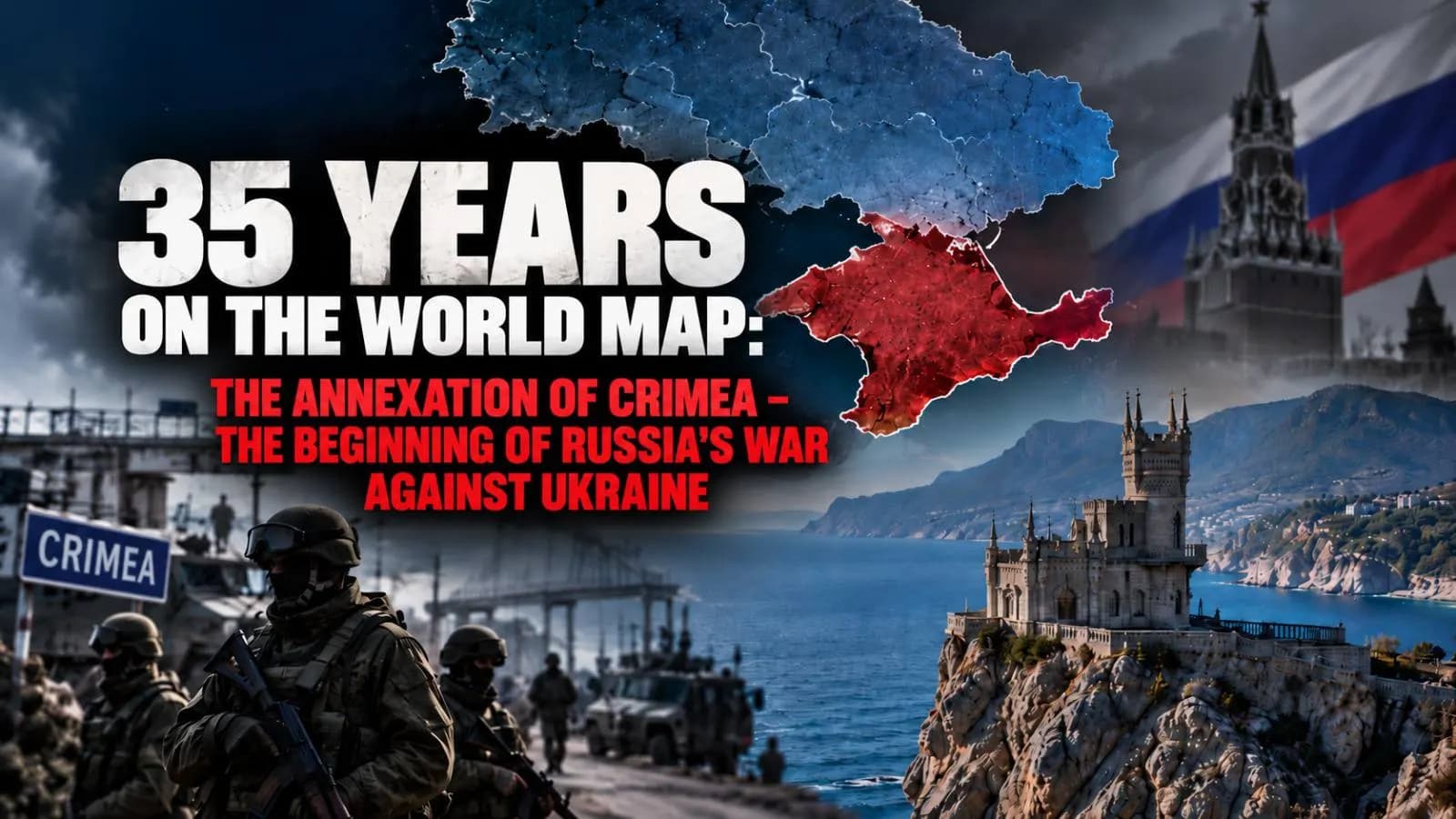
35 Years on the World Map: The Annexation of Crimea — The Beginning of Russia's War Against Ukraine
The shooting at Maidan and the escape of President Yanukovych divided Ukraine's fate into "before" and "after." Painting the victory of the Revolution of Dignity as a "coup d'état" and the "coming to power of the Bandera junta," from February 2014, Russia began aggression against Ukraine: initially covertly, using "hybrid" methods, it occupied Crimea, as well as Donetsk and Luhansk regions; and on February 24, 2022, it launched full-scale, open military actions aimed at the complete destruction of the Ukrainian state.
The "polite" annexation of Crimea
According to Russian propaganda and official statements, Crimea was "returned to its native harbor" "without a single shot." Unidentified individuals, who were actually Russian special forces without insignia, were called "polite people" in Russia. Thus, during the operation to detach Crimea from Ukraine, expel Ukrainian troops, and annex the peninsula to Russia, weapons were almost not used. The aggressors acted by other methods, which were called "hybrid" — mainly methods of PSYOP and threats of a full-scale invasion at a time when Ukraine could not resist. It was a rather complex operation, and, in my opinion, it is worth examining it in more detail.
Together with Yanukovych, all the main officials fled: the Minister of Internal Affairs Zakharchenko, Prosecutor General Pshonka, the Minister of Defense, etc., taking state funds with them. The country was left without power, without money, and without an army. The Verkhovna Rada took over the management. Taking advantage of the moment of uncertainty and confusion in the central government of Ukraine, Russia, from February 20 — simultaneously with the shooting at Maidan — began to provoke unrest in Crimea and eastern Ukraine, in Donetsk and Luhansk regions.
The seemingly "peaceful" capture of Crimea was described in detail by the well-known political scientist, colonel of the Armed Forces of Ukraine Taras Berezovets, himself a native of Crimea ("Annexation: The Island of Crimea. Chronicle of the 'Hybrid War'. Kyiv: Bright Star Publishing, 2015. 391 pages). This is a chronicle of the Russian capture of the Ukrainian peninsula — a detailed hourly description of events, with quotes from officials of Ukraine, Russia, and Crimea itself, along with a detailed analysis of the methods by which Russia managed to occupy Crimea.
How did it happen? Why didn't Ukraine organize armed resistance? The book provides answers to these questions and prompts retrospective reflections: what was society like in mainland Ukraine and Crimea at that time? How did it change during the war?
In Crimea, there was a significant foundation for Russian PSYOP: pro-Russian parties and public movements that strengthened under Yanukovych, as well as the shortcomings of the Ukrainian central and local authorities in developing Crimea as a territory of Ukraine and the Crimean Tatars. None of the officials even raised the issue of recognizing the Crimean Tatars as the indigenous people of Ukraine. All this prepared the ground for the success of the Russian "hybrid war."
This article can only briefly review the course of events.
On February 22, 2014, Yanukovych fled Kyiv and, through Kharkiv and Donetsk, headed to Crimea, as noted in the book. Meanwhile, the Crimean units of the Internal Troops of Ukraine and "Berkut" returned to Crimea. "The general state of the Crimean security forces was characterized by two words: anger and despair," Berezovets emphasizes.
In the Crimean media, there was intensified agitation regarding the organization of armed resistance by residents against the "Kyiv regime," calls for the creation of "people's militias."
According to former Russian State Duma deputy Ilya Ponomarev, who later had to leave Russia, on February 22, Putin ordered the Russian Ministry of Defense General Staff to begin the operation to capture Crimea. "According to Ponomarev, the final straw that convinced Putin that the annexation should begin immediately were the events on Euromaidan in Kyiv from February 18–21, 2014," notes Taras Berezovets.
On February 23, the Kremlin, with the help of local pro-Russian forces, organized a rally in Sevastopol "People's Will Against Fascism in Ukraine." "The participants of the rally, according to Dmytro Bilotserkovets [coordinator of the youth wing of the 'Udar' party of V. Klychko. — N. B.], were mainly family members of servicemen of the Russian Black Sea Fleet, who voted for the 'new mayor' (according to the Constitution of Ukraine, the special status of Sevastopol did not provide for the position of mayor) — the odious businessman, Russian citizen Alexei Chaly, and also refused to 'pay taxes to Kyiv,'" the book states.
The next day, on February 24, "unidentified APCs (obviously belonging to Russia — Ed.) completely blocked all entrances and exits to Sevastopol. Anti-tank 'hedgehogs' had already appeared there, and 'self-defense' units began to form in the city," the author notes.
On February 25, a group of Russian State Duma deputies led by the chairman of the CIS Affairs Committee Leonid Slutsky arrived in Simferopol. "It was Slutsky who made a statement that can be interpreted as the first official Kremlin claim to 'protect compatriots' in Crimea" and "the main priority of the Kremlin's foreign doctrine — the protection of the Russian-speaking population, wherever they may be," Berezovets emphasizes.
On the evening of the same day, the head of the Verkhovna Rada Oleksandr Turchynov convened an emergency meeting of the National Security and Defense Council in Kyiv regarding the situation in Crimea. But Turchynov was, at that time, the only officially appointed official. "Even the Prime Minister had not yet been appointed (this would happen on February 27), the Minister of Internal Affairs (Arsen Avakov became acting minister on February 22, but the Verkhovna Rada appointed him as a full minister on February 27), the head of the Security Service of Ukraine (from February 24, acting Valentin Nalyvaichenko), and other security agencies. The Ukrainian Armed Forces and security forces on the peninsula were paralyzed, as, in fact, in Kyiv, because there was no one to order how to act in specific conditions," the book states.
Meanwhile, the Russians acted coherently, confidently, and cunningly. Berezovets cites Turchynov's testimony.
"They began preparations for the annexation of Crimea and the invasion of Ukraine back in 2005, after the Orange Revolution, when they saw that our country, having broken free from the embrace of Russia, could move towards Europe. Therefore, the invasion of Crimea was not an improvisation, but a carefully planned operation [...] The Revolution of Dignity won, and they went on the offensive [...] The army practically does not exist, the maximum that the Minister of Defense and the Chief of the General Staff could do was to gather about 5,000 soldiers from all over the country capable of carrying out any orders [...] there is no army, no security structures, no government, the police have fled; those who remained are afraid to go out into the streets, where the tires are still burning. Government institutions are not working, armed people are in their premises. And there is 0.0 hryvnias in the treasury account. A unique situation to attack, which Russia did. But their goal was not only to capture Crimea, the goal was to overthrow the new government and revive the puppet regime of Yanukovych," Turchynov said.
On February 26, Russia began four-day military exercises along the border with Ukraine. "Under this cover, on the night of February 27, 'green men' will seize the Crimean Parliament," the author summarizes.
On that infamous day, February 26, an extraordinary emergency session was to be held in the Crimean Parliament regarding the situation on the peninsula. At that time, two rallies gathered near the Crimean Parliament: a pro-Ukrainian one, with a significant number of participants being Crimean Tatars, and a pro-Russian one. A clash erupted between them, resulting in the deaths of two participants.
"Pro-Ukrainian activists managed to defend Ukrainian power and Ukraine's sovereignty over Crimea. But, unfortunately, blood was shed here for the first time. None of the rally participants yet knew that they had fulfilled a historical mission, only for one day stopping the terrible scenario of the 'Russian spring' in Crimea and breaking Putin's maniacal plans," concludes Taras Berezovets.
"Green men capture centers of power in Crimea"
After the events of February 26, on the night of the 27th, the Crimean Parliament was seized by "unknown" individuals. In green "semi-military" uniforms without insignia, they surrounded the Crimean Parliament building under the cover of night. "It was then that the Kremlin realized that it would not be possible to seize power in Crimea in any other way and threw in the main army reserve of Russia — special forces," the book states.
"Russian propaganda had, obviously, as its main goal to show — for the first time since the Georgian war, that the Russian armed forces had become fundamentally different [...] Russia developed a special uniform that was supposed to suddenly appear on the world's TV screens and seem particularly attractive," notes Taras Berezovets.
He cites the testimony of the commander of the Internal Troops in Crimea, Mykola Balan. "On the night of the 26th to the 27th, at 4 a.m., the duty officer called me and said that they called from the Crimean Ministry of Internal Affairs, saying that unknown people had seized the buildings of the Crimean Parliament and the Council of Ministers." Balan convened a working group. "We were deciding what to do: whether to storm, with what forces to storm." The "Alpha" and "Berkut" units refused to go on the assault. "The reserves could only be the Armed Forces of Ukraine, but an internal conflict is not their task. They suggested that the border guards completely block the Kerch crossing, which they conscientiously did not do [...]. Then came the information that Il-76 planes began landing in Hvardiyske," Balan recounts.
Initially, they decided to engage diplomacy. "At that time, pacifist sentiments still prevailed in Kyiv, and some representatives of the new government demonstrated complete detachment from reality," Berezovets comments. In particular, they tried to appeal to the Budapest Memorandum. However, the Kremlin presented the events as an internal Ukrainian conflict. "President Putin, in a phone conversation with President Obama, literally days ago pledged to respect Ukraine's territorial integrity," Berezovets quotes U.S. Secretary of State John Kerry.
Meanwhile, "suddenly for everyone, the Crimean Parliament published an appeal to Crimeans, in which it effectively announced the holding of a referendum on the status of Crimea on the peninsula," the book states.
"February 27 went down in history as the day when, for the first time, history began to be made not by politicians or citizens, but by unidentified 'green men.' Unfortunately, the realization of the beginning of the catastrophe had not yet come to the majority of Ukrainian, European, and American politicians. They were convinced that it was just another surge of separatism, supported by Russia, whose goal was banal blackmail. Putin [...] knew exactly how Ukraine and the West would respond to him. Putin sent, as he thought, a powerful signal to the West. However, he never received a response to it," concludes Taras Berezovets.
The annexation of the peninsula's territory and the expulsion of Ukrainian troops
Since then, "green men" have consistently captured military facilities and Ukrainian military units. They began by blocking two Crimean airports, using military units of the Russian Black Sea Fleet and "green men" — on February 28, the "Belbek" airport in Sevastopol and the international airport "Simferopol" were surrounded.
In addition to the general confusion, there was another reason why the internal forces of Ukraine in Crimea did not resist: the situation after "Maidan," when the units of these troops, especially "Berkut," stained themselves by participating in the shootings of peaceful protesters. "Berkut" was disbanded, its fighters were subject to prosecution for violating the laws of Ukraine. Thus, "Berkut" and "Alpha" in Crimea found themselves between the Scylla of the post-Maidan situation and the Charybdis of the duty to defend Ukraine's territory from invaders.
Berezovets cites in connection with this situation the testimony of People's Deputy Serhiy Kunitsyn — he was acting as the representative of the President of Ukraine in Crimea.
"I was in Turchynov's office — with Nalyvaichenko, Avakov, security officials. We saw the broadcast that this was no 'self-defense,' this was Russian special forces. In Crimea, I was constantly in contact with people. But who was there to negotiate with? Those guys who seized the buildings, [...] their task was — not to talk to anyone. Their task was — to capture and hold until the arrival of the main forces. In Crimea, there was 'Berkut' — 400 people, there was 'Alpha' — 160 people, about 600 people of the Internal Troops. That is, 1200 people — a tenfold advantage over the Russian mercenaries. If the relations with these commanders had been properly built, everything would have been different. The Crimean 'Berkut' closed itself on its base, they were afraid that they would be lustrated. 'Alpha' — the same. If they had been given some guarantees — drive out the invaders, and you will have amnesty, they would have done it. But because there was no one to tell them this, plus we lost a week, nothing could be changed anymore [...] they told me: "It's too late. They have already been given guarantees from the Russian side that when Crimea is taken, there will be a place for them too."»
On March 1, the Federation Council of Russia adopted "the first legal document that regulated the introduction of its Armed Forces into the territory of Ukraine. From the point of view of international law, this is not just an aggressive step, in essence, it is a declaration of war. However, without an official notification about it. March 1 can be considered the beginning of the 'hybrid war' against Ukraine, when the first legal document appeared, by which Russia de facto recognized itself as an aggressor country," Taras Berezovets summarizes.
According to the testimony of the acting Minister of Defense of Ukraine Ihor Tenyukh, Russia introduced 6,000 soldiers into Crimea and "relocated about 30 BTR-80s to the territory of the Autonomous Republic of Crimea, which is a gross violation of agreements and treaties."
"At this time, the separatist authorities of the peninsula began to act according to the classic NKVD-KGB canons," Berezovets emphasizes. Thus, the self-proclaimed Prime Minister Sergey Aksyonov read out an appeal to Putin for help. It was on the basis of this appeal that the Federation Council made the decision to allow the introduction of troops into Crimea.
The consistent capture of Ukrainian military units occurred in the PSYOP mode.
"The State Border Service confirmed the facts of personnel recruitment. During February-March and until the final annexation, the Russians used armed threats, intimidation, direct physical influence [...]. To convince the most steadfast Ukrainian officers, they resorted to cynical methods from the times of the KGB of the USSR: psychological and moral pressure, intimidation, threats to them and their family members. Softer techniques involved bringing former classmates, fellow soldiers from Russia to talk with Ukrainian officers. For this, of course, detailed dossiers were needed [...] Often, Russian officers, whom our servicemen had known for years from joint exercises and parades, were specifically placed against Ukrainian military units, with the calculation that Ukrainian officers would not open fire on them," Berezovets notes.
This technique is detailed by Andriy Parubiy — the book cites his words: "With each commander about the surrender of military units talked [...] former classmates or those who served together, or family friends. They offered prospects, apartments, rewards. It was a well-prepared operation. There is no doubt that this preparation began back when the Kharkiv agreements were ratified on April 27, 2010. Putin later said in his interview that without new military units he would not have been able to do this." Russia also bribed some Ukrainian military and law enforcement officers.
However, the actions of the Russian special forces were far from "polite" everywhere. Here is just one example — the capture of the military unit in Balaklava on March 3.
"At 2 a.m., our soldiers were laid on the floor and kicked like kittens," said an officer of unit No. 2382 in Balaklava. «He also reported that Ukrainian soldiers defended part of the area with batons and shields, while Russian military forces confronted them with machine guns,» added Berezovets.
The Russian military used civilian women as human shields — this is evidenced by Arsen Avakov: «It was a blaze along the entire line — all garrisons were attacked, and we faced the dilemma: choosing between people and a clash that could lead to serious casualties, or trying to find a balance [...] For the Russians, the question was absolutely clear: to seize at any cost, but first to try to seize through 'hybrid combinations'.»
Raider seizures, looting, theft of military units' property and personal belongings of soldiers — all this occurred on a massive scale, as previously in Georgia, according to testimonies cited in the book.
The Russian Federation relied on outright criminals and traitors in the local authorities of the Autonomous Republic of Crimea, particularly on the 'self-proclaimed' (in fact, appointed by Russian special services) 'premier' Sergey Aksyonov and the head of the Crimean Parliament Konstantinov. Some Ukrainian officers also sided with the Russian Federation — the highest-ranking among them was Denis Berezovsky, who was appointed acting deputy commander of the Ukrainian Navy by Tenyukh just a few days before his betrayal. However, there were very few traitors among the Ukrainian military.
'People's Will': 123 percent — for 'Crimean Independence'
On March 11, the Crimean Parliament unexpectedly adopted the 'Declaration of Independence of the Republic of Crimea', removing the term 'Autonomous' from its name, which severed Crimea's connection with 'its true Motherland', as Berezovets notes. By this time, the seizure of the peninsula was almost complete. Streams of refugees began moving from Crimea to mainland Ukraine. The Russian Federation rapidly increased its military presence at the border and on the peninsula.
Of course, in the Crimean Parliament's address to Crimeans, the reason for separation was stated as the 'coup in Kyiv', as a result of which 'armed gangs roam the capital of Ukraine and its regions, intimidating the authorities, courts, and ordinary peaceful residents. The country has plunged into chaos and lawlessness,' the author quotes this address.
'Crimeans have always been passive during election campaigns — turnout here was lower than the national average. This referendum was no exception, so the drawn 83.1% did not correspond to reality and was achieved by bringing in many Russian citizens, as local election commissions allowed voting even with Russian passports — both for Cossacks and Russian military personnel. At the same time, the lowest turnout was in Sevastopol — the most pro-Russian city in Crimea. However, Eastern Crimea: Leninsky, Feodosia districts, Kerch — showed the highest turnout, further confirming the facts of Russian citizens being brought in: they did not travel too far from the Kerch Strait, through which they arrived in Crimea,' Berezovets notes. Nevertheless, according to the fabricated results, 123% of Sevastopol residents 'supported' Crimea's 'independence'.
From then on, the fate of the peninsula was sealed.
The main conclusion drawn from Berezovets' book is that Crimea resisted Russian hybrid aggression as best it could — with rallies, the activities of activists who risked their lives and faced persecution and torture (at least two died), as well as the heroic, though unarmed, resistance of Ukrainian military personnel and many law enforcement officers. Unfortunately, due to the combined effects of the reasons discussed above — confusion in the central government, a prepared pro-Russian foundation, betrayal by officials and some military personnel, uncertainty about the fate of 'Berkut' and 'Alpha' after Maidan, psychological unpreparedness for armed confrontation, and the use of PSYOPS methods — Crimea was annexed.
The book provides a detailed account of attempts to resolve the conflict through international diplomacy. Although Russia's actions were met with international condemnation, and Russia was excluded from the G8 and sanctioned for the first time, these measures proved too weak. They not only failed to stop the raider seizure of Crimea but also convinced Putin of the possibility of further aggressive actions.