
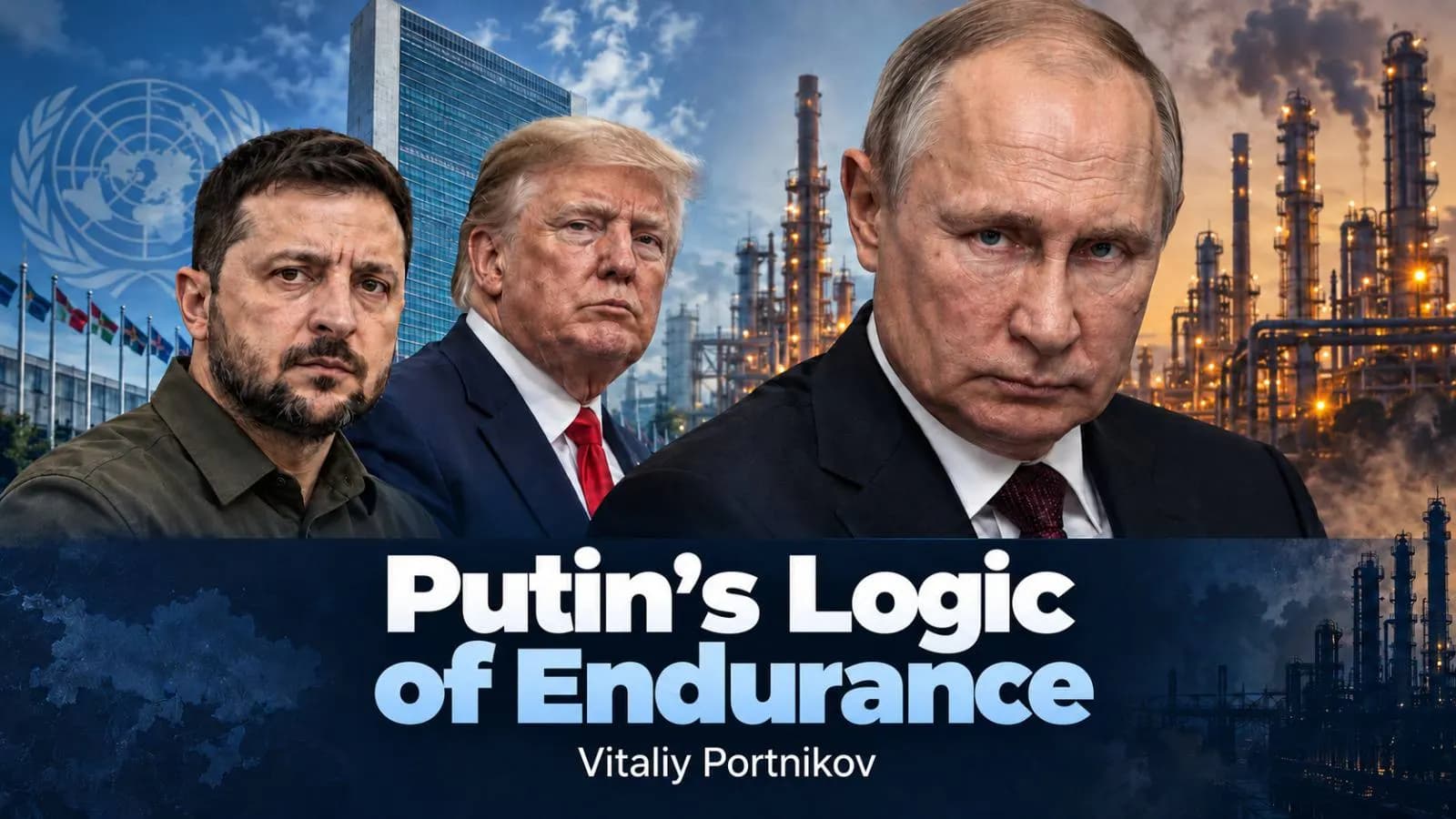
Putin's Logic of Endurance
Volodymyr Zelenskyy met with Donald Trump on the sidelines of the UN General Assembly session in New York. Currently, this meeting does not appear to lead to any specific results in the process of finding opportunities to end the war. However, the fact of the meeting itself is important because it demonstrates that the President of the United States cannot simply ignore this war and that the search for ways to end it and cooperate with Ukraine remains an important part of the American political agenda — at least until the midterm elections, which are crucial for Donald Trump.
Perhaps it is precisely because Trump realizes that the majority of American society supports Ukraine that he himself demonstrates this support. However, demonstrating support and hoping for specifics are not the same thing. Discussions about licenses for anti-aircraft missiles continue, and in the event of an agreement, it will take years before missiles are produced in Ukraine. An agreement on using Starlink on sovereign Russian territory to destroy Russian ballistic missiles also failed once again. Trump advises Zelenskyy to talk to Musk, and Musk advises Zelenskyy to talk to Trump. This game can be played until the end of the war.
However, it is necessary to talk with the Ukrainian president about ways to end the war. Let me remind you that after the visit to Moscow and Kyiv by American intermediaries Steve Witkoff and Jared Kushner, Donald Trump intended to talk with both Putin and Zelenskyy. At that time, only a conversation with the President of Russia took place, which Trump described as "good," but he did not provide any specifics — perhaps because there were none. Witkoff and Kushner could discuss economic projects in Moscow for hours, but they failed to achieve the main goal from Putin — an agreement to end the war.
Ignoring Zelenskyy in this situation turned out not to be the best option. Especially since Trump constantly says that the result of Ukrainian strikes on Russian oil refineries is an increase in diesel fuel prices — including at American gas stations. This is, of course, an electoral exaggeration. Without the opening of Hormuz, the price of fuel is unlikely to change significantly — even if Ukraine stops hitting Russian refineries. But for the American president, it is at least important to demonstrate that he is making efforts to solve the problem. He sends intermediaries to Kyiv and Moscow, signs the "Graham Act," meets with Zelenskyy, and warns Putin about the consequences for his oil refining industry, which, at least from Trump's perspective, he no longer controls.
In business, Trump always tries to adhere to logic. If Putin needs to save his own oil refining industry, he must agree to at least an energy truce. That is why Trump began publicly reminding the Russian president that he has lost control over his own oil refining.
But Putin has a different logic, more akin to Trump's Iranian "partners." Putin measures the situation not by economic interest but by the boundaries of endurance. For the Russian president, it is not important how much Russia loses, but what pressure it can withstand. He exhausts Ukraine for the same reasons — to reach such destruction that will undermine the enemy's endurance. And he "terrorizes" Europe for the same reasons — so that Europeans do not provide Ukraine with the means to resist Russian aggression.
This is not the logic of business. This is the logic of fanaticism. But in their search for ways to end the Russian-Ukrainian war, both Zelenskyy and Trump need to consider this logic. Putin will not start real negotiations as long as he has the opportunity to exhaust Ukraine. As long as Russia has resources for war and endurance. This is a simple formula that argues in favor of further strikes on Russia and increasing support for Ukraine. This means that Russia's oil refining industry needs to be finished off, and air defense missiles for Ukraine need to be found.
And yes, this requires acknowledging that what is ongoing is a war of attrition, not a successful negotiation process. However, such acknowledgment brings us closer to real, not feigned, peace negotiations.