
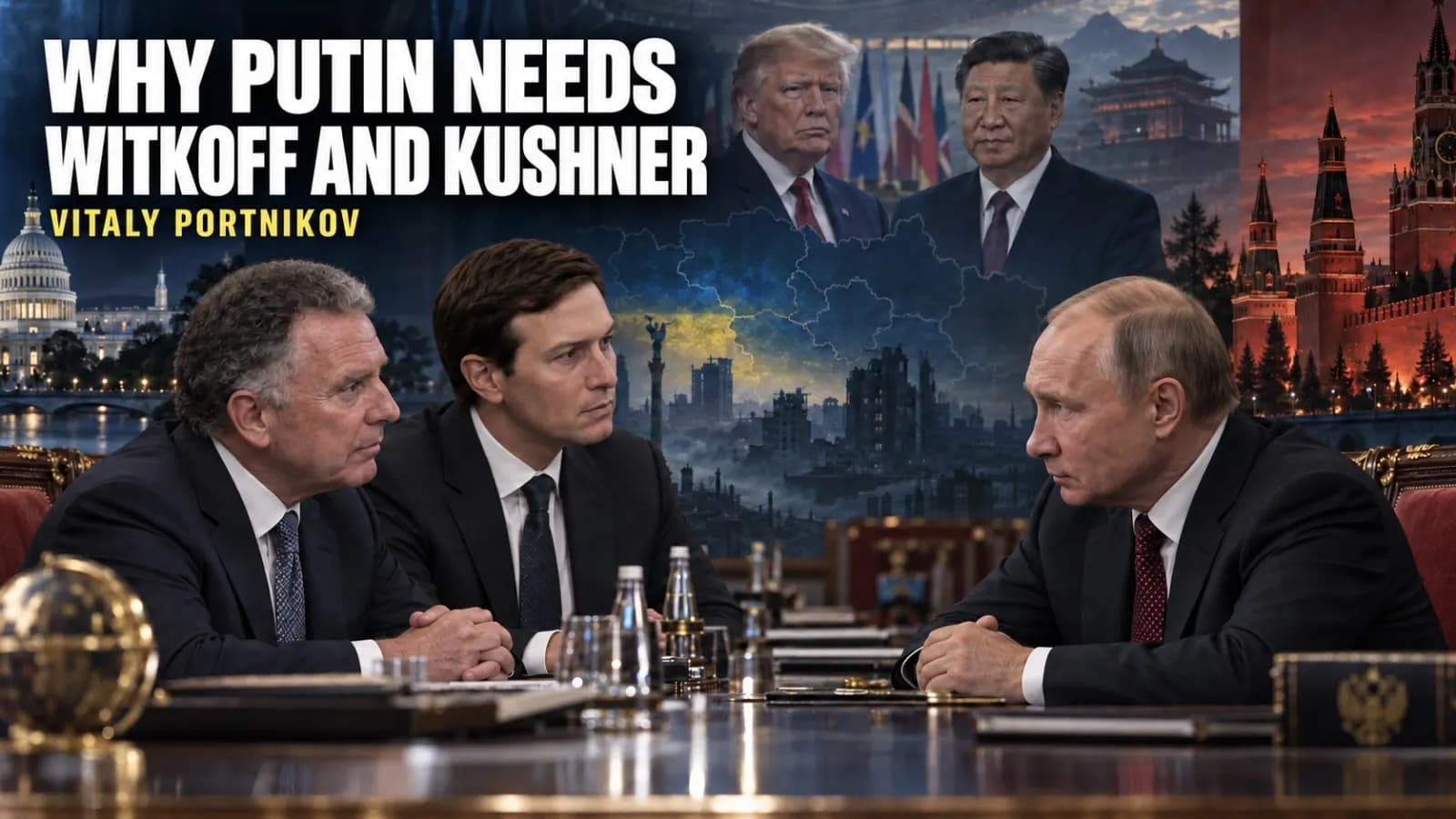
Why Putin Needs Witkoff and Kushner
A few months ago, the very possibility of resuming negotiations between Russia and Ukraine with the participation of American intermediaries seemed more like political fiction, although both Moscow and Kyiv did not rule out new visits by Steve Witkoff and Jared Kushner. However, the intermediaries were engaged in a Sisyphean task — seeking ways to resolve the situation after the war with Iran, and the Kremlin was in no hurry to negotiate. It is worth recalling that it was not the Americans or Ukrainians who withdrew from the consultation process, but the Russians. Until recently, Moscow emphasized that negotiations could only resume after Kyiv withdraws troops from the part of the Donetsk and Luhansk regions that remains under the control of the legitimate Ukrainian government. Until then, Putin refuses any talks.
But September came — and the intermediaries went to Moscow and Kyiv. Although resolving the situation around Iran is hardly expected. Although Ukrainian troops remain in Donbas. And although Russian strikes on Kyiv and other Ukrainian cities continue, from which it is still difficult to defend.
We understand why the resumption of negotiations is important for Zelensky: as the head of a state that has suffered aggression and destruction, he is simply obliged to seek ways to a just peace. From the perspective of his own society's demands, tired of endless war, and from the perspective of partners' interests, who would like Kyiv not to reject chances for peace.
We understand why the resumption of negotiations is important for Trump, who would like the success of his peacemaking efforts and opportunities to restore economic cooperation with Russia.
And we do not quite understand why the resumption of negotiations is important for Putin. Unless the Russian president is indeed concerned about the state of his economy and would like to stop Ukrainian strikes. But how to do this without peace agreements?
However, the negotiations of Witkoff and Kushner in Moscow did not record any real changes in the Russian position. Therefore, Putin's readiness for negotiations can still be explained by his usual tactic of buying time. Only now, it is quite likely that Putin is buying time not only for Trump but also for the leaders of the Global South countries, Russia's economic sponsors — Chinese President Xi Jinping and Indian Prime Minister Narendra Modi. Putin met with both during the Shanghai Cooperation Organization summit in Bishkek. And, by the way, it was after this that the tone of his statements noticeably changed.
Another reason that could have influenced Putin's mood is the Russian president's desire to meet with his American counterpart during the APEC summit in November in Shenzhen, China. It is clear that Putin's reluctance to meet with American intermediaries and demonstrate readiness to seek ways to peace could hinder such a meeting. Especially since Putin has an even more ambitious idea, which, after his negotiations with Witkoff and Kushner, was "revealed" by Russian presidential adviser Yuri Ushakov.
This is the holding of a trilateral summit of Trump, Putin, and Xi Jinping on the sidelines of the meeting in Shenzhen. For Putin, such a meeting would be a huge achievement, as it would confirm that he is one of the leaders of the modern world and stands alongside the US president and the head of China. And Trump, as is known, is inclined towards such a format.
And it is quite likely that the resumption of negotiations on ending the Russian-Ukrainian war has become part of the Kremlin's plans to organize a trilateral meeting — and nothing more. But the visit of American intermediaries may have nothing to do with the actual end of the war and Russia's transition to more constructive and realistic positions.