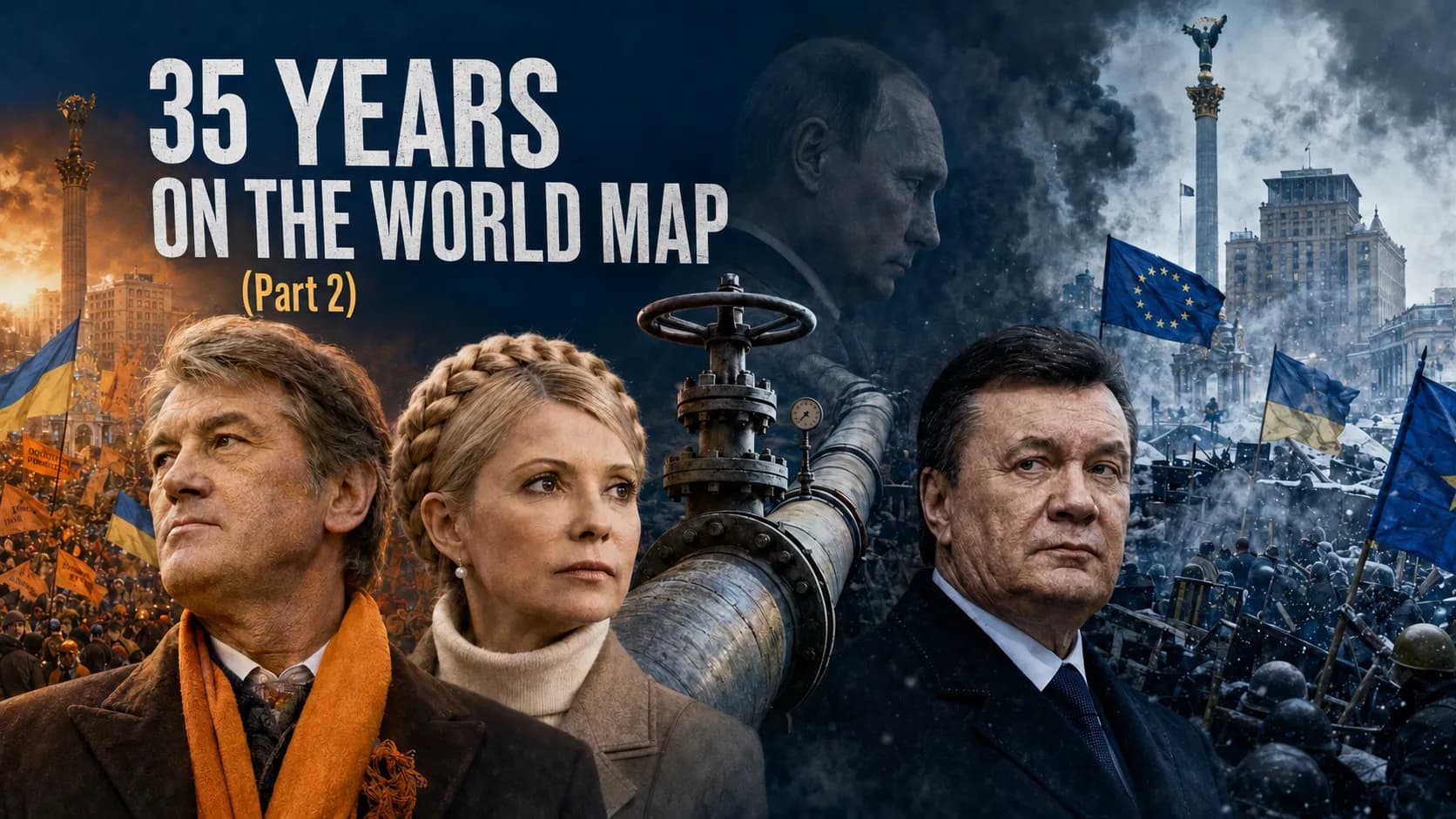
35 years on the world map. The beginning of national-democratic transformations in Ukraine and the gas wars
Viktor Yushchenko, for the first time since the declaration of independence, undertook to implement a national-patriotic program and infuse statehood with national identity. During his presidency, there was a gradual rehabilitation of the history of the national liberation movement of the Ukrainian people in Ukrainian society: the first monuments to Stepan Bandera were erected, streets were renamed in honor of heroes of the struggle against Russian enslavement, and the Holodomor was recognized as genocide. The national-patriotic public welcomed these transformations of mass public consciousness; the pro-Russian part of society fiercely resisted, yet national identity gradually, slowly began to encompass wider circles of ordinary Ukrainians.
However, ideology became the only realm of at least partial success for the "orange" movement. All other spheres — economy, politics, everyday life, etc., suffered acute defeat. This was caused by both the economic wars initiated by Moscow and the unfortunate mistakes of Yushchenko as president.
Two fundamental mistakes by Yushchenko determined the path of the "orange" movement to defeat. The first mistake was bringing close to him everyone who at least seemingly supported the 2004 revolution or those who quickly "changed colors": oligarchs, even such odious ones as Dmytro Firtash; cultural figures who were appointed to positions of ministers of culture and education without any assessment of their professional qualities. In other words, Yushchenko laid the foundation for the creation of a state apparatus based on the principle of personal and political loyalty, which outweighed the principle of professionalism and appropriate personal qualities. This principle of personal loyalty would later be adopted by other presidents.
The second mistake of Yushchenko was the inability to create conditions for the reform of the judicial branch (and this would continue and persist to this day), making it impossible to separate political struggle from the society's struggle for the rule of law. As a result of this mistake, the main expectations of society from the revolution remained unfulfilled: the completion of high-profile investigations of political-economic crimes, political murders, and unlawful privatization, etc. The absence of an independent judicial system created the prerequisites for the gradual return of the country to a semi-mafia regime and the revival of Yanukovych. A system was created in which some political forces, represented by President Yushchenko and the even more radical Prime Minister Yulia Tymoshenko, opposed the capture of Ukraine at that time by the Russian mafia; however, other political forces, led by Yanukovych, whom Yushchenko himself returned to power by appointing him as prime minister instead of Tymoshenko, fiercely resisted reforms and the country's progress towards the West. Moreover, both parts of Ukrainian society at that time were heading towards the West, only the patriotic part sought to unite with the West on the basis of values, while the mafia inclined towards similar mafia circles in the West itself (mostly these circles were connected with Russian "colleagues" and ultimately with the FSB).
The most vivid struggle of these two forces manifested in the struggle around the monster created by Russian and Ukrainian oligarchs and FSB agents called RosUkrEnergo, or RUE.
This mafia formation deliberately complicated gas trade between the Russian Federation and Ukraine in such a way that its Russian part put Ukraine in economic dependence. Some Western businessmen were involved in this corporation, including a Swiss citizen who ensured the establishment of RUE in the Swiss canton of Zug, where taxes are purely symbolic; the very complex scheme of RUE's activities diverted the corporation's profits to its founders, including Dmytro Firtash.
RUE was constructed in such a way that the Russian Federation could, at its discretion, at any moment shut off the valve on the gas pipeline leading to the Ukrainian gas transportation system, through which gas purchased from the Russian Federation was pumped not only to Ukraine but also to almost half of European countries.
And Russia shut off this valve twice: in 2006 and 2008, during the New Year holidays. The "gas war" aimed at seizing the Ukrainian gas transportation system.
In 2008, Putin's two constitutional terms expired — 8 years. The task of "leaving is impossible to stay" was resolved by a "castling" between the positions of president and prime minister, which was occupied by Dmitry Medvedev. Medvedev became president, and Putin took the chair of the prime minister. This year, the infamous NATO summit took place in Bucharest, where it was planned to provide Ukraine and Georgia with a "Membership Action Plan," but at Putin's demand, this decision was canceled at the last minute. That same year, in August, Russia, for the first time since the collapse of the USSR, attacked a sovereign state — Georgia (where a year earlier than in Ukraine, in 2003, thanks to a popular rally, the pro-Western president Mikheil Saakashvili won). Bombs fell on peaceful Georgian cities, the Russian army invaded them, looting, raping, and killing residents. The aim of the war was to seize the autonomous republic of Abkhazia and the region of South Ossetia — in both regions, a significant part of the population consisted of Abkhazians and Ossetians, although Georgians also lived there. Abkhazians and Ossetians, with the support of Russian troops, carried out ethnic cleansing of Georgians in these regions, causing Georgians to flee to other regions of the country.
Ukraine provided significant humanitarian aid to Georgia. European countries and the USA (represented by President George Bush) strongly condemned the Russian aggression. A "landing" of presidents from Poland (Lech Kaczyński; in 2010, he, as part of a delegation of Polish high-ranking officials, would fly to the sad anniversary of the Katyn massacre and tragically die along with the entire delegation in a plane crash over Ryazan; the circumstances of the crash are still unclear), Lithuania (Valdas Adamkus), Latvia (Ivars Godmanis), Estonia (Toomas Hendrik Ilves), and Ukraine (Viktor Yushchenko) landed in Tbilisi.
Russia was forced to stop, not capturing Tbilisi. The war in Georgia lasted five days, but it brought the country destruction, streams of refugees, and the loss of over 300 people.
On New Year's 2009, Russia again shut off the valve to Ukraine. Prime Minister Yulia Tymoshenko went to Moscow to resolve the situation with her counterpart Putin. She managed to negotiate direct gas purchases from the Russian Federation, without the "mediation" of RUE, but at a price three times higher. This can be considered a strategic victory: despite the increased price, the monstrous corporation, which was a cancerous tumor on Ukraine's body, effectively disappeared from the market. However, Russian agent-oligarchs launched a frenzied propaganda campaign against Tymoshenko and the "orange" movement in general; Yushchenko's rating before the next presidential elections fell to 5%, while Tymoshenko's was higher.
The Comeback of the "Twice Convicted"
In the 2010 presidential elections, what was considered incredible happened: Tymoshenko and Yanukovych made it to the second round, and Yanukovych won with a 3% advantage. Neither the reminders of his two convictions, nor his demonstrative disdain for etiquette, morality, and culture norms, nor even his defeat in the 2004 elections helped. Voters, as if enchanted, saw in him an "effective manager" who promised to bring order to a country tired of chaotic reforms and discord among the "orange" forces.
Yanukovych, meanwhile, won by a margin of 3%, which could have justified a Maidan (there were well-founded rumors of election result falsification); however, it did not happen this time; perhaps the sharp disappointment due to the unfortunate mistakes of Yushchenko and Tymoshenko played a role.
With Yanukovych, the mafia and pro-Russian forces did not delay their comeback. Under their pressure, the Verkhovna Rada adopted the infamous "Kharkiv Accords" (despite the resistance of patriotic deputies): for cheap Russian gas, the base of the Black Sea Fleet in Sevastopol was allegedly "leased" to the Russian Federation for 49 years. Of course, at that time, even the majority of patriotically-minded and logically thinking political analysts could not foresee that this "lease" would become a springboard for the capture of Crimea by Russia four years later, and even less could they predict that the Russian Federation would go to war against Ukraine. However, alarming "bells" had already sounded. After the aggressive war of the Russian Federation against Georgia, US President Barack Obama announced the infamous "reset" with the Russian Federation, which untied its aggressive forces' hands for further actions; some political analysts warned that Ukraine could be the next victim of Russian aggression, but they were in the minority, and their warnings were not heeded.
Meanwhile, during Yanukovych's rule, the Russian Federation captured positions in Ukraine without war — the Russian agent mafia was activated, and Yanukovych appointed citizens of the Russian Federation (by passport!) as the Minister of Defense of Ukraine and the head of the SBU. There was a frenzied sale of Ukrainian strategic weapons, including missiles: after all, it was believed that Ukraine had no enemies, but there were debts to be paid.
Under Yanukovych, political repressions resumed in Ukraine. The entire country was shaken by the arrest of Yulia Tymoshenko on charges of "state treason" — she was incriminated with the same agreement on direct gas purchases and the liquidation of RUE; Yuriy Lutsenko, who was the Minister of Internal Affairs under Yushchenko, was also arrested, but he was soon released due to public outrage.
However, even Yanukovych initially did not dare to completely turn the country away from the pro-Western direction; rather, he tried to follow the "multi-vector" course initiated by Kuchma. Ukraine successfully hosted the European Football Championship in 2012, which brought it economic success.
Meanwhile, in the winter of 2012, the last attempt in its history to return the country to democratic tracks flared up in the Russian Federation. In response to the blatantly falsified results of the State Duma elections, citizens organized something akin to a Maidan; in Moscow, several tens of thousands, possibly up to a hundred thousand, took to the protest rally. However, unlike the Ukrainian Maidan of 2004, Russian fighters for democracy did not show enough determination to stand despite all hardships (including freezing in the cold); not to disperse, no matter how long they had to stand; to risk, if necessary, their lives, because it is never known whether the authorities will dare to forcibly disperse; to put the fate of their country above even their immediate duties at work, study, etc. Russian protesters also did not demonstrate the unity shown in Ukraine: Russian opposition leaders acted according to the well-known saying "everyone for themselves." But the Russian security forces showed unity and determination. They dispersed the rallies with mass beatings, and later, five or six years later, gradually, one by one, arrested and sentenced to prison terms all those who dared to come out then. The most popular leader, Boris Nemtsov, was shot dead near the Kremlin in 2015.
As a result of all these factors, the weak sprouts of democracy in the Russian Federation were uprooted, and Putin once again took the presidential chair.
Meanwhile, in Ukraine, events were rapidly approaching a climax. In 2013, Yanukovych was supposed to sign an agreement with the EU on Ukraine's "association" with the European Union. Putin summoned Yanukovych "to the carpet," provided him with a new "loan" for Ukraine (in fact, bribe money), and sternly ordered him not to sign anything. However, there was already an agreement with the EU to sign. And so, just before the already scheduled act of signing the association agreement, Prime Minister Mykola (actually, Nikolai) Azarov announced that, supposedly, the economic state of the country required the "postponement" of the agreement for a year. Ukrainian society was agitated by this statement.
This time, a relatively small group of Kyiv students came out to the Maidan, demanding adherence to the word — the signing of the agreement. They were brutally beaten by the police. This served as a starting point — hundreds of thousands of angry citizens took to the Maidan; Maidans began to be organized throughout the country. In total, several million people took to the protests. Thus began the second Maidan, which was called Euromaidan, because its goal was to achieve the signing of the agreement with the EU.
The protesters were as determined as their predecessors in 2004. Independence Square turned into a fortified "town" with tents, a kitchen, a medical point, etc. Here they lived as if in their own daily lives, almost independently of the rest of the city; unity was strengthened, determination to stand to the end grew; personal connections between protesters and their like-minded people "beyond" the Maidan were strengthened, etc. An important feature of the Maidan participants was their emphasized high culture of relations, a sense of their own dignity — this period was called the "revolution of dignity," which favorably distinguished it from the lack of culture of Yanukovych's power.
A political Ukrainian nation was strengthening on the Maidan, consisting of people of different ethnic origins, different socio-economic strata, etc.; the middle class of small entrepreneurs and some large entrepreneurs played a significant role.
Several times the police tried to storm the "town," but to no avail. Among the protesters, there was euphoria of imminent victory, it loomed, but did not come.
New Year 2014 was approaching…
Tragic Victorious Denouement
On January 16, pro-government deputies of the Verkhovna Rada adopted a series of laws that the protesters immediately called "dictatorial": the organizers of the Maidan were declared terrorists, the police were given powers to act against "violations of public order," etc. On January 18, for the first time in the history of this movement, shots were fired into the unarmed crowd on the Maidan. Four people died (ironically, among them were Armenian Serhiy Nigoyan and Belarusian Zhiznevsky).
The Maidan became even more united. People were not dispersed even by extraordinary frosts — over 30 degrees Celsius.
Yanukovych looked confused. He did not even meet the demands of the protesters to change the government, to dismiss Azarov; however, he also did not dare to seriously disperse the Maidan.
In February, for a moment, it seemed that the crisis could be resolved. In negotiations between Yanukovych and opposition deputies of the Verkhovna Rada, mediated by former Polish President Aleksander Kwaśniewski, Yanukovych allegedly agreed to hold early elections at the end of 2014.
What happened next is still not fully clarified for various objective and subjective reasons. One can only outline the course of events. Negotiations on early elections suddenly broke off, and calls for "Yanukovych — out!" immediately sounded on the Maidan. On February 18, snipers unexpectedly appeared and began shooting unarmed protesters with a barrage of fire. Whether the snipers were Ukrainian or sent from Moscow has not been officially clarified; however, everything indicates that the Russian Federation sent a firing squad, and Russian snipers "dissolved" among the special detachment of the Ukrainian police assigned to quell the "disorders." Protesters defended themselves as best they could — with homemade shields, some hunting weapons, etc.; the forces were unequal. Over three days of shootings, more than a hundred peaceful people fell — they were called the Heavenly Hundred. There were also casualties among the police, but why, in fact, did the authorities suddenly resort to a bloody dispersal of the rally, just when the crisis seemed to be approaching a peaceful resolution? This question has not yet been answered.
On February 20, it became known: Yanukovych fled the country. Someone helped him escape to Crimea, and from there — to Rostov-on-Don (Russia).
The Maidan celebrated victory despite the tragic losses.
(To be continued)