
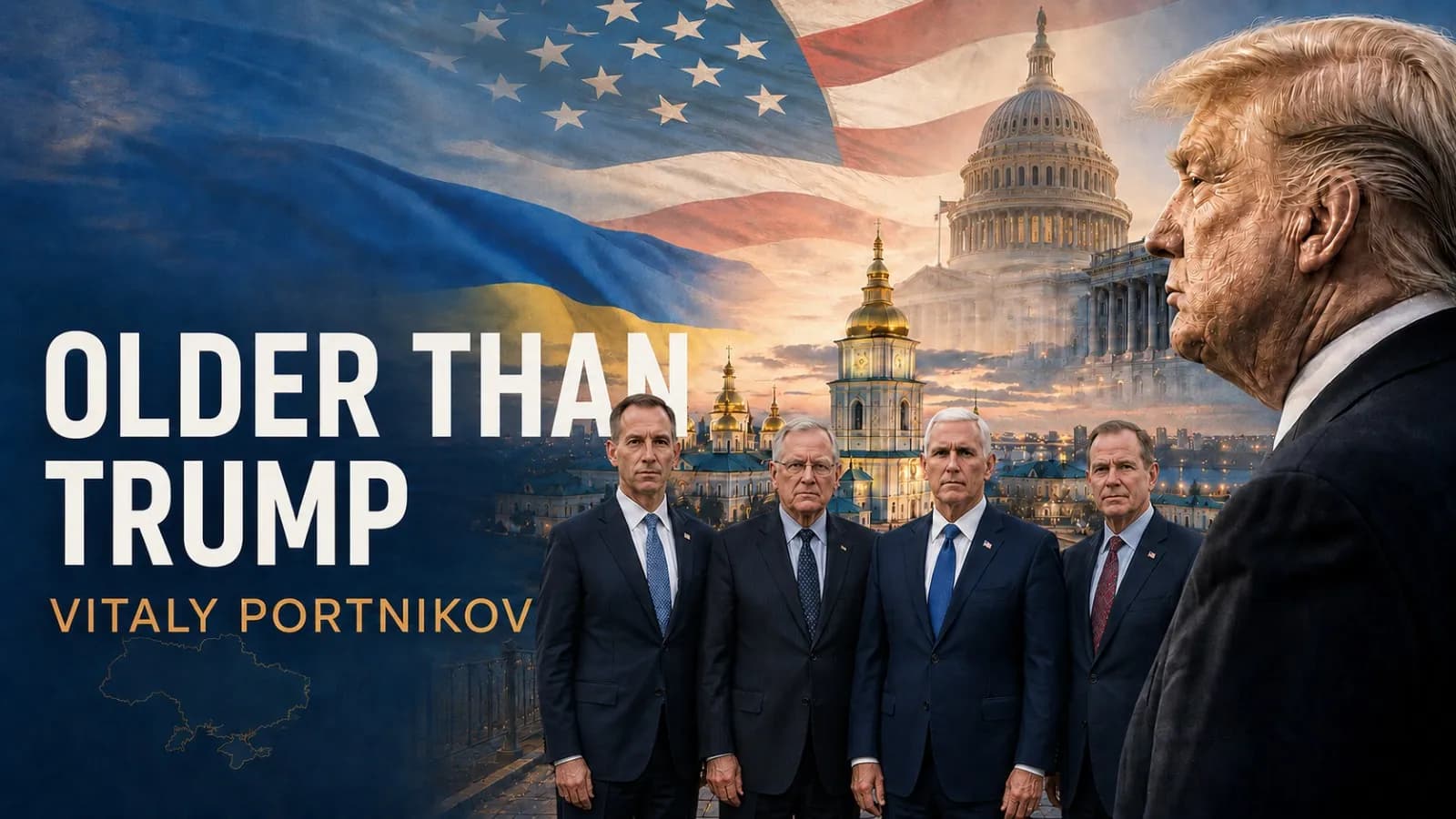
Older than Trump

On the eve of the thirty-fifth anniversary of Ukrainian independence, a whole group of leading American politicians visited Kyiv, among whom were former U.S. presidential envoy on Ukraine, General Keith Kellogg, Senators James Lankford and Richard Blumenthal, former U.S. Vice President Mike Pence, former congressmen, and spiritual leaders. An expert in current American politics might say that primarily "wedding generals" gathered in the Ukrainian capital. Most of them do not have real influence in Donald Trump's Republican Party. Keith Kellogg himself has already explained how his position turned out to be more of an attribute for international conferences than a real tool for influencing Donald Trump and other members of the administration.
However, the very fact of conservative politicians visiting Kyiv allows us to recall the model of bipartisan support, which remains an important part of U.S. assistance to Ukraine. Recently, such bipartisan support has not been typical for American politics at all. This, by the way, applies not only to Ukraine. We see how most Democrats support our country and seek Republican votes. And we see how most Republicans support Israel, while the Democratic Party's position begins to significantly differ on Middle Eastern issues. However, this should be an additional incentive for dialogue with those among whom Ukraine does not have a majority.
We are used to measuring modern conservative America by one measure—what Trump said. What Trump wrote. Whom Trump appointed. It's convenient, it fits into the news cycle, and it's not the whole truth.
Conservative support for Ukraine predates Trump and will outlast Trump. It is not based on a specific person in the Oval Office but on values and people. Prayer breakfasts, evangelical networks, congressional coalitions that have been formed over decades. They don't make headlines precisely because they work constantly, not episodically. And, by the way, few in Ukraine know about the persistent work of the Ukrainian diaspora with Republican congressmen at both the national and regional levels. And that's a pity!
American politics can change—and change significantly, as Donald Trump's presidency vividly demonstrated. But that doesn't mean that a decrease in support for Ukraine today can't turn into increased assistance tomorrow. However, this cannot happen without constant and persistent dialogue.
The Kremlin, instead of dialogue, uses money and promises. Putin doesn't need friends in the United States—he needs people interested in Russian money, quick profits, all those castles in the air that Russian officials build for their American interlocutors. Ukraine does not have such resource capabilities. And when the idea of joint business arises, it quickly turns into a real political scandal. It is worth recalling that Donald Trump's first impeachment was related precisely to the Ukrainian issue, with the conversation between the American president and his Ukrainian counterpart. And the biggest public scandal in White House history was also against the backdrop of a deal regarding Ukrainian resources. So, with Ukraine, it doesn't work that way. We need friends, we need an understanding of shared values. We need an understanding that without security in Europe, the United States will still face a real threat, related to the fact that the weakening of U.S. influence in Europe creates a temptation to encroach on American national interests anywhere.
That is why the visit of American conservative politicians to Kyiv is not just participation in a celebration but a continuation of a political tradition that cannot be abandoned. This is what I constantly advocate for—both when it comes to relations with the United States and when it comes to Ukraine's relations with European countries. Convincing friends is not difficult. Try convincing those who do not support us. And start this dialogue with representatives of their own political camp who stand on pro-Ukrainian positions and have authority in an environment challenging for Ukraine. This is not an easy task, which does not promise quick successes and applause. But, ultimately, this is exactly what is called bipartisan support.