35 Years on the World Map (Part I)
Collapse of the Soviet Empire: Starting Positions of Russia and Ukraine
1989 — Mikhail Gorbachev's "Perestroika" seemed to be proceeding smoothly at first glance. Most of the USSR was at peace, with fierce battles occurring only on the distant "peripheries": in Central Asia, along the border between Tajikistan and Kyrgyzstan and in some areas of Uzbekistan; in the Transnistrian region of Moldova; and the clashes between Azerbaijan and Armenia over Nagorno-Karabakh (an autonomous region in Azerbaijan, predominantly populated by Armenians at the time) escalated into war.
For the first time, the central Soviet authority not only allowed but encouraged the creation of public organizations, parties, cooperatives, local cultural centers independent of the "center," environmental organizations, and more. Ukraine then established a mass people's organization, the "People's Movement of Ukraine."
The processes developed quite logically: the peoples of the Soviet republics gradually gained subjectivity, increasingly recognizing themselves as separate nations. Estonia, Lithuania, and Latvia were at the forefront of these processes. Occupied by the Soviet Union only in 1940, they still retained the memory of their independence. Moreover, the international community did not recognize them as a legitimate part of the USSR, viewing them as occupied states. Therefore, it was easier for them than for other Soviet republics to aim for the restoration of independence — and their public organizations confidently moved in this direction.
Initially, it seemed that this process would end there: a few Baltic republics would take advantage of the Soviet Constitution's provision of the right "to self-determination up to secession and the formation of independent states" and leave the USSR. However, it soon became clear that the processes were much deeper and the desire for independence would not be limited to the Baltics.
Due to the inability of the central Soviet authority to stop the Armenian-Azerbaijani conflict, Armenia also began to seek separation, hoping that by becoming an independent state, it would exit the war with Azerbaijan. Georgia also declared its intention to separate; a mass rally in Tbilisi in April 1989 was brutally suppressed by the Soviet army, which only fueled "separatist" sentiments.
Centrifugal tendencies rapidly gained strength; the central Soviet authority, unable to keep up with events, made a desperate attempt to contain them. In January 1991, the Soviet army invaded Vilnius and Tallinn, attempting to suppress the separation processes. However, these processes flowed like a flood across the entire territory of the USSR. Then the central Soviet authority made perhaps its last attempt to maintain the Union: it was decided to sign a new union treaty on new terms. A new constitution, drafted by the world-renowned scientist and human rights activist Andrei Sakharov, was to be the foundation: the union and autonomous republics were equalized in status and subjectivity, Russia no longer held a dominant position and became equal with other republics. Moreover, it declared "independence from the USSR" and elected Boris Yeltsin as president.
For a while, it seemed that the new union would resemble the European Union. In March 1991, an all-union referendum was held: the majority supported the idea of a new union. However, the Baltic republics no longer participated in it.
However, the central Soviet authority, which included not only reformers but also revanchists, hindered the realization of this idea. Gorbachev tried to maneuver between the two camps.
But on the eve of signing the new union treaty, the revanchists made a desperate attempt to turn everything back. On August 19, 1991, the heads of the KGB, the army, and some other leaders declared Gorbachev ill (in reality, they blocked him at his dacha in Foros) and imposed a state of emergency throughout the USSR. Troops were brought into Moscow, and tanks drove through its streets. The vast state found itself on the brink of civil war, and the specter of 1918 loomed over it again… Perhaps it was the memory of this specter that restrained the situation — open war did not ensue.
The democratic public showed decisive strength. In Moscow, thousands of ordinary people, mostly intellectuals, gathered for an indefinite rally near the parliament; similar rallies took place in St. Petersburg and other cities of the Russian Federation. In Ukraine, democratic forces also gathered near the Verkhovna Rada, but the leadership cautiously waited to see how events would unfold, as 12,000 Moscow troops secretly awaited orders near Kyiv.
However, the coup turned out to be completely unprepared. Yeltsin and his team of reformers managed to take control of the situation in Moscow; the army refused to shoot at unarmed people. Gorbachev was freed from "captivity"; the conspirators were arrested. At that time, it seemed that the democratic forces had won decisively, and there would be no turning back. It was then that the leaders of the republics seized the historical moment. One by one, the Soviet republics declared state independence. The USSR effectively ceased to exist, although it had not yet been officially dissolved.
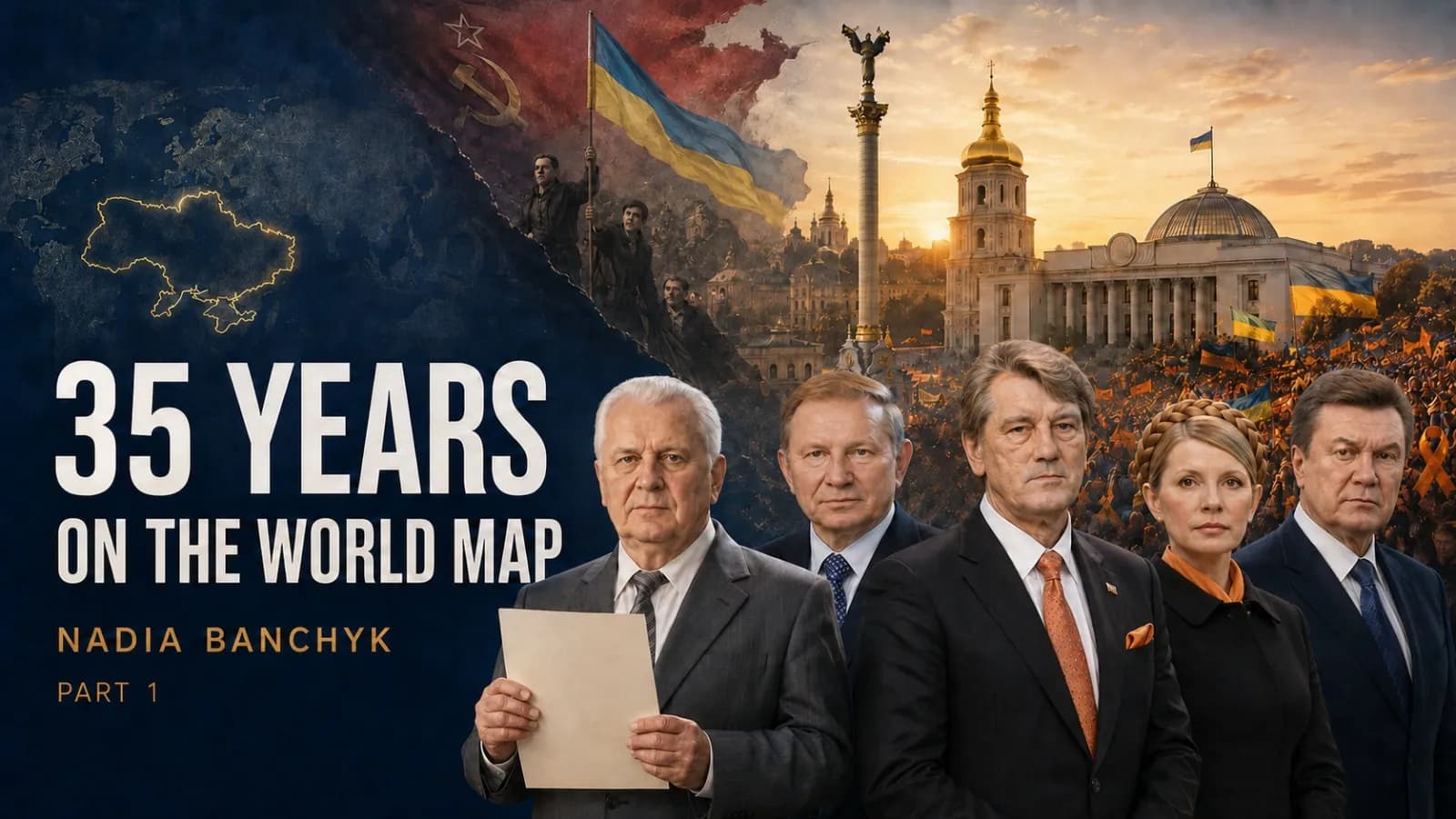
The Verkhovna Rada of Ukraine voted for independence on August 24; its head, Leonid Kravchuk (until recently the head of the ideology department of the Central Committee of the Communist Party of Ukraine), read out the Act of Declaration of Independence.
And on December 1, the Ukrainian people confirmed their desire for independence in a nationwide referendum.
On December 8, 1991, in Belarus, in the village of Viskuli, the presidents and heads of governments of three Soviet republics — Boris Yeltsin and Gennady Burbulis (RSFSR), Stanislav Shushkevich and Vyacheslav Kebich (BSSR), Leonid Kravchuk and Vitold Fokin (USSR) — signed an agreement on the cessation of the existence of the USSR and the creation of the Commonwealth of Independent States (CIS).
Soon, other former Soviet republics, which became states, joined the CIS. Once again, the specter of the European Union briefly flashed, as the CIS was proclaimed on the principles of full equality of states.
New Start for Ukraine and Russia: Shared Soviet Legacy, Slightly Different Societies
State-building began in a confused, divided society in both countries. For one part of society in Russia and Ukraine, the declaration of independence represented a historical chance to attempt to build a modern democratic order; but this part was a minority. The majority was confused between the loss of the familiar, stable way of life and the new complete unknown. Moreover, all new states found themselves in a severe economic crisis due to the difficulties of transforming the bankrupt Soviet economy into a market economy and due to the complication of economic relations between states.
Meanwhile, behind the facade of democratic transformations in Russia and Ukraine (as in other CIS countries), completely different processes were taking place, which at the time were unnoticed not only by the general public but also by most of the conscious citizens who sincerely sought to build democratic states and integrate with the West. These processes were studied in detail much later when they became obvious; one of the first to describe them was Alexander Litvinenko, a former member of the Russian special services (FSB), who was forced to flee Russia — he settled in the United Kingdom; however, Russia reached him there too — in November 2006, assassins sent by Moscow poisoned him with radioactive polonium-210 in his tea, causing him to die in agony. His book "FSB Blows Up Russia" describes in detail what was happening behind the curtain of democratic reforms.
The essence of these rather complex processes was the transformation of the power structures of the former USSR, primarily the KGB, into mafia-like formations that merged with organized crime and outright gangs. These formations appropriated Soviet state funds, the so-called "party gold," as well as former "socialist" enterprises. Privatization led to the transformation of the Soviet system into a mafia-oligarchic one, where former KGB members gradually seized all power during the 1990s.
In Russia and Ukraine, bloody showdowns took place between mafia clans and groups; according to the law of the jungle, the winners of these showdowns came to high positions in the state apparatus and the newly created big business by various means. Oligarchs enriched themselves at an unprecedented speed and scale, buying the most expensive plots of land and real estate both in their countries and around the world, primarily in Europe. Soon, these properties would become centers for spreading Rashism in Europe.
The oligarchy, under the leadership of the Chekists (there are no former Chekists!), laid the foundations for Russia's transformation from a semi-democratic to an authoritarian, and later to a totalitarian state, as it is now.
In Ukraine, the processes developed in a more complex way. Unlike Russia, where the overwhelming majority of the population increasingly longed for the lost USSR, in Ukraine, society was divided between those who longed for it and those who always considered the USSR a modification of Russian imperialism that colonized and occupied Ukraine — such citizens constituted a politically significant force. Therefore, political processes in Ukraine acquired a distinctly pronounced content — a struggle between two versions of state-building: one part was pro-Russian, but the other believed that it was necessary to move as far away from Moscow as possible and join the West.
The Paths of the Two Countries Diverge Further
In Russia, the attempt to build a democratic state effectively ended with the second attempt at a coup in October 1993, when revanchists, who constituted the majority in parliament, opposed Yeltsin's reformist government. The government responded by shooting the parliament and dissolving it — it was replaced by the State Duma. As a result of the elections, the great-power chauvinists (ironically, they called themselves the "Liberal Democratic Party" of Vladimir Zhirinovsky) received 64 seats; the liberal bloc of Yegor Gaidar received the same number; the Communist Party (Gennady Zyuganov) received 42 seats. Thus, in the first free elections in Russia, democrats found themselves in the minority. At that time, it was not yet visible that this coup determined the decisive stage of the beginning of the end of the attempt to build a democratic Russia.
In Ukraine at that time, pro-Russian forces won — in the 1994 presidential elections, Leonid Kuchma, the former director of the largest defense plant, Yuzhmash, defeated Leonid Kravchuk (Kravchuk, the first president of independent Ukraine, was already perceived as almost a nationalist at that time). Kuchma was president for two terms and went with the country from building an oligarchic-mafia system to decisively defending Ukraine from Russia's encroachments and writing the significant book "Ukraine is Not Russia." Kuchma also, in response to both US demands and post-Chernobyl sentiments in Ukraine, transferred the nuclear arsenal stored in Ukraine since Soviet times to Russia. In 1994, the Budapest Memorandum was signed, by which Ukraine transferred nuclear weapons to Russia under "assurances" (not "guarantees") from the US, the UK, and France regarding Ukraine's territorial integrity and sovereignty. Indeed, who would have thought at the time that Russia would go to war against Ukraine? Moreover, Ukraine could not maintain the nuclear arsenal due to a complete lack of funds.
By the beginning of the new millennium, Russia and Ukraine had approached almost completely differently. In Russia, the oligarchs and Yeltsin's entourage "elected" a successor from the KGB, Vladimir Putin. On September 9 and 12, 1999, suddenly, at dawn, when everyone was peacefully sleeping, two apartment buildings in Moscow exploded one after the other; a few days later, another explosion occurred, this time in Volgodonsk. The explosions were declared terrorist acts committed by "Chechen terrorists."
Chechnya-Ichkeria, which separated from the Chechen-Ingush Autonomous Republic of Russia, declared independence in 1991 along with the Soviet republics (taking advantage of the draft new constitution, which was never implemented because the 1991 coup ended the existence of the USSR), but it was not recognized by anyone. Instead, the Russian mafia created a gray zone for the "black market" in Chechnya. In December 1994, Russian troops invaded Chechnya to prevent its further separation from Russia and to ensure the unpunished and lawless functioning of this "black market." At that time, the semi-democratic Russian society decisively opposed this war, and in 1996, Russia withdrew its troops from Chechnya.
In 1999, the Chechen situation was decided to be played out again to seat Putin in the presidential chair. Russian troops invaded the small Caucasian country, which had not yet recovered from the first invasion, and completely destroyed it, committing a real genocide against a nation numbering no more than 1 million.
The aforementioned Alexander Litvinenko proves that the apartment building explosions were a special operation specifically organized by the Chekists to bind Russian society with fear of terrorists, thereby creating a basis for supporting Putin and gradually curtailing all of Russia's movements towards the West — that is, for a revanche.
Between 2000 and 2005, all independent TV channels in Russia were destroyed. A series of political assassinations eliminated the most prominent figures of the reformist camp. In 2003, a show trial was organized against Mikhail Khodorkovsky — a pro-Western oligarch, owner of the largest oil corporation; he was sentenced to 10 years in a colony. This was a signal to all oligarchs: do not dare to pursue any independent policy or finance political parties. The oligarchs understood the signal and rallied around the leader. Society increasingly weakly demanded an end to the bloodshed in Chechnya and eventually stopped showing even the slightest subjectivity, swaying "along with the general line" (as they would say in Stalin's years).
Thus, the new-old masters of Russia created the prerequisites for destroying all sprouts of freedom, democracy, and the creation of a modern state. They were now building what would later be called Rashism — a hybrid of the worst traits of the Soviet regime and the fascist regimes of the 20th century with an oligarchic-mafia structure of society that seeks endless enrichment at the expense of plundering the people and creates its centers around the world.
In Ukraine, too, the oligarchic-mafia system was strengthening and increasingly extending its tentacles, intertwining with the Russian one (after all, originating from the same Office) into an inseparable knot; the country was shaken by murders and showdowns. However, society offered much stronger resistance than in Russia.
Thus, the high-profile murder of opposition journalist Georgiy Gongadze in 2000 led to a mass rally in Kyiv under the slogan "Ukraine without Kuchma!" This rally became a prototype of the subsequent struggle of society against the mafia.
Kuchma increasingly wavered between the nationally oriented and pro-Russian parts of Ukrainian society. This was most clearly manifested in the appointment of prime ministers: in the early 2000s, Viktor Yushchenko, a young banker with a pronounced national-patriotic orientation, became prime minister; Yulia Tymoshenko, a young entrepreneur and founder of the oil and gas company "United Energy Systems of Ukraine" (UESU), became deputy prime minister. However, in 2003, on the eve of the presidential elections, Kuchma replaced Yushchenko with a politician with directly opposite views — Viktor Yanukovych, a native of the semi-criminal, mafia circles of Donbas, who boasted of his ignorance and disdain for Western values. Kuchma made it clear to society that he would like Yanukovych to be his successor.
Thus, from the early 2000s, Russia was building a mafia-fascist state, while Ukraine was building a mafia-democratic one.
The First Decisive Victory of Ukrainian Society
In the 2004 presidential elections in Ukraine, Yanukovych and Yushchenko clashed. According to the results of the second round, Yanukovych won. However, it soon became clear that the results of the popular vote were falsified.
The unexpected happened: tens of thousands of voters took to Independence Square and did not disperse. This was reminiscent of 1991 when thousands of people, overcoming fear, rallied throughout the USSR. Now Ukrainian voters demanded re-elections.
«Maidan» no one dared to disperse, let alone shoot at (even though a detachment of Russian troops was stationed near Kyiv); the rally became a people's celebration, and the euphoria of peaceful struggle prevailed over the crowd. At the forefront of the people's protest were the true winner of the elections, Viktor Yushchenko, and his ally Yulia Tymoshenko. Because Yushchenko-Tymoshenko supporters marked themselves with the color orange, this peaceful people's uprising went down in history as the Orange Maidan. And the protest won! An additional – third – round of voting was announced, where victory was honestly won by Yushchenko. Thus began the first nationally oriented Ukrainian government: Tymoshenko became the prime minister. However, already in the following year, deep differences in approaches to economic and political reforms between Yushchenko and Tymoshenko emerged. Yulia acted as a fervent revolutionary, striving to eliminate the oligarch-mafia system in one fell swoop; whereas Yushchenko hoped to at least reorient some oligarchs towards building a national state. Life under the "orange" turned into a high-speed ride on a steep serpentine: Yushchenko and Tymoshenko loudly broke off relations, only to reconcile again. Meanwhile, Moscow fanned this war within the Ukrainian government by all means and even imposed a "gas war" on Ukraine. To be continued...