
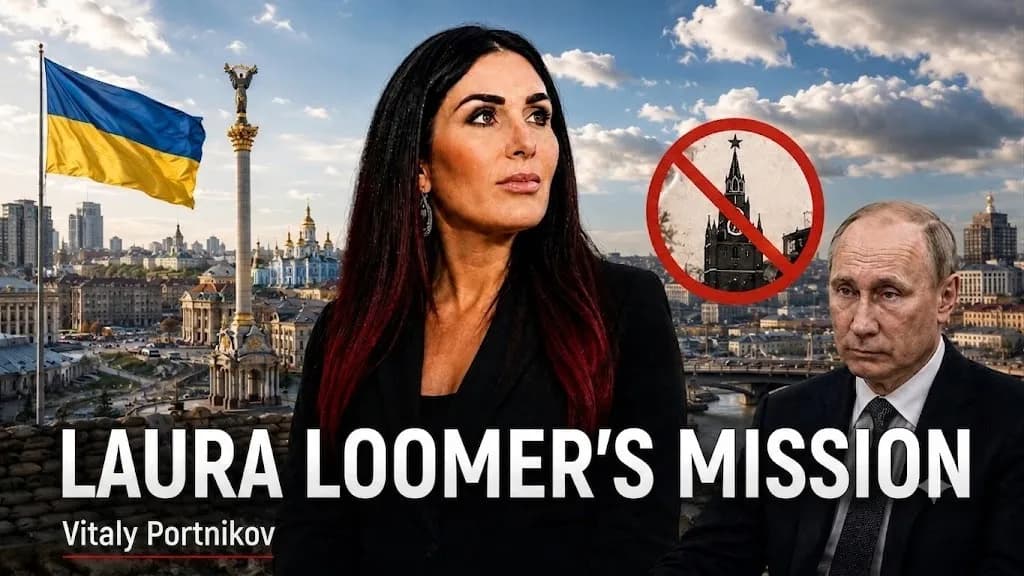
The Mission of Laura Loomer

The arrival of the well-known American right-wing conservative blogger Laura Loomer to the Ukrainian capital was perceived by the Ukrainian authorities and covered by our media as if it were a visit by an official whose decisions affect the relationship between Ukraine and the United States. Against the backdrop of Russian ballistic attacks, Volodymyr Zelenskyy gave an interview to Laura Loomer, and my colleague Marichka Padalka emotionally shared with the MAGA activist about the Ukrainian roots of her Jewish grandfather.
However, there is a certain grain of rationalism in such an attitude. Donald Trump himself is interested in Laura Loomer's words, although the American president has repeatedly demonstrated that even the most loyal supporters cannot influence his opinion if it contradicts their conclusions. So, who listens to whom is still a big question. After all, Laura Loomer continued to advocate in Kyiv for what I consider to be a completely erroneous approach of radical conservatives regarding the impossibility of continuing financial aid to Ukraine. And this is the main thing that could effectively change, because, as we know, sympathy and tears cannot be spread on bread.
Therefore, Laura Loomer's mission is primarily not to change her attitude towards Ukraine. It is to change her attitude towards Russia.
From this point of view, the visit of the popular blogger and conspiracy theorist can be seen as a kind of revenge for another right-wing conservative commentator, Tucker Carlson's trip to the Russian capital. Let me remind you that the Russian media then treated Carlson's arrival with no less, if not more, enthusiasm than Ukrainians did Loomer's, and Putin gave an interview to the authoritative showman in right-wing conservative circles.
Much has changed since then. After the start of the American-Israeli operation against Iran, Carlson became an irreconcilable opponent, even an enemy of Trump, leaving both the MAGA movement and the Republican Party. Trump himself speaks without enthusiasm about Putin, and his associates are wary of naming terms not only for the end of the Russian-Ukrainian war but even for the resumption of a low-prospect negotiation process.
The attitude of conservatives towards Russia is also changing, as it is no longer perceived by many as a Christian "city on a hill," as the last fortress of traditional values. Loomer announced a change in her attitude right in the courtyard of the Kyiv-Pechersk Lavra — a monastery that a few weeks ago became one of the targets of another Russian attack on the Ukrainian capital.
In fact, this is the main thing. Since Trump returned to the Oval Office, I have not tired of emphasizing that the White House owner, like his predecessor, does not have the key in his pocket to end the Russian-Ukrainian war. Especially now, when Trump has fallen into the energy trap of the Strait of Hormuz, from which it is generally unclear how to escape — and whether it is possible to escape at all.
Therefore, if the American president is not ready to help Ukraine, and we understand that such a decision would require him to fundamentally revise the entire philosophy of Trumpism, then at least let him not "help" Russia, let him be tougher on the Putin regime, let him have no illusions about the possibility of agreements with the Russian president, let him and his supporters stop perceiving Russia as an imagined conservative citadel.
If Laura Loomer manages to convince Trump of the appropriateness of this approach, it will already be a big step forward in the right direction.