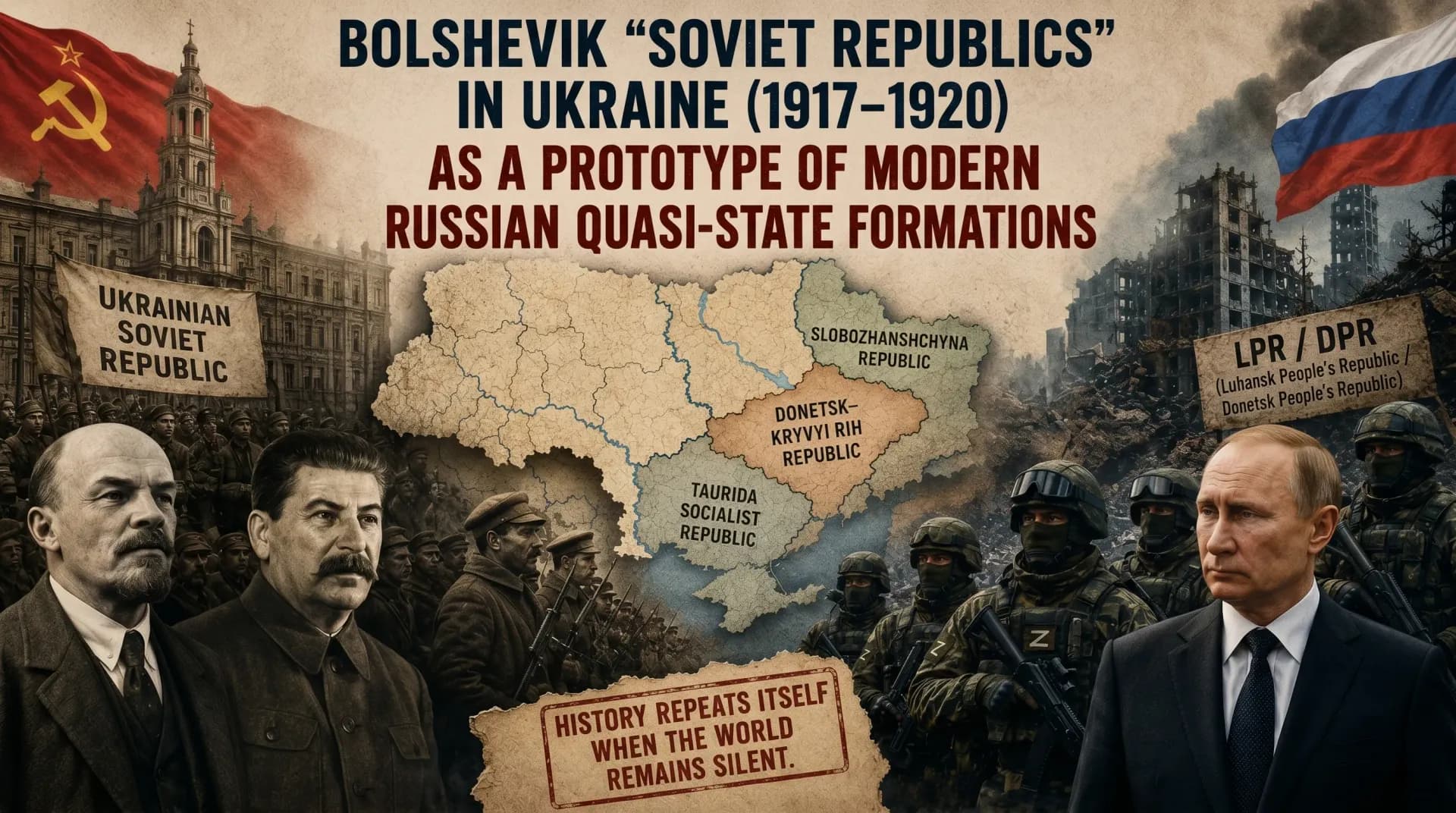
Bolshevik "Soviet Republics" in Ukraine 1917–1920 as a Prototype of Modern Russian Quasi-Entities

The relevance of researching this issue becomes particularly heightened in the context of the modern Russian-Ukrainian war, which is accompanied by the active use of historical narratives as a tool of political and ideological influence. In Vladimir Putin's article dated July 12, 2021, "On the Historical Unity of Russians and Ukrainians," alongside the traditional Russian propaganda theses about "common history" and "a single people," a key idea was that "true sovereignty of Ukraine is possible only in partnership with Russia."
At the beginning of 2022, Vladimir Putin increasingly promoted the narrative of an alleged threat to Russia's security from NATO due to the Alliance's cooperation with Ukraine. Using these assertions as a pretext for escalating the conflict, on February 21, 2022, the Russian Federation recognized the independence of the so-called "DNR" and "LNR," which became one of the key stages in preparing for a full-scale invasion of Ukraine's territory. These actions demonstrated the continuation of Russian policy in creating controlled quasi-state formations as a tool of political and military influence, which has historical parallels with the practices of Bolshevik Russia in the early 20th century.
Events in Russia after October 1917 quickly took on the form of a true apocalypse. Lenin skillfully exploited the temporary confusion and indecision of Western states to immediately launch an ambitious imperial project called the "world socialist revolution." An important component of this project was the violent integration of Ukraine into the Soviet system.
Lenin's calculation that the All-Ukrainian Congress of Soviets, which began its work on December 4 (17), 1917, in Kyiv, would re-elect the Ukrainian Central Rada, completely failed. The majority of delegates expressed support for the UCR and sharply condemned "the centralist intentions of the Moscow (Great Russian) government, which, leading to war between Moscow and Ukraine, threaten to completely sever the federal ties to which Ukrainian democracy aspires." On the same day, a "Manifesto to the Ukrainian People with Ultimatum Demands to the Central Rada" was sent to Kyiv by telegraph. In it, the "socialist government of Russia" formally recognized the right of all peoples of the former tsarist empire to self-determination, including secession. At the same time, the Petrograd leadership directly threatened the Central Rada with open war, a decision that had been made several days earlier.
Unfortunately, for a long time, the idea of a federal connection of Ukraine with other state formations within a single union dominated Ukrainian political circles. Moreover, on November 30, 1917, a conversation took place between the General Secretary of Labor of the UNR M. Porsh and the Soviet People's Commissar for Nationalities J. Stalin, during which Porsh stated that "in organizing the central body of democracy," cooperation between the UCR and the Radnarkom was entirely possible. Ultimately, Bolshevik aggression against the Ukrainian People's Republic definitively demonstrated the illusory hopes for an equal federation with Russia. V. Vynnychenko, in response to the ultimatum, declared: "Labeling us as 'bourgeois' is a means of struggle by non-Ukrainians against Ukrainians... It is not the General Secretariat, but the Council of People's Commissars that has initiated a fratricidal war..."
The further development of events demonstrated the transition of Bolshevik leadership from political pressure to the practical implementation of an alternative center of power in Ukraine. To this end, on December 24–25 (11–12), 1917, the Bolshevik faction united in Kharkiv with delegates from the Congress of Soviets of the Donetsk and Kryvyi Rih basins. Together, they held an alternative "All-Ukrainian Congress of Soviets," at which they proclaimed Ukraine a Republic of Soviets. The congress declared the overthrow of the Ukrainian Central Rada's power and the establishment of federal relations with Bolshevik Russia. In this way, Petrograd continued to interpret events in Ukraine as an internal conflict between "revolutionary councils" of workers and soldiers' deputies and the "bourgeois" Central Rada, which allowed legitimizing external intervention under the guise of supporting an "internal revolution." The People's Commissar for Nationalities J. Stalin claimed that there were no contradictions between the Ukrainian and Russian peoples, and the conflict was only between the councils of workers and soldiers' deputies and the General Secretariat. In his view, this conflict could only be resolved by the joint struggle of the Russian and Ukrainian peoples against the counter-revolutionary elements of the Central Rada," which he cynically accused of "annexing" the southern and eastern Ukrainian lands. Such rhetoric served as a tool for delegitimizing Ukrainian statehood and justifying Bolshevik intervention. In a broader context, the Soviet government, similar to the tsarist and Provisional governments, refused to recognize Slobozhanshchyna, Donbas, and the South as integral parts of Ukraine, reflecting a long-standing imperial tradition of denying Ukrainian sovereignty.
The creation of the Central Executive Committee and the executive body – the People's Secretariat – completed the formation of the puppet Bolshevik regime under the name of the Ukrainian People's Republic. Lenin officially assured that the Council of People's Commissars "promises the new government of the fraternal republic full and comprehensive support," and the commander of the Bolshevik troops, Mikhail Muravyov, openly acknowledged in order No. 14: "...we bring from the distant north on the point of our bayonets and where we establish it, we support it in every way with the force of these bayonets and the moral authority of the revolutionary socialist army."
In fact, this was the first trial by the Bolsheviks of the tactic of creating pseudo-governments that served as a cover for the occupation of Ukraine by the Red Army. Subsequently, they repeatedly applied a similar model in other national regions of the former empire.
On December 30 (17), the Soviet government of Ukraine – the People's Secretariat – officially declared war on the Ukrainian Central Rada and appealed to the Council of People's Commissars of the RSFSR for immediate military assistance. In the conditions of war at the end of December 1917, up to 20,000 Bolshevik troops – sailors, soldiers, and Red Guards – arrived in Ukraine.
Interestingly, at the beginning of January 1918, negotiations were taking place in Vitebsk between the Soviet and Ukrainian delegations. The Ukrainian side put forward clear conditions for continuing the dialogue: cessation of hostilities, withdrawal of Russian troops from Ukrainian territory, and official recognition of the UNR. The Russian delegation rejected these demands, calling them vague, and placed all responsibility for the further escalation of the war on the Central Rada.
On January 7, 1918 (December 25, 1917), Commissar V. Antonov-Ovseenko, appointed as the commissioner "for fighting counter-revolution in the South of Russia," ordered a general offensive against the Ukrainian People's Republic. At that time, a significant part of Left-Bank Ukraine was already under Bolshevik control. The Ukrainian authorities proved unable to effectively resist the Bolshevik onslaught, as they practically had no combat-ready armed forces of their own. Only on January 8, 1918 (December 26, 1917), did the General Secretariat of the Ukrainian Central Rada adopt a resolution on the creation of a regular Ukrainian army.
On January 11, 1918 (December 29, 1917), Bolshevik troops captured Katerynoslav (modern-day Dnipro). On the eve of this, a pre-prepared armed uprising of workers, organized by local Bolsheviks, broke out in the city, supported by units from Russia. Subsequently, such a combined tactic – internal uprising plus external military intervention – was repeatedly used by the Bolsheviks in Mykolaiv, Odesa, Kyiv, and other cities.
On January 15 (2), 1918, Oleksandrivsk (now Zaporizhzhia) was occupied, and on January 19 (6), Poltava. After this, Bolshevik forces, in two columns – from the directions of Kharkiv–Poltava and Homel–Kursk–Bakhmach – began a large-scale offensive on Kyiv. After five days of intense artillery shelling and heavy street fighting, on February 9 (January 26), 1918, Ukrainian troops and government institutions left Kyiv.
The unfolding of these events demonstrated not only the military nature of the conflict but also the deep contradiction between the declared principles of Bolshevik policy and their practical implementation. This was particularly evident in the national question. The duality of standards in national policy is traced in the theory and practice of Bolshevik leadership. Thus, in Lenin's telegrams to G. Ordzhonikidze and V. Antonov-Ovseenko, there was a demand for strict adherence to the sovereignty of Soviet Ukraine, but the "red terror" established as a result of Bolshevik occupation demonstrated the true essence of the Bolshevik regime, which was based on total terror.
Member of the UCR M. Kovalevsky described the events in Kyiv as follows: "They ravaged the city as a wild conqueror might, who managed to capture a foreign city." "Terror was carried out with all the cruelty that can be. Some streets were littered with the bodies of killed haidamaks, officers, free Cossacks, as well as random passersby," wrote member of the Kyiv headquarters of the Red Army Ivan Tyagay. The organ of the Ukrainian Social Democrats (left) stated: "We experienced a whole bacchanalia of destroying all signs of the Ukrainian nation, trampling on portraits of Shevchenko, executions for Ukrainian identification and for the Ukrainian language."
Promises of land and factories in practice turned into the establishment of a strict centralized planned economy and total control over the population. The declared respect for the Ukrainian language, culture, and religious beliefs resulted in systematic repressions against culture and the church. Overall, the Kremlin viewed any form of Ukrainian statehood only as a temporary phenomenon within the framework of the struggle for a world communist revolution.
Realizing the inability of the Red Army to stop the German advance, the Soviet government of Russia was forced to start peace negotiations with the Central Powers in Brest-Litovsk. The Russian delegation tried to retain the monopoly right to represent the interests of the entire former Russian Empire, and its own armed aggression against Ukraine was presented exclusively as an internal "civil conflict," claiming that "this is a domestic matter of the Ukrainian people themselves."
To this end, the head of the Soviet delegation L. Trotsky insisted on the participation of representatives of the People's Secretariat in the negotiations. Delegates from the puppet government (Y. Medvedev, V. Zatonsky, and V. Shakhrai) met with Lenin before leaving for Brest, who was primarily interested in Donbas and the ability to export coal to Russia. At the Brest-Litovsk negotiations, the Kharkiv delegation of the People's Secretariat made statements in which, on behalf of "the entire Ukrainian people and government," they declared that they did not recognize any decisions and international agreements concluded by the General Secretariat of the UNR. They called the Central Rada a "self-proclaimed bourgeois group of the Ukrainian population," due to which "no obligations taken by the Central Rada will be recognized by either the Ukrainian Soviet government or the Ukrainian people."
However, on January 10, 1918, under pressure from the German side, Trotsky was forced to recognize the UNR delegation as an independent participant in the conference, thereby recognizing the UNR as an independent state.
However, the recognition of the Ukrainian delegation did not mean a real abandonment by the Bolshevik leadership of plans to subordinate Ukraine. For Soviet Russia, this was rather a forced diplomatic step dictated by international circumstances and the pressure of the Central Powers during the Brest-Litovsk negotiations. This is evidenced by the creation in January-February by the Bolsheviks of such quasi-state formations as the Donetsk-Kryvyi Rih Republic, the Odesa Soviet Republic, the Soviet Republic of Tavrida, or the Mykolaiv District Socialist Labor Commune, which had not only a military-political but also a distinct ideological character. Their emergence was aimed at undermining the authority of the Ukrainian Central Rada and discrediting the very idea of Ukrainian statehood. According to the "fathers" of the Soviet republics, their territories "have absolutely no relation to Ukraine... all claims of the Central Rada to these lands are fantastic and moreover unfounded."
The artificial fragmentation of Ukraine's territory into separate "Soviet republics" was intended to create the impression of regional disunity. The Bolshevik leadership sought to demonstrate that Ukrainian lands allegedly did not constitute a single political and national space, and therefore were incapable of existing within the framework of an independent state.
An important factor in the creation of Bolshevik puppet formations on the territory of Ukraine was also the economic interests of Soviet Russia. This primarily concerned the industrially developed regions – Donbas, Kryvyi Rih, Southern Ukraine, and the Black Sea ports, which were of strategic importance for the economy of the former Russian Empire. In particular, control over the Donetsk-Kryvyi Rih basin provided access to coal, the metallurgical industry, and the raw material base. During January–April 1918, over 17.3 million poods of grain were exported from Ukrainian territory to Russia. This indicates that the establishment of Soviet power in Ukraine aimed not only at political subjugation but also at ensuring control over food and industrial resources, critically important for maintaining the Bolshevik regime.
According to the Brest-Litovsk Peace Treaty of March 3, 1918, the Bolshevik government of Russia was obliged to recognize the Ukrainian Central Rada, sign a peace treaty with it, cease agitation against it, and withdraw its troops from Ukrainian territory.
Realizing the complex international situation, the Bolshevik leadership continued to insist on the necessity of a single "revolutionary front" against the German-Ukrainian troops, considering the existence of separate Soviet republics as politically inexpedient. Therefore, on March 17–19, 1918, at the II All-Ukrainian Congress of Soviets, the creation of a single Soviet government of Ukraine was proclaimed, thereby effectively completing the legal absorption of quasi-state formations by the so-called "independent" Soviet UNR.
The resolution of the congress "On the State Structure" directly emphasized that the struggle for the restoration of Bolshevik power in Ukraine should end with its unification with Soviet Russia. This once again demonstrated the temporary and purely tactical nature of Soviet "Ukrainian statehood," which was viewed by the Bolshevik center not as an independent political project but as a tool for establishing control over Ukraine. Until this goal was realized, the activities of Ukrainian Bolshevik party structures were transferred to the territory of Russia.
The fact that the creation of so-called "Soviet republics" was viewed by the Bolshevik leadership as a tool of colonial policy is convincingly evidenced by the events of the second Russian-Ukrainian war, which unfolded at the end of 1918. Throughout 1919–1920, the status of Soviet Ukraine remained a subject of constant political manipulation: from a practically undefined position in the form of a "military-political union" in 1919 – to the decision to incorporate the USRR into the "all-Russian" federal republic, and later – to the formal recognition of its independence and sovereignty by the treaty between the RSFSR and the USRR on December 28, 1920.
Such inconsistency was not accidental. The Bolshevik leadership used declarations of "sovereignty" of Soviet republics exclusively as a tactical means to legitimize their own power in the national peripheries of the former Russian Empire. The Bolsheviks' refusal in 1920 from the previous practice of creating regional Soviet republics was explained not by a change in principles, but by the fact that Soviet Ukraine found itself under the complete political control of the Russian Communist Party (Bolsheviks).
In the structure of the RCP(b), the governing bodies of national republics, including the Central Committee of the CP(b)U, effectively had no broader powers than ordinary regional or provincial party committees within the RSFSR. This indicates that the proclaimed federalism was purely declarative, while the real model of the Soviet state was based on unitarism, centralism, and the formation of a totalitarian system. If in Dnieper Ukraine, the Soviet Ukrainian People's Republic was initially proclaimed, and only later was the CP(b)U created as its party center, in Eastern Galicia, the Bolshevik strategy was implemented in reverse order. As early as February 1919, the Communist Party of Bolsheviks of Galicia and Bukovina emerged as a regional organization of the CP(b)U, while the Soviet "statehood" in the region was proclaimed only in July 1920. This indicates that the Bolsheviks viewed the party apparatus as the main instrument for future political subordination of the region. The Communist Party of Eastern Galicia (CPEG) actively fought against the Western Ukrainian People's Republic, striving to establish Soviet power following the Russian-Bolshevik model. At the same time, Soviet Russia sought to use the Eastern Galician issue in a broader geopolitical context. As early as March 1919, the Petrograd government negotiated with the government of the Western Ukrainian People's Republic about providing a "corridor" for the passage of the Red Army to support the Hungarian Soviet regime of Béla Kun (the negotiations were unsuccessful). According to the Bolshevik leadership's plan, it was through the territory of Galicia that a direct connection between Soviet Russia and Soviet Hungary was to be established, which was supposed to promote the spread of the revolution in Central Europe. Preparation for the Sovietization of Eastern Galicia was carried out systematically and in advance. On February 26, 1920, the Galician Bureau was created in Moscow under the Central Committee of the RCP(b), tasked with coordinating political agitation among Galicians, organizing propaganda and publishing activities. Later, on April 23, 1920, the Galician Organizational Committee (Galorgkom) was formed in Kyiv, headed by Felix Kon, which conducted active agitation work among the population of the region. Simultaneously, the Bolshevik authorities organized special courses in Kharkiv and Odesa to train agitators intended for activities in the occupied territories of Galicia. The successes of the Red Army during the Soviet-Polish war in June 1920 led to a revival of plans in the leadership circles of the RSFSR regarding the further spread of the revolutionary movement in Europe. In this context, the idea of a "liberation campaign" to Eastern Galicia became particularly relevant. In service notes of that time, including those from L. Kamenev to V. Lenin, the strategic importance of the region as a convenient platform for the penetration of the revolutionary movement into Poland and as a "gateway" towards Europe was emphasized. Thus, Eastern Galicia was viewed by the Soviet leadership not as an independent political entity but as a strategic platform for realizing the idea of a world revolution, where military, ideological, and administrative mechanisms operated in close interconnection. Simultaneously, the Soviet leadership paid significant attention to the informational and propaganda influence on the population of Eastern Galicia, attempting to form a positive image of the Red Army. Military intervention and possible occupation were ideologically justified by theses about "helping" workers and peasants in creating their own Soviet power and "liberating" them from the old socio-economic order. Thus, the classic rhetoric of the Bolshevik policy of international mission and social liberation was applied, masking real geopolitical interests. At the same time, at the level of party-administrative structures, practical preparations for the implementation of these plans were carried out: the creation of Galician revolutionary management bodies and propaganda centers under the Central Committee of the RCP(b) and CP(b)U was discussed. On June 30, 1920, at a meeting of the Politburo of the Central Committee of the CP(b)U, the creation of the Galician Revolutionary Committee before the entry of the Red Army into Galicia was discussed. The Galician Bureau of Propaganda and Agitation was created under the Central Committee of the RCP(b). On July 8, 1920, the Galrevkom was created, consisting of: V. Zatonsky (chairman), M. Baran (deputy), F. Konar, K. Lytvynovych, and I. Nemylovskyi (members). On July 16, 1920, its composition was approved at the plenary session of the Central Committee of the RCP(b). In the declaration of July 15, 1920, the Galrevkom proclaimed the creation of a Soviet quasi-state – the Galician Socialist Soviet Republic. The activities of the Galrevkom had a distinctly centralized character and were under the direct control of Soviet military-political structures. In particular, all its documents, including decrees, were printed in the field printing house of the Political Department of the Revolutionary Military Council of the 14th Army of the Red Army, further testifying to its dependence on military command. In the proclaimed decrees, the Galrevkom declared itself the highest authority in the region until the convening of a congress of workers', peasants', and soldiers' deputies. Locally, power was transferred to a network of subordinate revolutionary committees, ensuring a strict vertical of governance. The socio-economic measures of the Soviet administration envisaged a radical restructuring of property, including the proclamation of "people's ownership of land" and the confiscation of large land holdings. However, in practice, these measures were implemented in a limited way, as a significant part of the peasantry was distrustful of radical changes to the traditional land system. For Galicians, the slogan "grab what has been grabbed" was not understood. V. Zatonsky noted: "...not even that the peasants were afraid of the return of the Poles, but simply considered it impossible to violate the 'sacred' right of ownership, even of the gentry... A special order had to be issued for the peasants to harvest the former gentry's grain. Only after verifying that the signatures and seals were correct did the peasants move onto the gentry's fields." The ideological policy of the Galrevkom envisaged the establishment of the dictatorship of the proletariat as the basis of the state system, as well as the introduction of a number of normative acts aimed at unifying political, cultural, and economic life according to the Soviet model. Among them were decrees on the separation of church and state, regulation of currency circulation, abolition of the mandatory state language, and other measures that were essentially aimed at displacing national institutions and traditions. In particular, the fourth decree of the Galrevkom "On the abolition of the mandatory state language" condemned any manifestations of national consciousness. "All those who, by their behavior or word, will incite national enmity and hatred among the proletarian masses will be declared enemies of the revolution and the working people and handed over to the military revolutionary tribunal." Alongside this, repressive mechanisms of control were actively introduced in the region. Bodies associated with the Cheka were formed, which fought against political opponents of Soviet power using arrests, searches, confiscations, and other forms of administrative and criminal pressure. On September 3, 1920, the head of the Galrevkom department, M. Levytsky, reported to the Bolshevik government of Russia that revolutionary committees had been formed in the counties, "which are closely connected with the Galician Cheka" and have the task of fighting counter-revolutionaries, saboteurs, speculators, spies, etc. Forms and methods were also defined: searches, arrests, raids, confiscation of property of the arrested, surveillance of people, administrative and criminal penalties. Thus, the Soviet presence in Galicia had not only a political but also a distinctly repressive character, accompanied by the establishment of a system of extraordinary control over the population. Despite the fact that the Bolsheviks managed to create 20 county and 1150 village revolutionary committees (revkoms), they failed to deploy their full-fledged activities. The reasons for this were, firstly, the weakness and disorganization of left-radical forces in Eastern Galicia at the beginning of the 1920s. Secondly, the deep distrust of the Bolshevik leadership towards the local population of the Western Ukrainian region. That is why Galicians who had arrived from Russia and Dnieper Ukraine were actively involved in the Bolshevization of the region, but their numbers proved insufficient. Therefore, it was decided "not to conduct mobilization in Galicia, but to accept volunteers cautiously." It is worth noting that in mid-August 1920, during the second attempt of the Red Army's counteroffensive, Ferenc Békés proclaimed the creation of the Boyko Soviet Republic in Skole, which lasted only a few days. With the change in the military-political situation on September 15–20, 1920, Polish-Ukrainian troops approached Ternopil. Galician Bolshevik figures were forced to urgently retreat beyond the Zbruch River. During the retreat from Eastern Galicia, dismantled industrial equipment, agricultural tools, currency, precious metals, as well as a significant amount of requisitioned food and livestock were taken out. On September 25, 1920, in Vinnytsia, the Galrevkom self-liquidated. Soon after, the Galburo and Galorgkom ceased to exist. Just as during the Brest-Litovsk negotiations, the RSFSR government actively supported the Galrevkom and the Galician Socialist Soviet Republic (GSSR) proclaimed by it during the Riga Peace Conference (September 1920 – March 1921), considering the possibility of its international recognition. For this purpose, the creation of a single Galician representation, which would unite the GSSR and the Western Ukrainian People's Republic, was even planned. However, in the fall of 1920, due to the shift in the balance of power on the front not in favor of the Bolsheviks, the RSFSR government was forced to agree to the Polish delegation's demand to remove the Eastern Galician issue from the conference agenda. Summarizing the activities of the Galrevkom, V. Zatonsky, in a letter to Lenin, the Central Committee of the CP(b)U, and the Revolutionary Military Council of the Southwestern Front dated September 23, 1920, acknowledged: "we were very poorly prepared for such a serious matter as the transfer of the social revolution and Soviet power, even if in a shabby form." At the same time, he emphasized that "now, when Galicia is lost to us, it is necessary to prepare for a return there." Thus, from the first days after the October coup, the Bolshevik leadership viewed Ukraine not as an equal partner but as an object of political, military, and economic subordination. Under the slogans of "world revolution," "fraternal assistance," and "federalism," it consistently implemented a strategy of creating puppet "Soviet republics" – from the Kharkiv "Ukrainian People's Republic" and the Donetsk-Krivoy Rog Republic to the Galician Socialist Soviet Republic. These pseudo-state formations served as political cover for armed aggression, an instrument for delegitimizing the Ukrainian People's Republic and the Western Ukrainian People's Republic, and a means of economic plunder of Ukrainian lands. The declared "sovereignty" and "right to self-determination" in practice turned out to be a temporary propaganda facade behind which stood rigid centralism, red terror, and blatant colonialism. The history of 1917–1920 convincingly demonstrated that for Bolshevik Russia, any form of Ukrainian statehood was acceptable only as a transitional stage to complete absorption. That is why even the formally proclaimed "Soviet republics" quickly lost their remnants of autonomy, turning into ordinary administrative-territorial units under direct control from Moscow. Contemporary events related to the creation of quasi-state formations "DPR" and "LPR" by the Russian Federation, as well as the spread of narratives about the "historical belonging" of the eastern and southern regions of Ukraine to Russia, indicate the persistence of similar approaches in Russian policy. The use of historical manipulations, propaganda, and instruments of external influence to justify aggression testifies to the continuity of the imperial model aimed at limiting Ukrainian sovereignty. In this regard, the study of the activities of puppet republics at the beginning of the 20th century is important not only for understanding historical processes but also for analyzing modern threats to Ukrainian statehood.