
A Free Bird in Captivity
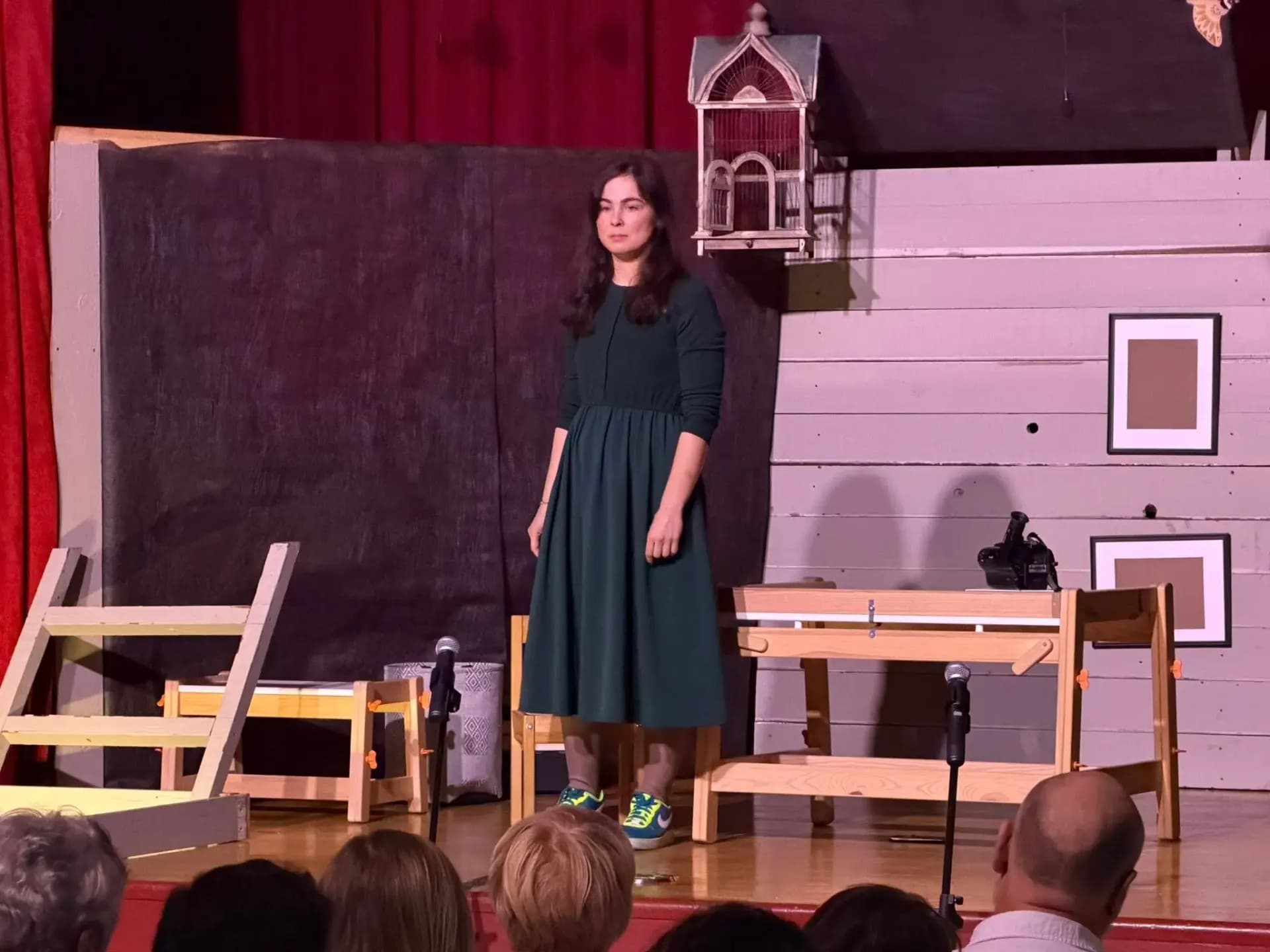
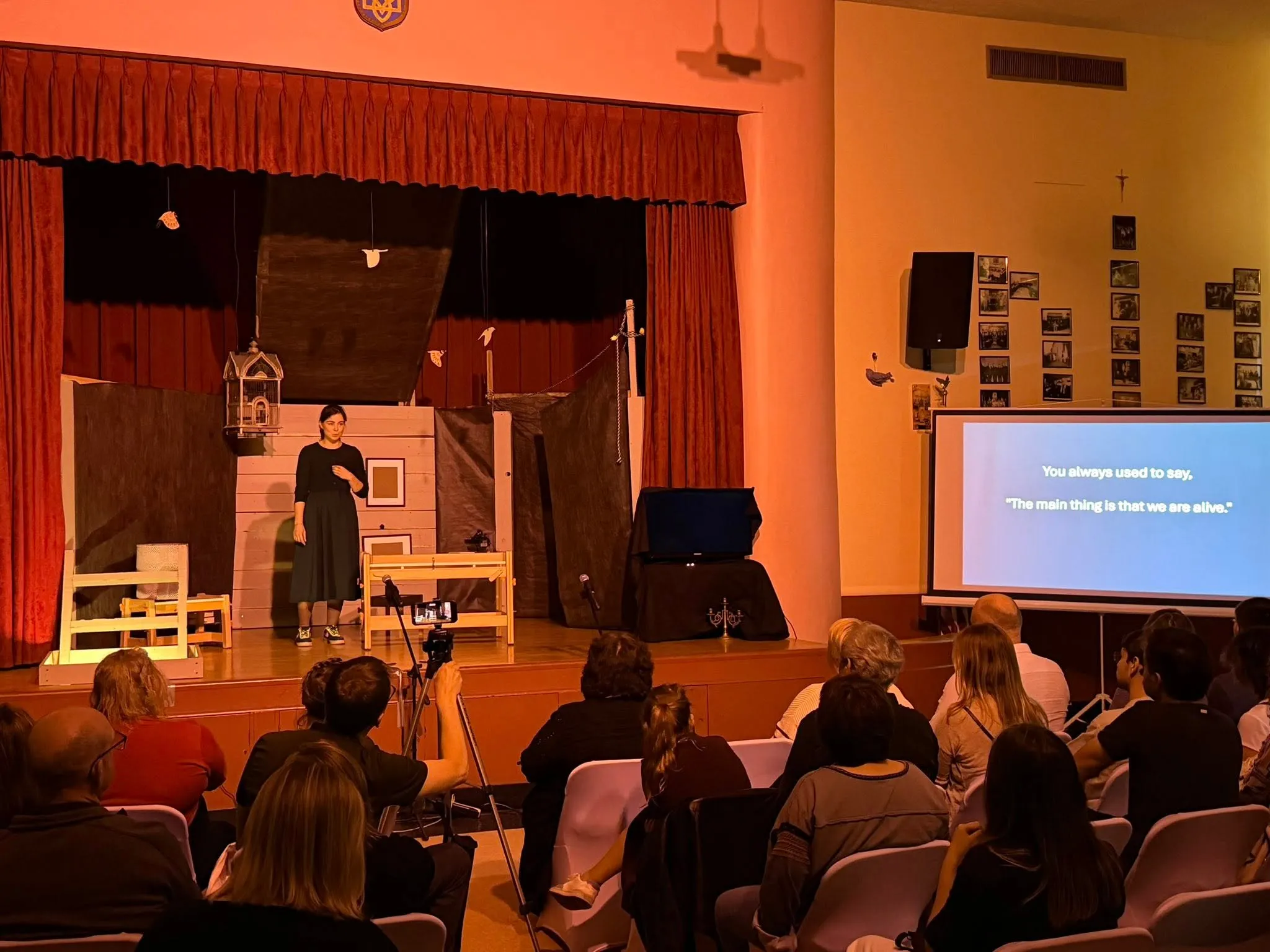
On stage is a 13-year-old Ukrainian girl. She seems to be having a conversation with her mother. However, from the conversation, it becomes clear: her mother is either no longer in this world or is far away. The girl records the conversation on a video camera she found here, hoping that maybe someday she will meet her mother or at least send her these conversations. After all, the girl's entire world is the attic of a house belonging to a family that supposedly "adopted" her.
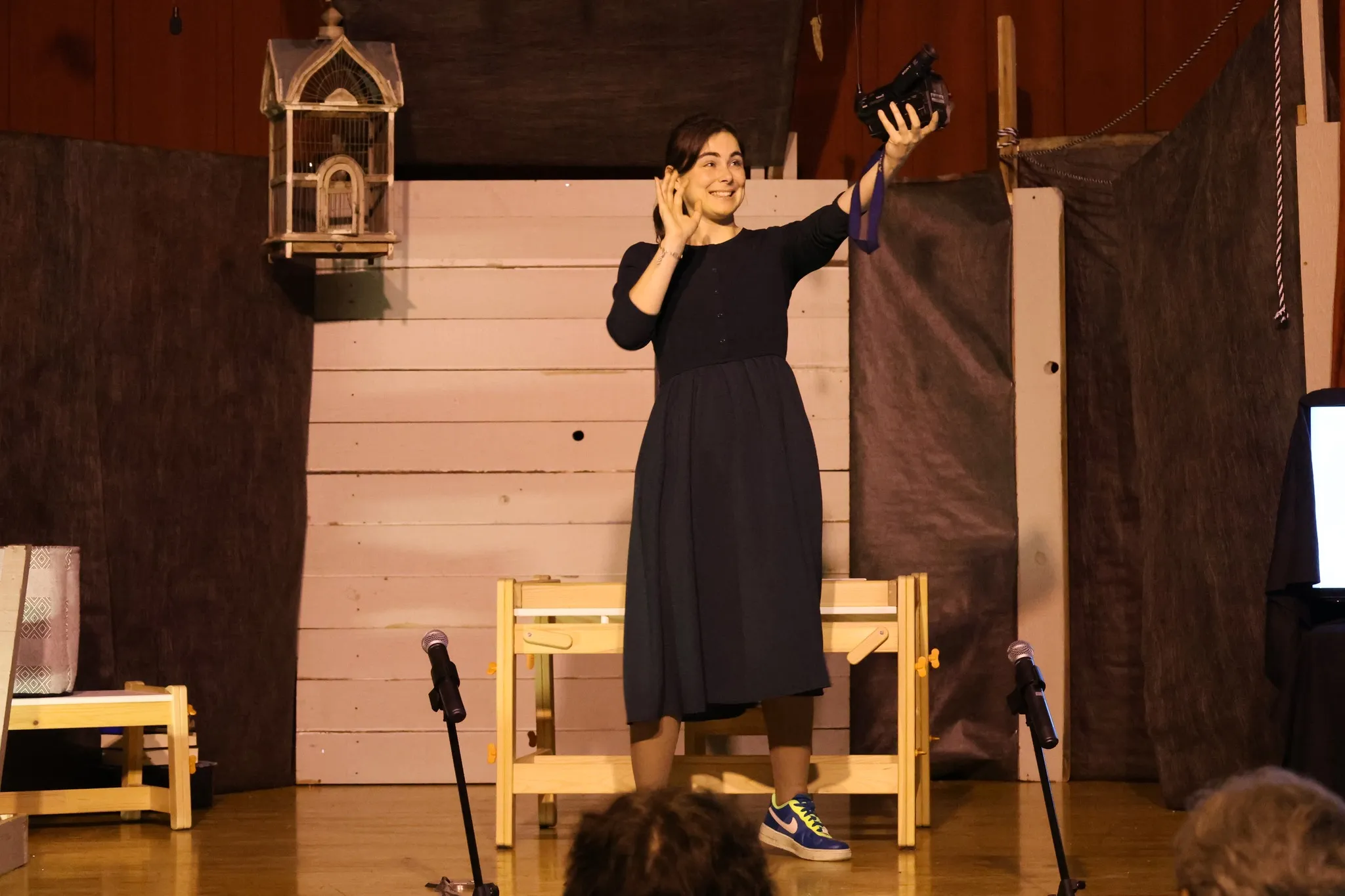
("‘Adopting’ me is absolutely impossible," the girl jokes). However, adopting her is also impossible. At least by this family. Because this family is Russian, and the girl ended up with them from Ukraine. From Mariupol. When she and her mother were fleeing the occupied city, they were detained at a Russian checkpoint. "There — a terrible, dirty room with a filthy sofa," the girl recounts excitedly. "But they didn't like me. They pushed me outside, I stumbled and fell." In this strange way, she avoided rape. But it was there that she was separated from her mother. Her mother was detained by soldiers at the checkpoint because she had a military ID. From that moment, the girl never saw her mother again. The girl does not say (because, likely, she cannot, is not able to convince herself) that her mother is most likely no longer alive. And yet, deep in her soul, there is hope: maybe her mother is alive? In captivity? Although such an accusation at the checkpoint is highly likely a death sentence.
The girl fell, broke her leg, and ended up in the hospital. There, she was almost strangled by a roommate from Donetsk. The girl's only fault was speaking Ukrainian. And the roommate's son had died, and having listened to Russian propaganda about Ukrainian Nazis supposedly destroying Donbas, she decided to take revenge on the 13-year-old Ukrainian girl...
There, in the hospital, she was found by this Masha. Her and another boy, Nikita. A teenager, a bit older than her. An orphan who, unlike her, was happy because Masha could lead him to a path of life. Nikita integrated into the Russian family. Masha adopted him. But for this 13-year-old Ukrainian girl, "adoption" in a Russian family is not "salvation from war," but captivity. She is forced to attend the Russian church, school, and for the slightest "offense," that is, manifestations of being Ukrainian, she is locked in the attic. She is forbidden to use a mobile phone, only for communication with Masha; she is allowed to use the computer only under the watchful eye of her guardians.
However, isolation in the attic for her is not a punishment at all, because only there, alone with herself, can she be herself. In the attic, she has an open conversation with her mother, telling her about her teenage feelings, about how she maintains her dignity in a family that constantly humiliates her, imposes a foreign way of perceiving the world, foreign customs. The life of this family is vividly described by the girl's mention of one of the older members, either a daughter or "adopted" – Sasha. "Her favorite pastime: scattering seeds on the windowsill, birds flock there, and she covers them with a bell jar, and they suffocate," – we, the audience, physically feel the captive's throat tighten when she shares this revelation with her mother, whom she will most likely never see again.
And it becomes clear: the 13-year-old Ukrainian girl feels like a bird in a foreign family, lured by supposed food and treacherously covered with a bell jar, deprived of the oxygen necessary for life.
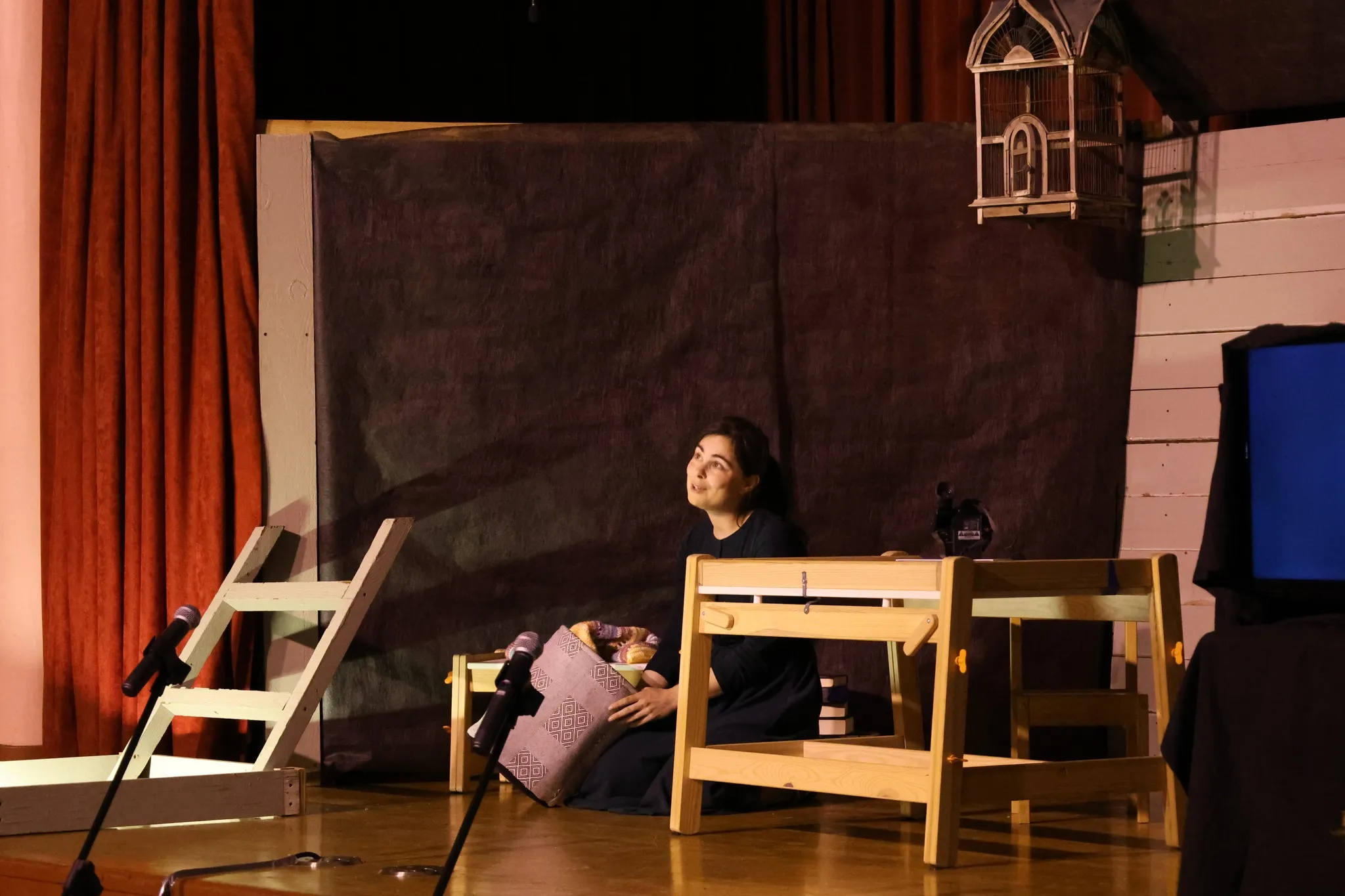
In an imaginary conversation with her mother, she mocks her hosts; boasts about how she hummed the Ukrainian anthem in their presence — for this, of course, she was once again sent to the attic...
...Only after the performance did I learn that the actress who transformed into the 13-year-old girl, Diana Yavorska, is well over 30. Neither her appearance nor her performance shows this. The actress (one of the few non-professional actors in this theater, the director Olena Bilyak told me) conveys the richness of the subtlest intonational nuances, gestures, and movements the depth of the drama experienced by the 13-year-old girl. Diana's heroine, while remaining a teenager, pure, untouched in her feelings, is simultaneously an adult who deeply understands everything happening to her and around her. She is one of tens of thousands of children from whom Russian occupiers stole her family, deprived her of her world, and are trying to reshape her very essence — just because she is Ukrainian and lived in a country that, according to the criminal plan of the Russian dictator, should not exist.
...And here is her triumph: the captive tells how her "stepmother" Masha read that she, Maria, was accused by the International Criminal Court of abducting Ukrainian children and was put on the international wanted list! So we learn: this girl was abducted not by an ordinary Russian family, but by the "authorized representative for the protection of children of the Russian Federation" Maria Lvova-Belova. (But this ultimately does not change the essence, as any Russian family would behave similarly with abducted Ukrainian children — the captive children are evidently distributed to pre-prepared families, vetted for loyalty to the "general line," aimed at erasing any manifestations of being Ukrainian).
How did this captive free bird fly across the ocean to our land? Why did the "Wandering Stars" choose this work by Kharkiv writer Oleh Mykhailov?
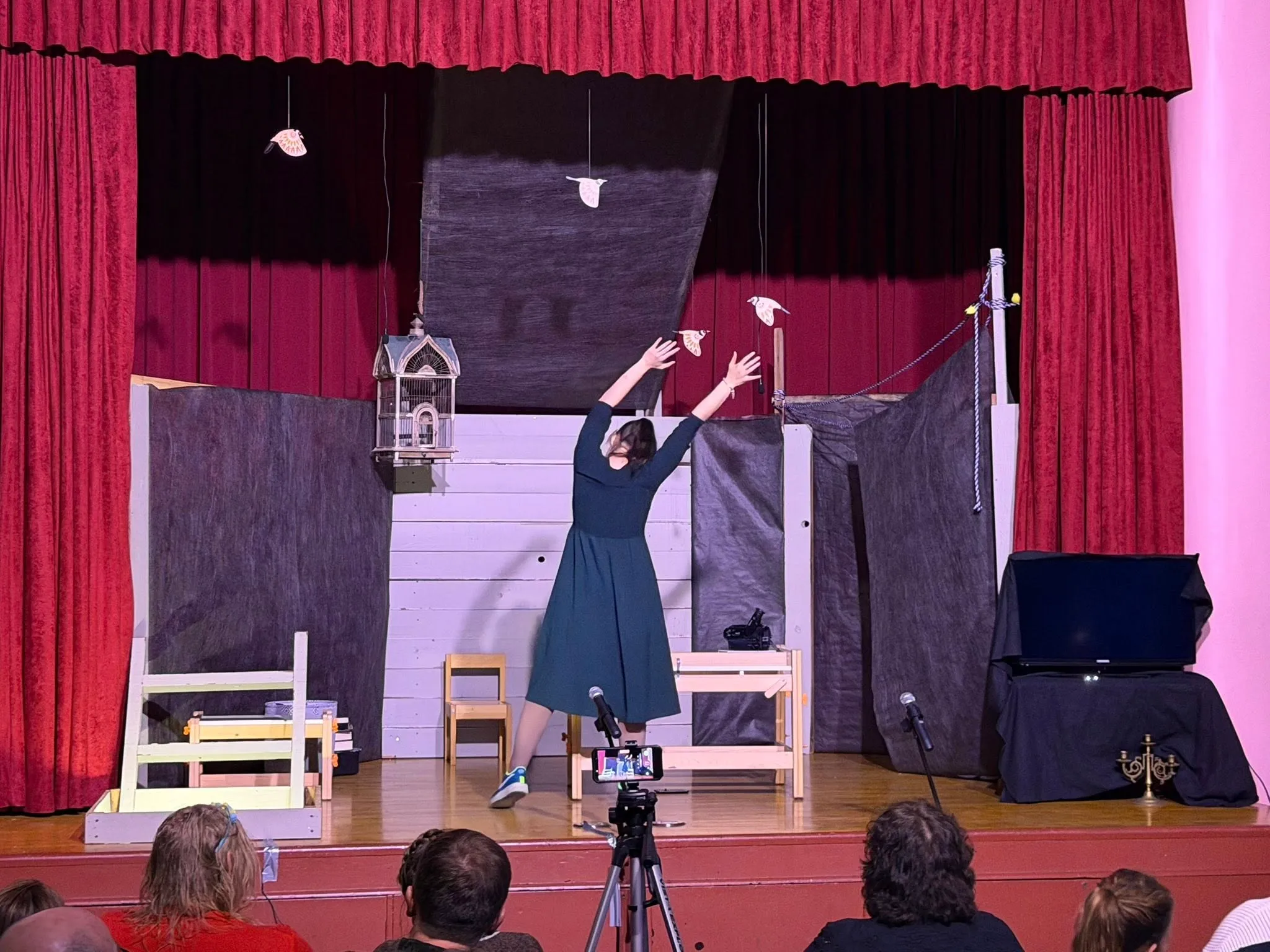
- I saw this performance on the internet, staged in Ukraine, — Olena Bilyak told me. — In Ukraine, it is very popular, performed in many theaters. However, the performance I watched was staged in a completely different way: documentary, with the reading of documents. But I saw in this plot a complex and deep psychological drama of a 13-year-old captive. I have worked and continue to work with teenagers all my life, so I was captivated by the idea of conveying this psychological drama on stage.
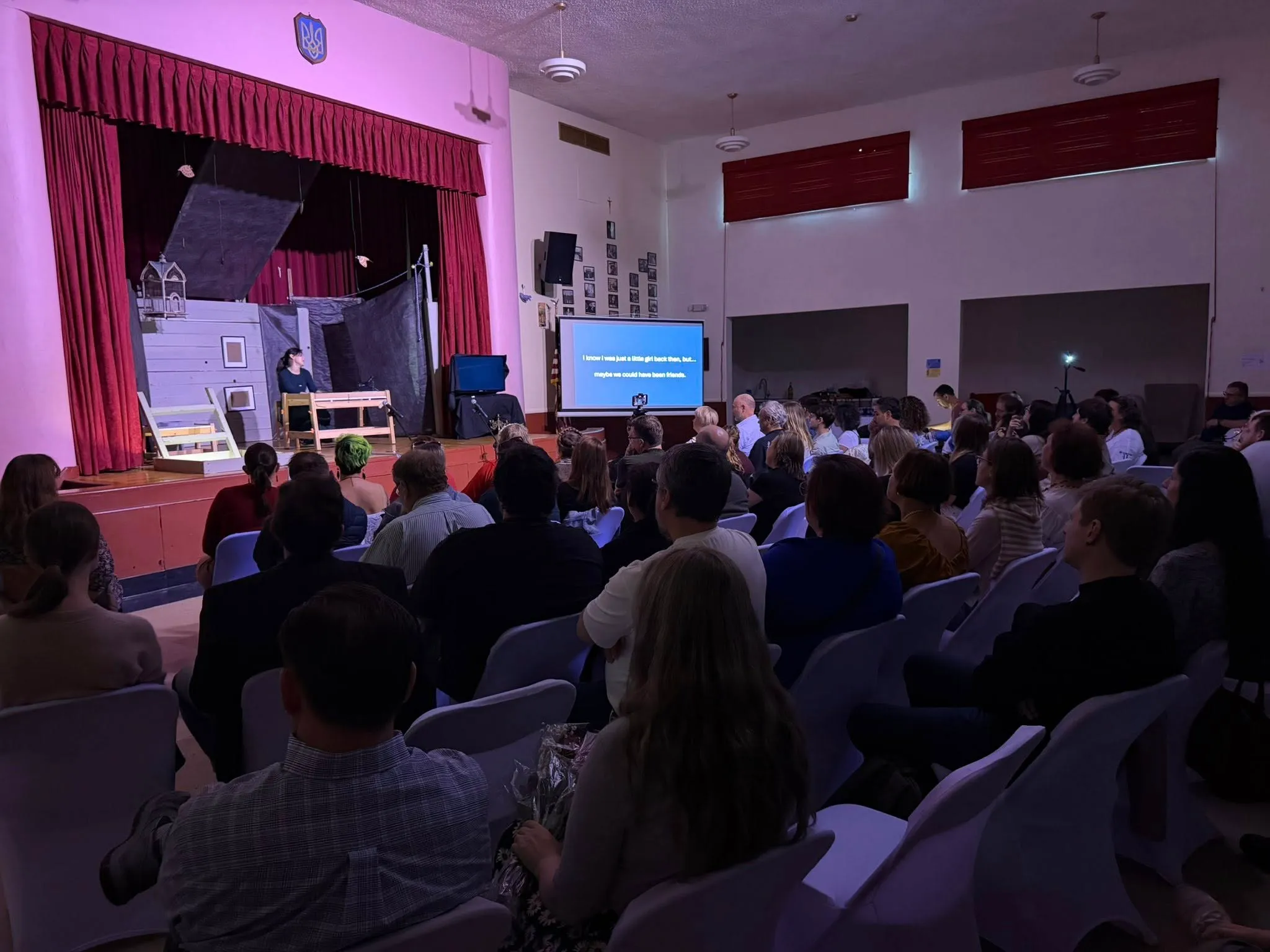
Thanks to the skill of the director, the actress, and all the participants, this idea was embodied in a performance that, with minimal but harmoniously selected means – minimal decorations, stage movement (Olena Kolodko), songs behind the scenes (music editor and sound director Volodymyr Karpovych), video footage (Yuriy Lozhnevskiy) – conveys the full depth of the psychological drama and trauma of a teenage girl from whom Russian invaders took the most valuable thing – her family, her country, her world – and are trying to forcibly change her identity. Futile attempts. Deprived of freedom, the 13-year-old heroine of the performance remains herself..