
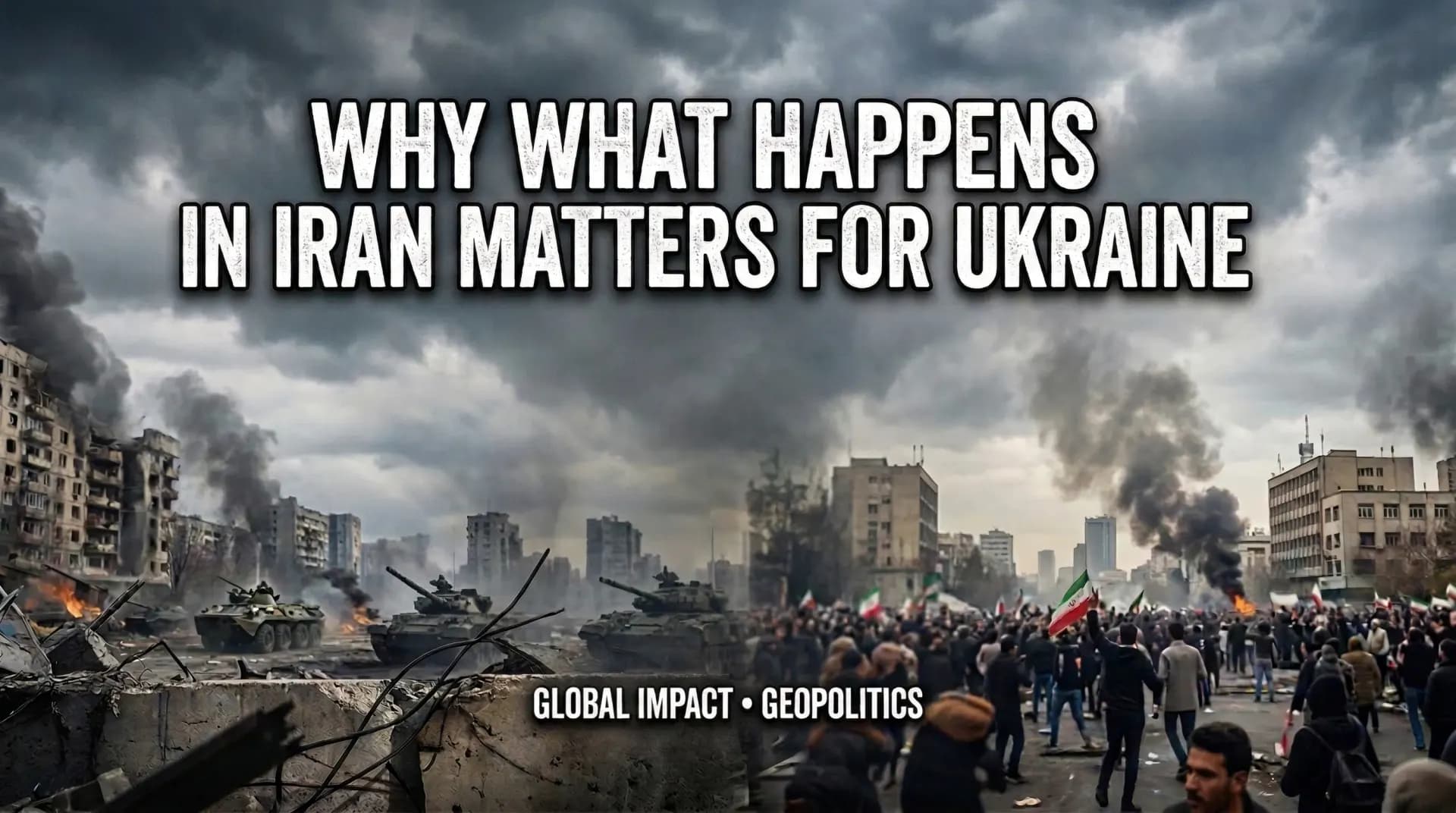
Why What Happens In Iran Matters For Ukraine
Events in Iran for Ukraine are not "distant geopolitics," but another front in the same war. The Iranian regime supplies Russia with drones that strike our cities, and today, with the same weaponry, it attacks countries that helped it circumvent sanctions. It is important for us to simultaneously call the regime an accomplice in aggression and remain in solidarity with the Iranian people who are fighting against dictatorship.
For us Ukrainians, Iran has long ceased to be a "distant" country somewhere on the map of the Middle East. It is a state whose drones have been flying to our cities for months, killing people, destroying energy infrastructure, and forcing millions to sit without light and heat. At the same time, it is a country where the people themselves have been standing up against a regime that has strangled its own country and simultaneously helps Russia wage war against Ukraine.
Iran as an accomplice in the war against Ukraine
The full-scale war has made the name "Shahed" as familiar to Ukrainians as "Kalibr" or "Iskander." The Iranian regime transferred strike drones, technologies, and components to Russia and later helped launch local production of these drones on Russian territory. Behind the dry technical language lies a simple fact: each such launch on Kyiv, Odesa, Kharkiv, or Mykolaiv is a joint crime of Moscow and Tehran.
These drones did not appear out of thin air. They are the result of targeted cooperation between two regimes that are fighting not only against Ukraine but also against the very idea of the democratic West. For Ukraine, this meant hundreds of attacks on energy infrastructure, destroyed substations, thermal power plants, residential buildings, and civilian objects. Every "Shahed" buzzing over our heads is the materialized policy of the Iranian leadership, which has consciously chosen the path of participating in the war against our state.
The gray economy, drones, and "accomplices" from the Persian Gulf
Iranian drones are not just about factories in Iran. They are about an entire shadow ecosystem of money, logistics, and corruption. Money, components, microchips, engines - all of this has been moving through the "gray zone" of the global economy for years. A special place here is occupied by the countries of the Persian Gulf, primarily the United Arab Emirates.
Through shell companies, offshore accounts, and "logistics hubs," the UAE and other regional states have been channels for the supply of electronics and parts that formally had no relation to weapons but were actually going into Iranian and Russian defense projects. Some businesses in the Emirates profited handsomely from this, turning a blind eye to the fact that the final destination of these goods would be factories assembling drones for strikes on Ukrainian cities.
When someone in the global South says, "This is not our war, we are just doing business," it is worth honestly saying: in the 21st century, "just business" often means very specific responsibility. If you help regimes circumvent sanctions, sell them high-tech components, and provide payment channels, you become part of a chain that ends with an explosion somewhere in the center of Dnipro or Lviv.
When the boomerang returns: Iranian missiles on those who helped
Today we see a paradoxical but very telling situation. The same Iran that for years enjoyed the hospitality of the Gulf's financial and trade hubs has begun massive missile-drone strikes on these very countries. Drones and missiles fly towards Qatar, Saudi Arabia, the UAE, Bahrain; air defense systems intercept hundreds of targets, but some hit oil refining infrastructure, gas facilities, ports, and even civilian areas.
For Ukraine, there is a bitter but important moral in this story. Those who helped Russia and Iran circumvent sanctions thought for years that they could remain "above the fray" and just count profits. Now they themselves have come under the strikes of the same regime they helped strengthen the military machine. This is not a reason for gloating, but it is a very clear reminder: tolerating an aggressor, trading with them "as usual," never goes without consequences.
The regime is not the people: why it is important for Ukrainians to articulate this
Despite all our personal and collective anger at Iran as a source of drones, it is important to clearly distinguish: the enemy is not the Iranian people, but the Iranian regime. It is the regime that makes decisions about supplying weapons to Russia, about repression within the country, about dispersing protests, about money going to drones instead of normal life for people.
In recent years, Iran has been repeatedly shaken by protests - from women's demonstrations against coercion and the "morality police" to economic demonstrations against poverty, corruption, and devaluation. This is the desperation of people who, like us, want a normal, peaceful, modern country instead of a clerical-military dictatorship that has become a factory of instability for the entire region.
In January 2026, the regime crossed a new line. In just a few days of nationwide protests, security forces staged, according to human rights activists, the bloodiest massacre in the history of the Islamic Republic. Independent media and human rights networks report over 36,000 killed during the suppression of protests on January 8-9, and some estimates suggest the total number of deaths in the protests of 2025-2026 may approach 40,000.
Against this backdrop, the historical contrast is particularly striking. Shah Mohammad Reza Pahlavi left because he did not want to watch his country burn in flames. Now Iran is burning again - and the current Islamic Republic would rather let the country burn than return it to its own people. One loved Iran and Iranians. The other despises both the country and its people.
It is important for Ukrainians not to transfer justified hatred for drones and missiles onto ordinary Iranians. On the contrary, we probably understand better than anyone what it means to live between the hammer of imperial ambitions and the anvil of repressive power. It is natural for us to be on the side of those who stand against dictatorship - especially if it is a dictatorship that today helps our enemy.
How the weakening of Iran affects Ukraine's security
Every internal crisis cycle in Iran is not only about justice for Iranians but also about security for Ukrainians. When the regime is forced to throw resources at suppressing protests, patching up the economy, fighting sanctions, and chaos in the region, it is harder for it to simultaneously invest money and technology in the Russian military machine.
If the sanctions pressure on the Iranian military-industrial complex intensifies, if supply chains are disrupted, if companies in the Persian Gulf find it more expensive and risky to cooperate with Tehran and Moscow, this directly affects the quantity and quality of drones, missiles, and ammunition that Russia can receive. For Ukraine, this sounds very specific: fewer resources for the enemy - fewer attacks, less destruction, more chances that our air defense will have time to shoot down everything that flies.
Therefore, events in Iran are not a "foreign revolution" or an "internal affair of a distant country." They are part of the great war in which Ukraine finds itself on the front line, and the Iranian regime is on the side of the aggressor.
Egypt: a military giant choosing business over war
In this context, the example of Egypt—a country where I currently live - is illustrative. It is a state with one of the strongest armies in the region: hundreds of thousands of military personnel, thousands of tanks, large stocks of equipment and ammunition. According to various indices, Egypt consistently ranks among the most militarized countries in the Middle East.
For the Egyptian authorities, the key priority remains internal stability and security - calm on the streets, control over borders, basic economic manageability - and only then large geopolitical games. Cairo does not get involved in the US and Israel's war against Iran, maintains a peace treaty with Tel Aviv, tries to act as a mediator, and promotes its image as a "stabilizing force."
Although Egypt, by its Constitution and modern history, is predominantly a Muslim country, it also has a very significant Christian community, primarily Copts. Muslims and Christians have shared the same cities, neighborhoods, and markets for centuries, celebrate their holidays side by side, and are accustomed to the fact that another faith is not a reason for enmity, but part of the common landscape.
In a region where drones and missiles have already become part of the landscape, Egypt demonstrates a cynical but understandable position: you don't have to love everyone, but you have to reckon with everyone. While some states play "war for the sake of ideas" and drag neighbors into it, others count dividends and try not to burn their own house in someone else's fire.
Why all this is important specifically for Ukrainians
For us, events in and around Iran are not an exotic picture from the news. They are:
- a source of drones that kill our people;
- a test of honesty for countries that help aggressors circumvent sanctions;
- a chance to weaken one of the key centers of support for Russia;
- a story about a people who, like us, are fighting their own repressive regime.
It is important for Ukraine to call things by their names: the Iranian regime is an accomplice in aggression against us, and any country or company that helps it or Russia circumvent restrictions becomes part of this war.
Events in Iran are yet another front in the same great struggle for the future, in which Ukraine has already paid too high a price to afford the luxury of pretending it is “not our business.”