Mini Fairs: Ukrainians for Ukrainians
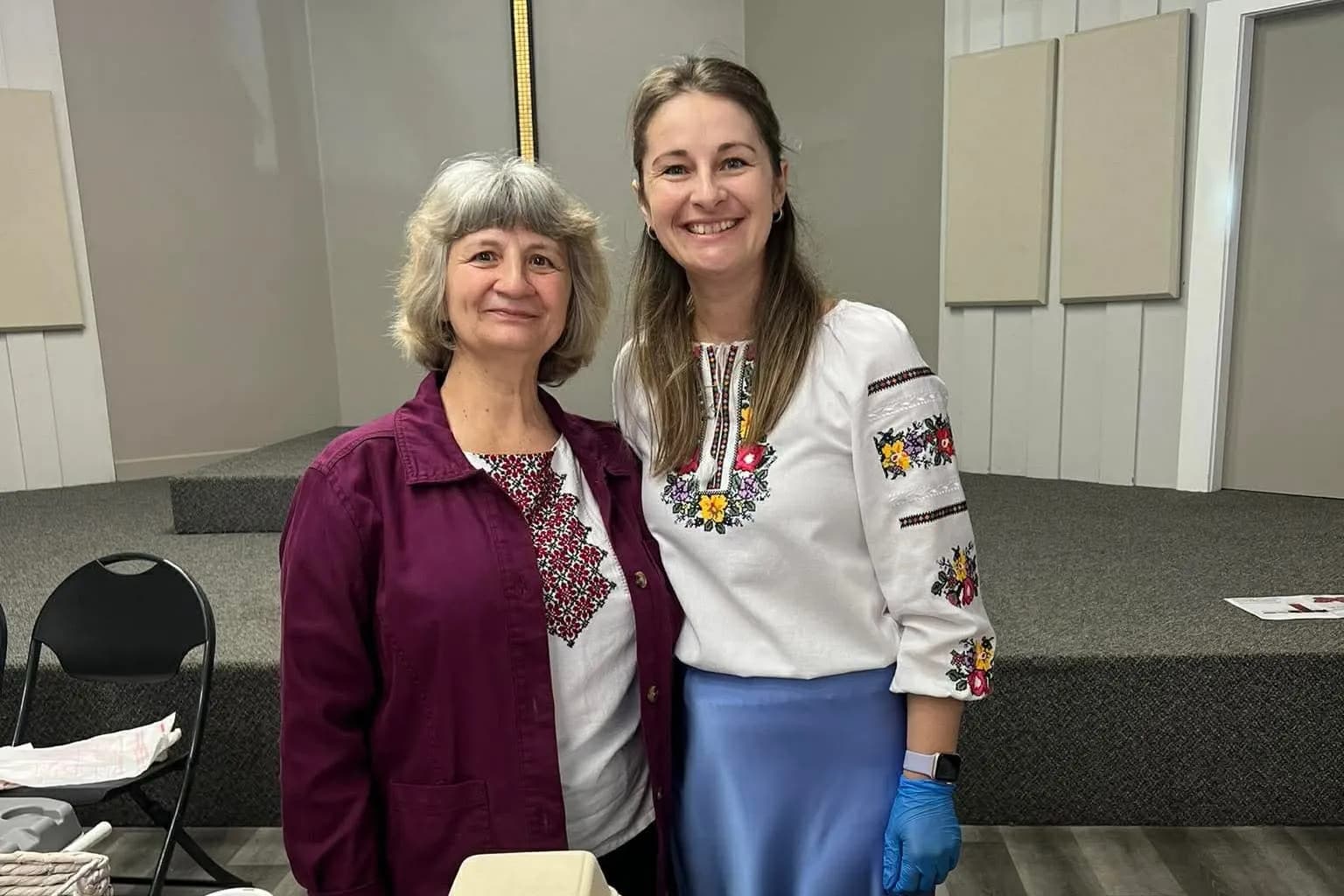
These small fairs have become almost customary. They are organized about once a month by a group of Ukrainians, mostly women, living in the San Francisco Bay Area.
These fairs take place in various locations, mostly in churches. This time — in a Lutheran church in Saratoga.
…In the small hall, there is an almost homely coziness; many of the sellers and visitors have known each other for a long time. On the tables are lovingly and skillfully baked pastries, prepared dumplings, pancakes, salads with pickled vegetables, and, of course, traditional Ukrainian borscht. Nearby are colorful necklaces, beads, brooches, and pins with Ukrainian symbols, soft toys. Almost all the goods are creations of local craftswomen; some items are sent from Ukraine to be sold here.
All proceeds go not just to charity but across the ocean — hand to hand: most of the sellers personally know people in Ukraine who pass these funds on to the needs of the Armed Forces, hospitals, orphanages, and homes for the elderly.
One of the co-organizers of this event is Mrs. Maria, an American, a parishioner of this church. One of her acquaintances, also an American without "Ukrainian blood," often travels to Ukraine on a humanitarian mission. Just in January, he delivered four vehicles for the Armed Forces. He was lucky: he was in the frontline village of Barvinkove and left there one day before the terrible bombing of a train from this village near Kharkiv at the end of January (five passengers died then).
The co-organizer of the fair is Lyudmila Bondar. She transfers the earned funds to the charity fund "Mriya," founded by her nephews — Dmytro and Maksym Pyrohov. This fund mainly cooperates with France: it buys and repairs vehicles for the military, collects and distributes equipment for wounded soldiers and civilians, etc.
— I can't remember exactly how many of these small fairs I've organized — maybe 10–15. At first, we gathered in my yard, then held them in Los Gatos, Santa Clara, San Jose, and other places. A group of regular participants formed — 12–15 people who constantly bake, cook, make jewelry and toys. I've been living here for 22 years, but before the full-scale war, I somehow lived my life; my relatives in Ukraine lived quite well, so I didn't think about Ukraine that often. But as soon as the big war started, I began baking honey cakes, cooking dumplings, making sausages — and selling them to help people in Ukraine, — said Lyudmila.
Anna Byetina and her husband Volodymyr Bichynskyi are regular participants in the fairs. Her table is filled with homemade pickled salads, borscht, dumplings, pancakes.
— I started volunteering in Kyiv on the Maidan in 2013, got acquainted with volunteers at the Kyiv military hospital. After arriving here in 2014, I immediately found volunteer girls and got involved in helping. I always tried to personally meet those who needed help. And yet there were cases when I stopped contacts because I found out that my help was being sold.
Now I know exactly where the funds raised at charity events go. 95% is medical equipment, diapers, rehabilitation equipment for war-disabled soldiers and civilians; I help a home for the elderly. My wards are in Chernihiv, Odesa regions, and in the Ukrainian-controlled part of Donetsk region.
The demand to leave the entire Donetsk region? — It's impossible neither from a legal nor a human point of view, — Anna answered my question.
At the neighboring table, Natalia Perilo and her daughter Hanna Bakirova have almost sold out their pastries. Hanna came to the USA from the Mykolaiv region — from the infamous Vradiivka, where in 2012, under Yanukovych, a group, or rather a gang of policemen raped and killed a girl.
— This crime of the then police in Vradiivka happened to my neighbor, with whom I grew up. I came to the USA in 2013 — two days before the start of the Maidan, before the students were beaten.
From here, I help a university classmate: her husband is fighting on the Kherson front, in the 189th battalion, 123rd brigade. They have four children, the youngest was born on that ominous day — February 24, 2022… We are raising funds for cars, tourniquets, other equipment — we can't keep up with the demand because cars, like people, perish in battles.
Hanna, together with her mother, opened a kindergarten, which has ten children — not only Ukrainians but also Belarusians, Moldovans, even Indians. Natalia came under the U4U program in 2022 with Hanna's sister, who was 14 at the time.
Olena Malakhova is also a regular participant. She sells handmade chocolate.
— I came in 2017 on my husband's visa from the Luhansk region — now it's occupied territory. I have a license to make chocolate and bakery products. I send charitable funds to a foundation I know personally. It helps in the treatment of soldiers and civilians whose eyes were damaged by the war. "See the Victory!" — that's the name of the foundation. It also supplies fiber optics and vehicles to the front, particularly for the 93rd brigade.
Each participant could have a story written about them — that's how intertwined the fates of people in Ukraine and the USA are here.
I was about to leave when I suddenly heard English. It's not just Ukrainians here!
A young man named Bob, a local resident, a school teacher. It turns out he lived in Kyiv for seven years. He was looking for a job — and found it across the ocean. He taught at the Kyiv International School — and has been interested in Ukraine ever since.
— When the war started, I wanted to help Ukrainians. I was looking for opportunities — and found this event. Wonderful dishes, wonderful atmosphere!
We look forward to new meetings with benefactors.