
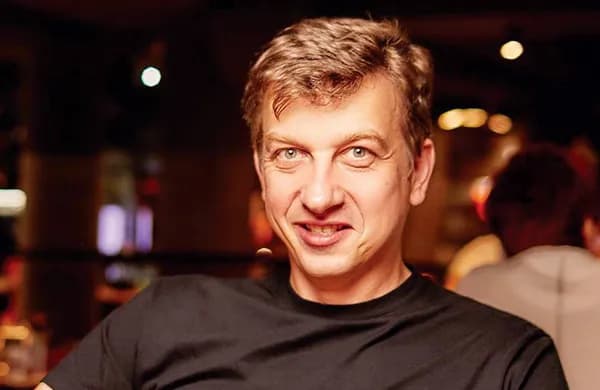
“What is happiness for you?” — this was the last question I asked Semen Gluzman during our hour-long conversation for YouTube — probably the last full-scale interview of his life.
He answered in his surprisingly quiet voice, thoughtfully and very simply: “To wake up in another Ukraine. Where I will not be a stranger.”
This phrase today sounds like a sad summary of his entire life, the life of a dissident, a dissident who was inconvenient even when it seemed that former dissidents were already honored.
On February 16, Semen Fishelovich passed away. A person who consistently, for decades, remained inconvenient for any system departed. First for the Soviet, then for the Ukrainian. Because Gluzman belonged to a rare breed of people who either cannot or do not want to adapt.
His path to dissidence began neither with culture nor politics, but with his profession. A young Kyiv psychiatrist faced a moral choice in the case of General Petro Grigorenko — a front-line soldier who openly and passionately criticized Soviet national policy and human rights violations. Simply throwing the general in jail would have meant admitting that dissenters existed even among the highest military ranks, so another satanic method was used against Grigorenko: he was declared mentally ill.
Punitive psychiatry in the USSR was one of the most cynical tools of repression. There was no need to prove guilt — it was enough to diagnose. A person was isolated in a special hospital, broken with drugs, and simultaneously discredited.
In 1971, Gluzman did what no one in the system dared: he prepared an independent absentee psychiatric evaluation in Grigorenko’s case. Based on the available materials, he professionally proved — there were no signs of mental illness. This was a direct challenge to the state machine.
The retribution was swift. In 1972, he was arrested: 7 years in strict regime camps and 3 years of exile. Like many former political prisoners, Gluzman later called the camps his “universities.” It was there that he met Ivan Svitlychny — a person who became a guru and guide to the world of Ukrainian culture for the previously quite cosmopolitan young Kyiv doctor.
I was fortunate to be personally acquainted with Anatoliy Lupynis and Leonid Plyushch, both of whom went through Soviet “psychiatric hospitals” for their political beliefs. Their stories were terrifying: forced injections, isolation, complete lack of rights. Against this backdrop, Gluzman’s act seems even more significant — he stood against the system from within the profession.
In independent Ukraine, former political prisoners behaved differently. Many expressed themselves by entering politics, becoming deputies of various levels, and their contribution to state-building was significant and foundational. Gluzman chose a different path. He remained in psychiatry, closely followed medical reforms, and fought for professional standards.
And here the paradox of his fate manifested. The deeper he immersed himself in the profession, and in “peaceful” life in general, the more he became a dissenter again. No longer in the USSR — in independent Ukraine, a country he sincerely loved. His voice was increasingly not wanted to be heard. He felt more and more like a loner.
That is why his last answer about happiness sounds so painfully precise.
Semen Gluzman became a co-author of my book “Ukrainian Dream. 25 Steps to Public Happiness,” specifically providing me with an article titled “Time to Gather Stones,” which began with the sentence: “Life is not endless.” And, understanding the finiteness of his own life, he repeatedly told me that my Concept of “25 Steps” resonated with his understanding: the measure of a state’s quality should be the feeling of a person’s happiness.
Perhaps he just wanted to live to see such a Ukraine.
He didn’t make it.