
Ukrainian Artists In Californian's Diversity
Celebrating March as Women's History Month, the Lesya Ukrainka Chapter 107 of the Ukrainian Women's Union of America (UWUA) organized a one-day event entitled "Women in Art: an exhibition of works by women of Ukrainian descent living in the San Francisco Bay Area" at the Google Cuddle visitor center.
Paintings hang on temporary stands. Bright flowers in the Petrykivka style and abstract compositions; portraits of girls in Ukrainian dress and scenes from San Francisco life painted in oil, like frozen movie frames; impressionist landscapes and sketches of old Odessa with laundry hanging on balconies and the inevitable cats; colorful mosaic paintings and whimsically carved woodcuts. On the tables are ceramic vases, ashtrays, and wooden Easter eggs... Elegant artists lively discuss the style and content of their works and those of their colleagues. In the small hall, all this creates an uplifting and at the same time relaxed atmosphere that invites free communication and fills the soul with a sense of involvement in creation.
The artists are mostly young. Some came here over the last 20 years, others quite recently, fleeing full-scale war. There are professionals and amateurs.
For example, Olga Bolzovska shows her mosaics. She works as a massage therapist, but graduated from a printing technical school in Lviv. "After graduating from technical school, I worked in a printing house, setting type. I didn't like it then. But during the COVID pandemic, when my husband and I, like everyone else, were sitting at home, we decided to try our hand at mosaics. My husband makes wooden tables, and I decorate them with mosaics, and I really enjoy putting together mosaic pictures,“ Olga shares the ”secrets" of her creativity.
...Pencil and pen drawings in the form of postcards, stylized in the 1910s, depict gates and corners of Odessa, Californian courtyards, Italian landscapes... Olena Kovtash is originally from Zaporizhia, but her artistic talent was revealed during an excursion to Odessa, also during COVID. "And there was no COVID on Deribasovskaya Street, people without masks, lively, you could hear Odessa jokes! Our guide, Svitlana, enthusiastically showed us not only the well-known landmarks of the city, but also picturesque corners, courtyards, carved gates... When I returned home, I drew these postcards and sent them to Svitlana, who then handed them out on her tours." Perhaps this passion determined Olena's profession—graphic design—and she creates postcards in her spare time.
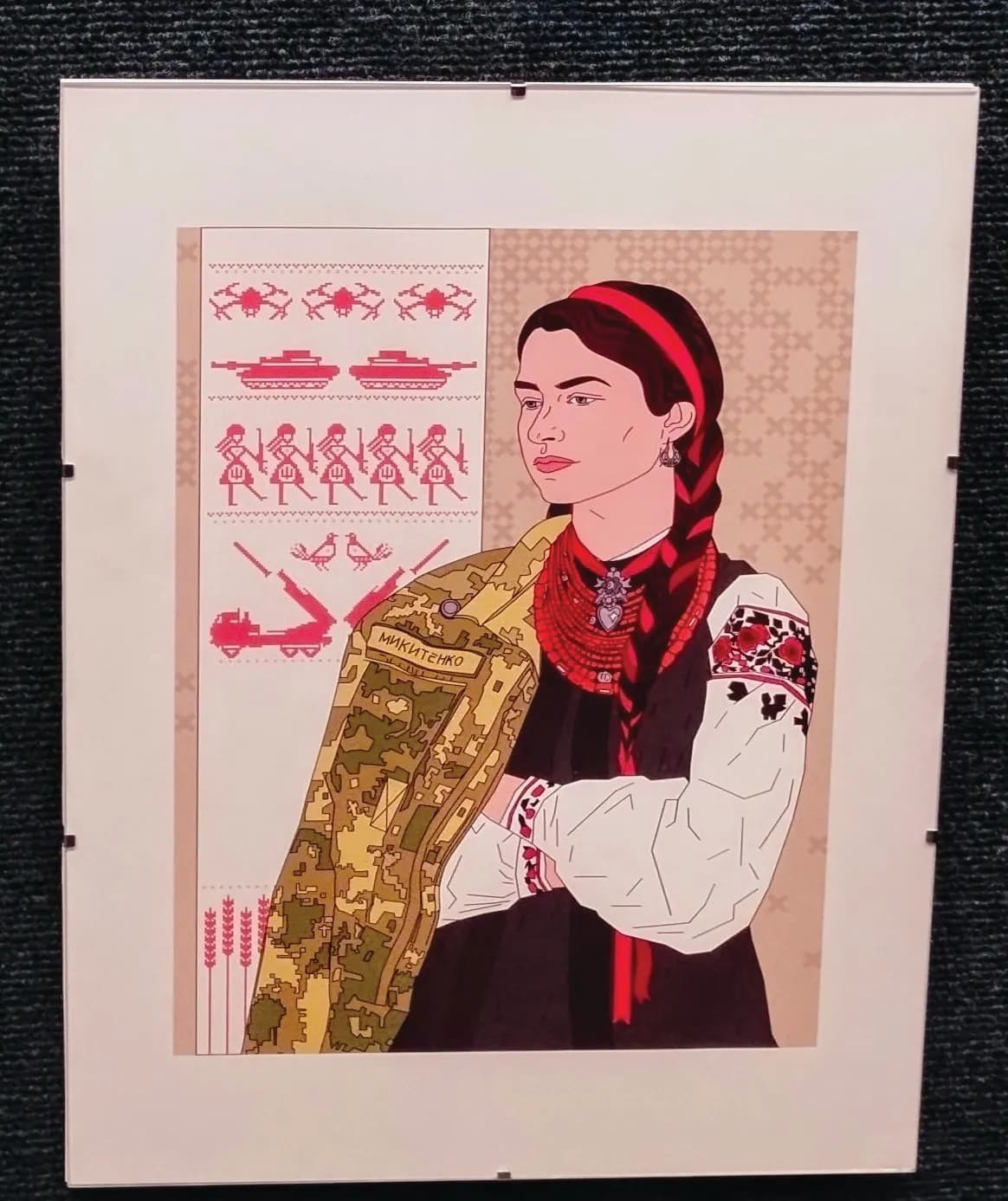
...The silhouette of Azovstal in red tones, beneath it — a portrait of an indomitable warrior, one of those who bled defending this plant for almost two months against the vastly superior forces of the Russian invaders... Another image of war is a girl in an embroidered shirt with a military jacket thrown over her shoulders, defender Yulia Mykytenko. This is how the current war is reflected in Oksana Fedko's work.
...A series of sketches of houses – different in architecture, size, and character. Each hut is a whole unique world. In this way, Yevhenia Zlotar reflected both her longing for her native home in Kharkiv and her fascination with cultural diversity. The artist lived in Scotland for some time and now lives in San Jose. "I was looking for answers to the questions: 'What is home to me? I don't belong only to Ukrainian culture, I belong to many cultures.“ However, in her everyday life, Yevheniia shows her Ukrainian roots — ”in clothing, jewelry, cuisine — borscht is borscht!" — Yevheniia said half-jokingly.
Nora Mason is also drawn to her native home. She was the only representative of the older generation of Ukrainian emigrants and allies at the exhibition: she left her native Lviv with her mother in 1943, when she was only two years old. Her black-and-white photographs of the house in Lviv where she spent her first two years, taken several decades after her departure, seem to transport the viewer back to a past world, to the most sacred place on Earth, where her first steps were taken...
Each exhibit has its own personal story. But the most attention is drawn to the artillery weapon tube, which rotates like a globe. It is painted in the Petrykivka style: bright poppies, sunflowers, cornflowers — and the inscription: “Freedom has a price.”
“This tube fought on the front lines in the first months of the full-scale invasion,” says Lyubov Spitsyna, who represents the work of painter Maria Malyarenko (what else could she be, with a surname like that!), because Maria lives in Los Angeles and was unable to attend the exhibition. "This work embodies the ability of Ukrainians to transform what kills into what inspires; the ability to treat any situation with love. The tube came to Marina from the front through the non-profit organization Volya with great difficulty. After being displayed at several exhibitions, it will be sold at auction and the money will be transferred to the Armed Forces of Ukraine," explains Lyubov Spitsyna.
The exhibition was organized by Maria Vladimirova, our department's cultural affairs officer. "The idea for the exhibition came about quite a long time ago, and now the opportunity has arisen—Google has provided us with this space to hold the event. I didn't select the artists—they found me when I announced the exhibition on Facebook. We didn't want to limit ourselves to purely Ukrainian artists, but decided to present a wide range of artists of Ukrainian origin: some draw on their roots, while others spread their wings, entering the world of American culture with all its diversity."
After viewing the exhibition, there was a discussion, followed by a reading of Ukrainian poetry. Not only Ukrainian women took part in the reading, but also a guest: Mansee Rishi, an American of Indian origin. She has been interested in Ukrainian culture for quite some time and attended a poetry evening organized by our department last year. Now she read several poems by Lesya Ukrainka in English translations, as well as a wonderful poem by a Ukrainian soldier in the current war, which echoes Lesya's fiery lines. Along with the poets of Ukraine, poems by our contemporary Olena Bilyak, who lives in San Francisco, were also read. Her poems are dedicated to her native Lviv and to the horror of war, which is impossible to get used to—even here, across the ocean. “Don't get used to it!” urges one of her poems.
...An exhibition of artworks, poetry, and free communication all came together in a small hall, creating an atmosphere of warmth and love that overcomes the horrors of war. And the works of Ukrainian artists, like the artists themselves, have organically woven themselves into the colorful fabric of Californian life.